The ad said Widowed farmer, 82, good teeth, own tractor, seeks lady for pie and conversation, and Leland Dahl wanted to crawl under the porch.
It was on page fourteen of the Prairie Farm Weekly, in the classifieds, between a used grain auger and a litter of Australian shepherd puppies. It was in a little box with a border around it, which meant somebody had paid extra.
Leland read it at his kitchen table on Thursday morning with his coffee. He read it twice. Then he set the paper down very carefully, the way you'd set down a snake.
"Brynn," he called up the stairs.
His granddaughter didn't answer. That was how he knew.
Leland was eighty-two. He'd farmed corn and soybeans on four hundred acres outside Loup Crossing, Nebraska, for sixty-four years, the last forty with his son.
He'd been married to Marlys for fifty-six of those years. She'd died in the fall of 2022, of a stroke, in the garden, picking the last of the tomatoes.
He'd been fine since then. He told people so. He was fine.
He went to the co-op for coffee at six every morning. He went to the Methodist church on Sundays.
He watched the Huskers lose on Saturdays in the fall. He ate supper alone at the kitchen table at five-thirty every night, out of the freezer, with the radio on.
His granddaughter, Brynn, was sixteen. She'd been staying with him that summer, while her parents were in Omaha with her little brother, who was sick.
She was good company. She was also, it turned out, a criminal.
She came down the stairs at nine with her hair in a towel and saw the paper on the table, open to page fourteen, and stopped.
"Okay," she said. "Before you get mad."
"Good teeth?" Leland said.
"You do have good teeth, Grandpa. They're all yours. That's rare at your age. I looked it up."
"Pie and conversation?"
"You like pie. And you used to like conversation." Brynn sat down across from him. Her face had gone serious. "Grandpa, you eat frozen dinners every night by yourself. You talk to the radio. Grandma's been gone almost five years." She swallowed. "She made me promise. Before she died. She said, don't let him turn into a hermit, Brynnie. He'll do it if you let him."
Leland didn't say anything. He looked out the window at the garden, where Marlys's tomato cages still stood empty.
"Eleven dollars," Brynn said. "That's all it cost. It runs for two weeks. And if you hate it, I swear I'll never do anything like it again."
Leland picked up his coffee cup. It was empty. He set it back down.
"Not a soul is going to answer a thing like that," he said.
Forty-one women answered.
They came over the next three weeks, to the post office box Brynn had rented in town with her babysitting money. Brynn brought them home in a grocery sack and dumped them on the kitchen table. Envelopes of every color.
Some typed, some handwritten. One in purple ink.
One with a pressed flower inside. One from a woman in Kearney who'd included a recipe for rhubarb pie, a photo of herself with a prize-winning heifer, and her cholesterol numbers.
"She's very thorough," Brynn said.
Leland was horrified. Then, despite himself, he was curious.
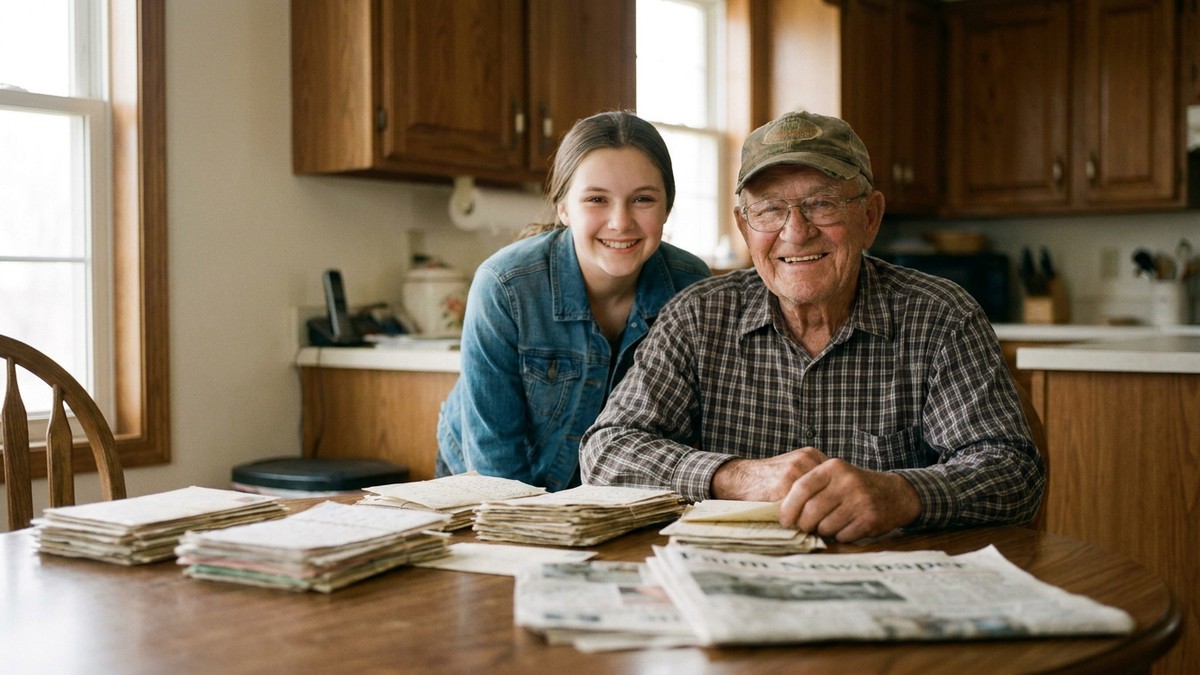
They read them together at the kitchen table every evening after supper. Brynn read them out loud, and Leland pretended not to listen, and then asked her to read the good parts again.
There was a retired schoolteacher in Grand Island who wanted to know his position on the Oxford comma. There was a widow in Broken Bow who wrote four pages about her late husband and only one sentence about anything else.
There was a woman in Lincoln, fifty-one years old, who asked if his farm had a swimming pool. There was a man in Hastings who'd answered by mistake, trying to sell him crop insurance.
There was a lady from Columbus who wanted to know if he danced. There was a lady from Ord who said she didn't care if he danced as long as he didn't snore.
"Do you snore?" Brynn asked.
"Your grandmother said I did," Leland said. "I never heard it."
He laughed more in those three weeks than he had in five years. He didn't notice until Brynn pointed it out.
On the last Sunday in July, Brynn dumped the last sack on the table. Five letters. The ad had run out.
"You have to pick one, Grandpa," she said. "That was the deal."
"There wasn't any deal."
"There was a deal. I made it. You just weren't there."
Leland sighed. He went through the last five slowly, with his reading glasses on. A woman in Aurora who quilted.
A woman in Central City who was looking for a fishing partner. A woman in York who sent a photo from about 1985.
Then he picked up the last envelope.
It was small and cream-colored, the old-fashioned kind with a deckled edge. The address was written in a careful, slanting hand in blue fountain pen. The postmark said St. Paul, Nebraska, thirty miles east.
Inside was a single sheet of cream paper. There was only one line written on it.
Do you still have the red Farmall?
It wasn't signed. There was just a return address, and a phone number.
Leland sat very still.
"What?" Brynn said. "Grandpa, what's wrong?"
He did still have the red Farmall. A 1952 Farmall M, his father's, with a narrow front end and a seat that had been reupholstered three times.
It sat in the machine shed. He started it every spring and drove it in the Fourth of July parade, and that was all.
But he hadn't driven it anywhere that mattered since September of 1961.
That fall, when he was sixteen, he'd driven his father's red Farmall M four miles down the gravel road to the Svoboda place, in his church clothes, with his hair combed wet and a corsage from the drugstore in a box on his lap. He'd parked it in the Svobodas' yard. He'd knocked on the door.
He'd asked Arlette Svoboda, fifteen, the prettiest girl at Loup Crossing High School, to go with him to the harvest dance at the Sokol hall.
And she'd said no.
Leland put the cream-colored letter down on the table. He looked at the return address again, in that careful, slanting blue hand.
Arlette Svoboda Kral. St. Paul, Nebraska.
"Brynn," he said slowly. "I believe I'll answer this one."