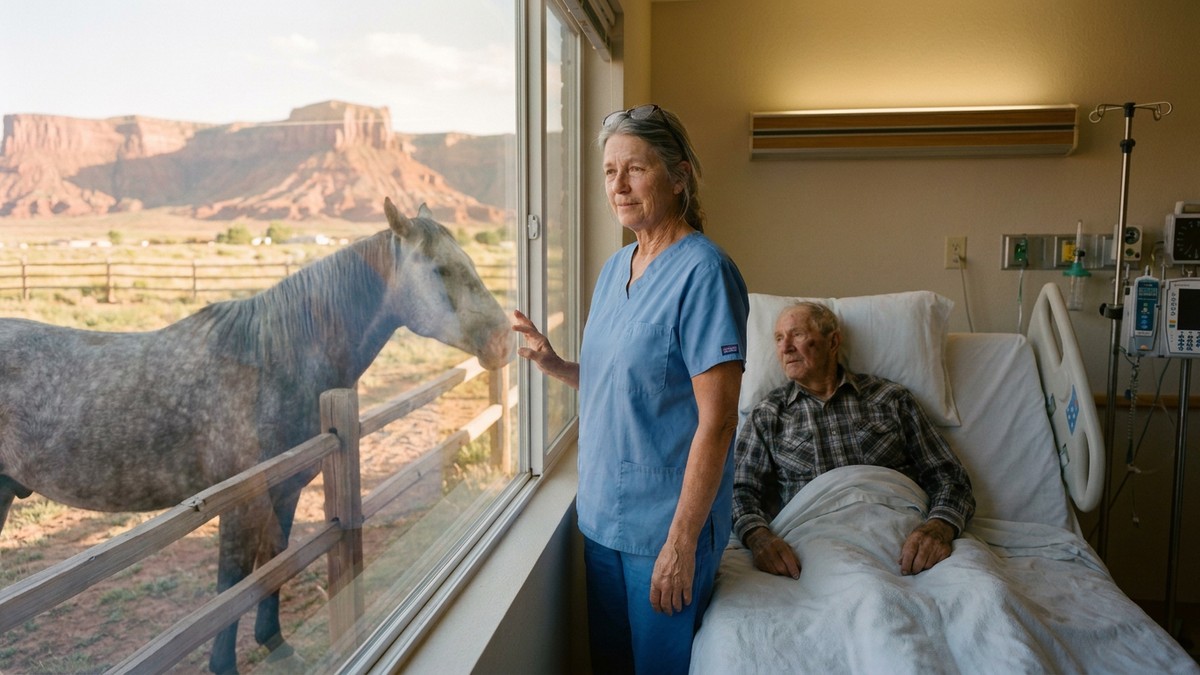
Junior Mayfield had asked for his horse every day for a week, and on Monday, the hospice nurse wrote it down.
She wrote it on the whiteboard in his room, under Goals for the Day, where she usually wrote things like Sit up for lunch or Call daughter. In her neat blue marker, she wrote: See Smoke.
Then she stood back and looked at it, and wondered what on earth she'd just promised.
Pam Villanueva was sixty-two. She'd been a hospice nurse for twenty-six years, the last eleven at Book Cliffs Hospice House, a low tan building on the edge of Grand Junction, Colorado, with twelve beds, a garden full of sage and roses, and a view of the long red mesas to the north. She'd sat with more than two thousand people at the end of their lives.
She'd learned that most of them wanted the same few things. To not be in pain.
To not be alone. To see the people they loved one more time.
Junior Mayfield wanted to see his horse.
He was eighty-eight. He'd been a cowboy his whole life, and he looked like one even in a hospital gown.
Long and bony, with a face like a saddle that had been left out in the weather, and big hands spotted brown, and pale blue eyes that still looked at you like he was judging how much you could carry. He'd ranched cattle on twelve hundred acres up on Grand Mesa for sixty years.
He had cancer in his lungs and his bones. The doctors had told his daughter he had a week, maybe two.
He didn't complain about the pain. He didn't complain about the food. He didn't complain about anything at all, except one.
"Where's Smoke?" he'd ask Pam every morning, when she came in to check his medicine. "Somebody's got to see to Smoke."
Smoke was a gray quarter horse gelding, twenty-four years old. Junior had raised him from a foal. He'd ridden him every day for twenty years, checking fence and moving cattle and riding in the Fourth of July parade in Collbran with an American flag in a stirrup boot.
Smoke would come to the fence at a trot when he heard Junior's pickup turn off the county road, a quarter mile away. He never did that for anybody else.
Junior's wife had died in 2018. His knees had given out in 2023.
Last fall, his daughter had finally convinced him to sell the ranch. He couldn't run it anymore, and she lived in Denver, and her two boys had jobs in the city.
The cattle went to the sale barn in Delta. The ranch went to a couple from Texas.
And Smoke went to a woman named Marisol Ochoa, who ran a riding program for kids with disabilities outside of Montrose, two hours away. Junior's daughter had picked her because she seemed kind.
Junior had stood in the corral the morning the trailer came and held Smoke's halter for a long time. Then he'd handed the lead rope to Marisol and walked into the house without looking back.
He'd never said goodbye. He'd told his daughter he couldn't.
Now, every morning, he asked where Smoke was.
Pam called Junior's daughter that Monday afternoon. The daughter found Marisol's number. Pam called Marisol on Tuesday.
Marisol listened to the whole thing without interrupting. Then she was quiet for a moment.
"I'll bring him," she said. "Tell me when."
Pam hung up the phone and sat at the nurses' station with her hand pressed flat on the desk. Then she went to find the director.
The director of Book Cliffs Hospice House was a careful, decent man named Craig Whitson. He'd been there four years. He came from a big hospital system in Denver, and he believed in rules, because rules kept people safe, and he'd seen what happened when they weren't followed.
He listened to Pam. He looked genuinely sorry.
"Pam," he said. "You know the policy. Dogs and cats, fine. Therapy animals, fine. Anything over fifty pounds stays outside the fence." He spread his hands. "A twelve-hundred-pound horse in a building full of oxygen tanks and IV poles and frail patients? If he spooks, if he kicks, if he slips on that tile floor. I can't. Our insurance won't allow it. The state won't allow it."
"He's not going to spook. He's twenty-four years old."
"I'm sorry," Craig said. "I really am. The horse can't come inside the gate."
Pam stood there in his office.
She'd been a nurse for thirty-nine years. She knew the difference between a rule she could bend and a rule she couldn't. This one, she couldn't.
And Craig was right. A horse in a hospice hallway was a bad idea, no matter how old and gentle he was.
She went back to the nurses' station and sat down.
Then she went down the hall to room seven. Junior was awake, looking out the window at the mesas. He turned his head when she came in.
"Where's Smoke?" he asked.
Pam pulled the visitor's chair over to his bed and sat down. She took his big, spotted hand in hers.
"Junior," she said. "Smoke's coming. Thursday."
His pale blue eyes went wide.
Then Pam looked past him, out his window, and then down the long hallway in her mind, all the way to the end of the building. She thought about the rule. Inside the gate.
And she thought, for the first time, about which side of the gate room twelve was on.