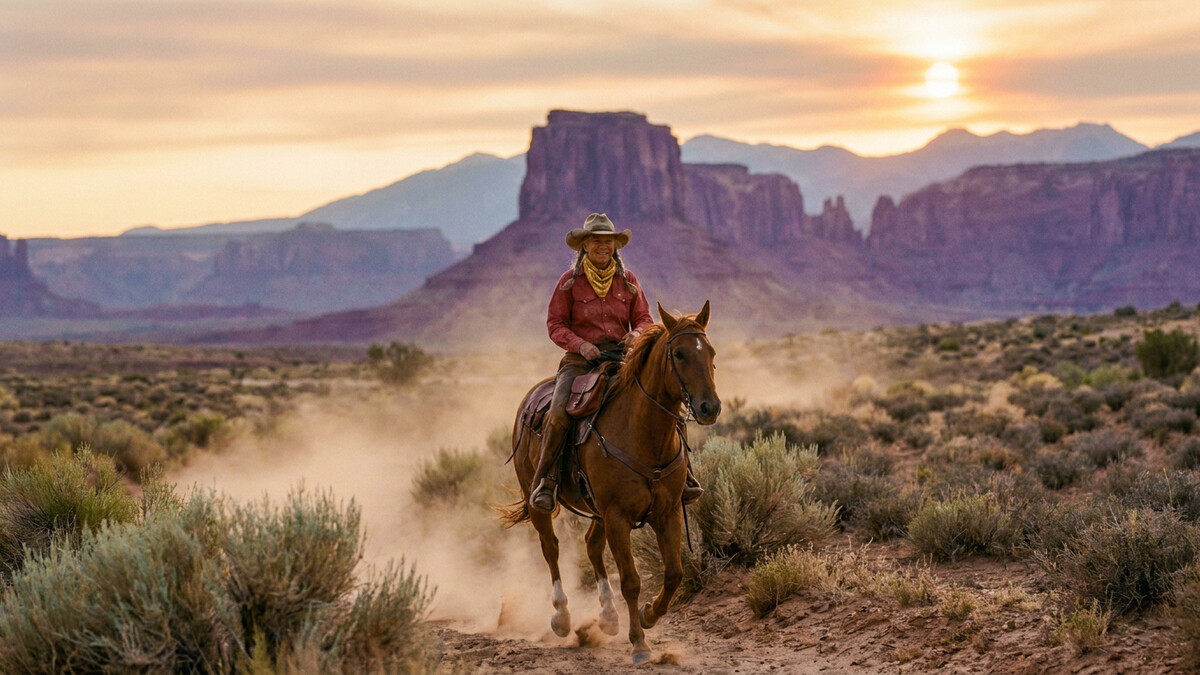
She walked as fast as she could.
It was not very fast. She was seventy-two. Her knees were bad and her hip was worse. The two-track was soft sand in places and loose rock in others. The mochila was heavier on her shoulder than it had been under her. The light was nearly gone.
Penny limped along behind her on the bad foot, patient, her head low.
Verla did not let herself think about how far it was. She thought about the next sagebrush. And the next. And the next.
She thought about LaRue, in the hospital bed in her front room, watching on a cell phone.
After half a mile, she heard a car behind her.
Headlights came bouncing down the two-track. It was the re-ride's support truck, which followed each leg in case of trouble. It pulled up beside her, and a gray-haired man in a red shirt leaned out the window.
"Ma'am. Are you all right? Your horse lame?"
"Threw a shoe," Verla said. "Cracked the hoof." She did not stop walking.
The man drove along slowly beside her.
"Ma'am, we can take the mochila. Drive it to the relay point. The next rider can take it from there. It happens. It's no disgrace."
"I know it's not," Verla said.
"It's a mile. You'll be late."
"Then I'll be late," Verla said. "But I'm carrying it."
The man looked at her for a long time from the truck window.
Then he put the truck in park and got out and walked beside her.
He did not offer again.
It took her thirty-four minutes to walk the last mile.
By the time she came up out of the last wash and saw the lights of the relay point ahead, a few lanterns and a horse trailer and a little crowd of people at the foot of the mountains, it was full dark, and the stars were out over the whole desert, and her legs were shaking so hard she was not sure she could take another step.
She took another step.
The crowd at the relay point saw her coming. A small, gray-haired woman in a red shirt and a yellow neckerchief, walking out of the dark, leading a limping horse, with the mochila over her shoulder.
They began to cheer.
The next rider was waiting on a tall black gelding. A young man, about twenty, a cowboy from Ibapah. He had been waiting forty minutes. He had heard on the radio what happened.
He did not say anything. He just leaned down out of his saddle and held out his hand.
Verla lifted the mochila off her shoulder and handed it up to him.
"Second pocket on the left," she said. "Take care of it."
"Yes, ma'am," the young man said.
He threw the mochila over his saddle and turned the black horse west and was gone into the dark at a gallop, and the sound of hoofbeats faded away toward Nevada.
Verla sat down on the tailgate of the horse trailer and could not get up again for a long time.
The re-ride reached Sacramento six days later, on schedule. The letters were postmarked at the old Pony Express terminal there, with a special commemorative stamp, and mailed out.
LaRue's letter went to an apartment building in the south part of the city.
It had a Pony Express postmark. It had LaRue's shaky left-handed writing on the front. And on the back, Verla had written a note, in her own hand, before she sealed it in April.
Carried by Verla Christensen, Faust Station to the Onaqui relay. On foot, the last mile. Please open it.
Nine days later, Verla's phone rang at six o'clock in the morning.
It was a woman's voice. Old and dry and careful. A voice Verla had not heard in fifty-four years.
"Verla," it said. "This is Darlis Jensen."
Verla sat up in bed.
"Darlis."
"I opened it," Darlis said.
There was a long silence on the line.
"I almost didn't," Darlis said. "I had it in my hand at the trash can. Then I saw the postmark. Pony Express. And I thought of Daddy. In 1960. And the ponies." Her voice broke. "And then I turned it over and saw what you wrote. On foot, the last mile."
Verla could not say anything.
"Is she still alive?" Darlis said.
"She's alive," Verla said. "She can't talk much anymore. She can't walk. But she's alive."
"I'm at the airport," Darlis said. "In Sacramento. My plane lands in Salt Lake at ten-fifteen. Will you come get me?"
Verla drove to the Salt Lake City airport that morning, an hour each way, and stood at the bottom of the escalator at baggage claim.
Darlis Jensen came down it with a small suitcase and a cane. She was seventy-seven, tall and thin and straight, with white hair cut short. She looked exactly like LaRue. Verla would have known her anywhere.
They did not hug. Not at first. They just looked at each other.
Then Darlis said, "You walked a mile in the desert in the dark at seventy-two. For a letter."
"For LaRue," Verla said.
Darlis nodded slowly. Then she put her arms around Verla, right there at the bottom of the escalator, and held on.
Verla did not go into LaRue's front room with her. That was not hers to see.
She sat outside on the porch, on the old wooden bench where she and LaRue had sat a thousand times, and looked out across the wide, dry valley toward the mountains.
She heard Darlis go in. She heard the hospice nurse quietly leave the room. She heard the screen door close.
Then, for a long time, she heard nothing at all.
And then, through the open window, very faintly, she heard two old women crying. And under it, in a slow, slurred whisper that took a long time to come out, she heard LaRue say one word.
"Sister."
LaRue Jensen Ashby died eleven days later, in her bed in the front room, with her sister holding one hand and Verla holding the other.
On the wall above the bed, in a wooden frame, there was an old black-and-white photograph from 1960. A cowboy on a tall horse, with a mochila across his saddle, riding at night by lantern light. And on either side of him, two little girls on ponies, holding hands across their father's horse.
Darlis took it home to Sacramento with her.
But the next June, she flew back to Utah. And when the Pony Express re-ride came west through Faust Station on the night of the third day, she was standing beside Verla at the relay point in a borrowed red shirt and a yellow neckerchief.
She had signed up to ride the last mile.