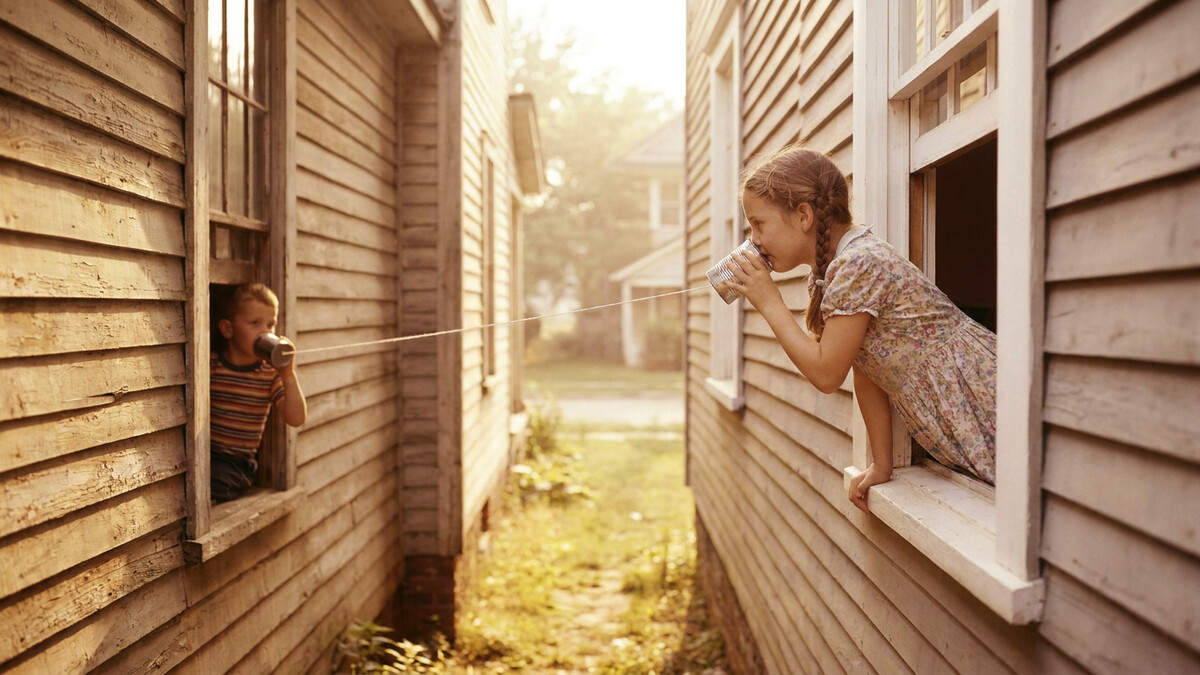
In the summer of 1952, when polio closed the swimming pool and the movie theater and the Sunday school in Pine Lake Corners, Michigan, eight-year-old Eleanor Vos spent every afternoon talking through her bedroom window to the boy in the house next door, who was not allowed out of his.
There was a yellow sign nailed to his front door. QUARANTINE. POLIOMYELITIS. KEEP OUT.
There were ten feet of air between his bedroom window and hers.
And there was a string.
Seventy-four years later, on a gray Tuesday in October, a letter came to Eleanor's house on Cherry Street in a long white envelope with an Arizona postmark.
She was eighty-two. She opened it at the kitchen table with a butter knife.
Inside was a typed letter on plain paper, and a photograph.
The photograph showed an old tin can. A Campbell's soup can, rusted almost brown, sitting on a polished wooden desk. Through a hole in the bottom ran a piece of frayed brown string, tied in a knot.
Eleanor set the photograph down on the kitchen table very carefully.
Then she put both hands over her face.
She had been eight years old that summer. It was the worst polio year in American history. Fifty-seven thousand people got it, most of them children. Thousands were paralyzed.
Eleanor remembered how it was. Not a single mother in Pine Lake Corners let her children out of her sight that summer. The public pool was drained in June. The movie theater closed. The church cancelled Bible school.
And in July, Artie Novak got sick.
He was eight too. He was a skinny, freckled, funny boy who could whistle through his fingers and knew every word of every Superman comic ever printed. He and Eleanor had been best friends since they were four.
One Saturday, he had a fever and a stiff neck. On Sunday, he could not move his left leg. The ambulance came from Grand Rapids and took him away.
Eleanor stood at her bedroom window and watched it go.
He came home in August.
He was lucky. The paralysis was only in his left leg, and it was only partial. He had a heavy steel brace from his hip to his ankle, and he would have to learn to walk again. But he had not ended up in an iron lung.
But he was still contagious, the doctors thought. Or might be. The doctors did not really know, in 1952. So the county health officer came and nailed the yellow sign on the Novaks' front door, and Artie was confined to his bedroom for six weeks.
No visitors. No friends.
Six weeks. Alone. In a leg brace. In August.
On the second day, Eleanor opened her bedroom window and saw him.
The two houses stood side by side on Cherry Street with a narrow strip of grass between them. Her bedroom was on the second floor, at the back. So was his. Their windows faced each other across ten feet of air.
He was sitting in bed by the window, in his pajamas, with the brace on his leg, staring at nothing. Thin and pale and miserable.
Eleanor waved.
He looked up. He saw her.
He did not wave back. He just looked at her, and then he turned his face away.
That night, at supper, Eleanor asked her father how to make a telephone out of tin cans.
Her father was an engineer at the furniture factory. He just went to the pantry after supper and emptied two soup cans, washed them out, and punched a hole in the bottom of each with a nail. Then he got a ball of brown kite string from the basement.
"The string has to be tight," he told her. "Pulled straight. Or it won't carry the sound."
The next morning, Eleanor tied one end of the string to one can. She wrapped the other can in a dish towel, with a note inside it in her best printing.
Artie. Pull this. Hold it to your ear. Eleanor.
She leaned out her bedroom window as far as she dared and threw it.
It missed. She pulled it back and threw it again. And again.
On the ninth try, Artie Novak's mother, came out into the yard with her hands on her hips. She looked up at Eleanor. Then she picked up the can, went back inside, climbed the stairs, and pushed it into her son's room through a crack in the screen.
For six weeks, they talked every afternoon.
From one o'clock until her mother called her for supper. Through two Campbell's soup cans and ten feet of brown kite string, pulled tight between two bedroom windows.
She read him comic books. Superman and Little Lulu and Donald Duck, every one she owned. She did all the voices. She read slowly, so he could imagine the pictures.
They played tic-tac-toe on their windowpanes, with a bar of soap, and called out the moves.
She told him about the world outside. Which neighbor's dog had puppies. What the Tigers were doing.
And slowly, very slowly, he started talking back.
He told her his leg hurt all the time. He told her he was scared he would never run again. He told her that the worst part, worse than the leg, was that people were afraid of him now. His own uncle had stood in the yard and talked to his mother through the kitchen window and would not come in.
"Grown-ups are scared of me," he said once, through the can, and then he could not finish.
"I'm not scared of you," Eleanor said.
There was a long silence on the string.
"Why not?" Artie said.
Eleanor thought about it.
"Because you're Artie," she said.
The yellow sign came off the Novaks' door on September 20.
Artie walked out of his house that day on crutches, with his brace, into the sun. Eleanor was waiting on the sidewalk. He almost fell twice. But he walked all the way to her.
In the spring of 1953, the Novaks moved to Arizona, because a doctor said the dry heat would be good for his leg.
Eleanor never saw him again.
Now she sat at her kitchen table with the photograph in front of her.
She picked up the typed letter with shaking hands.
Dear Mrs. Vos,
My name is Rachel Novak Ortiz. I am Arthur Novak's granddaughter. I hope you are the Eleanor who lived on Cherry Street in Pine Lake Corners in 1952.
My grandfather is eighty-two. He was a pediatrician in Tucson for forty-four years. He has Parkinson's disease and he cannot write anymore.
The doctors say he does not have very long. A few weeks, maybe.
He has had this tin can on his desk my whole life. On every desk he ever had, in every office, for seventy years. When I was little, I asked him what it was. He said it was the most important medical instrument he ever owned.
Last week, he asked me to find you.
He wants to know if you would talk to him one more time. Through a window.