The letter went on, on the second page.
I know that sounds strange. Let me explain. My grandfather cannot travel. He is in a hospice bed at home. But we have a tablet computer, and we can do a video call. You would see him on the screen, and he would see you. It would be like looking through a window.
He asked me to tell you one more thing, in his own words. He said, Tell her I still know every word of Superman number seventy-six.
If you are willing, please call me at the number below. Any time. Any day.
Thank you, Rachel.
Eleanor did not own a tablet computer. She did not own a smartphone. She had a telephone on the kitchen wall and a television that her grandson had to fix for her every time she pressed the wrong button.
She called her grandson.
His name was Brian. He was thirty-one, an electrician in Grand Rapids, and he drove over that afternoon in his work truck because his grandmother had never once in his life called him in the middle of a workday.
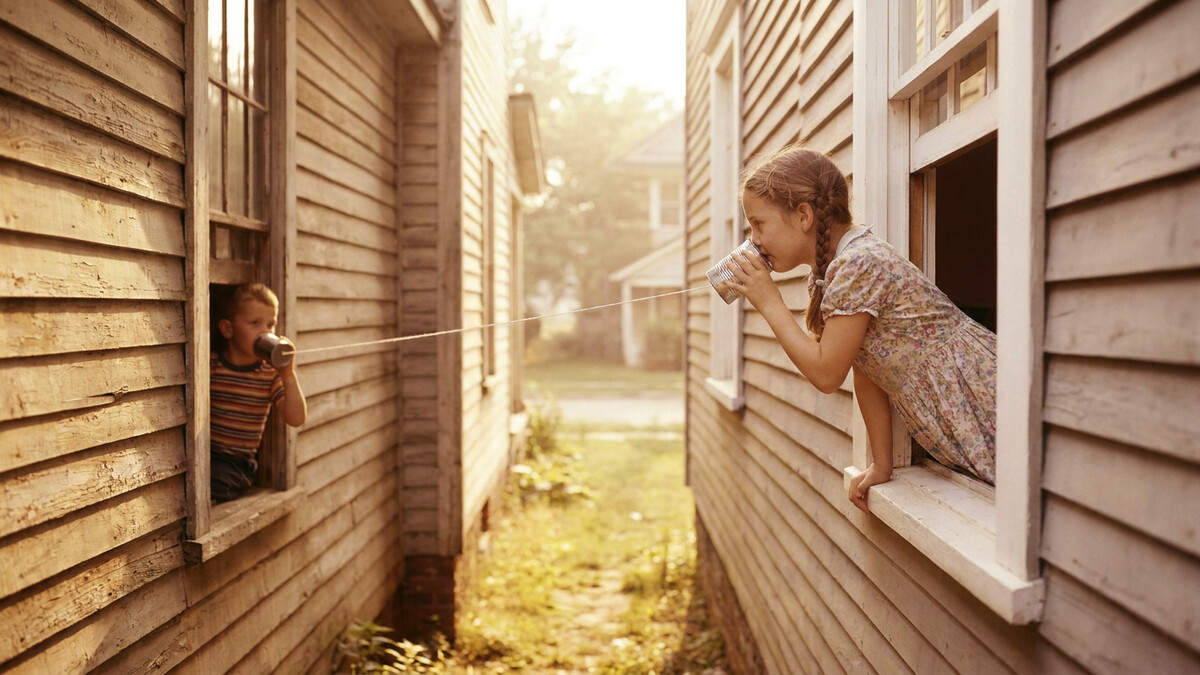
He read the letter at her kitchen table. He looked at the photograph of the tin can.
"Grandma," he said slowly. "Who is Arthur Novak?"
So Eleanor told him. All of it. The summer of 1952. The yellow sign. The string.
When she finished, Brian sat at the kitchen table without saying anything for a long time.
Then he took out his phone.
"Thursday," he said. "I'll set it up. I'll bring my laptop."
On Thursday afternoon, at one o'clock, Eleanor Vos sat at her kitchen table in her good blue cardigan, with her hair done, in front of her grandson's laptop computer.
She had been up since five. She had changed her cardigan twice.
On the table beside the laptop was a stack of old comic books. She had gone up to the attic on Wednesday with Brian, and found them in a cardboard box in the eaves, where they had been since 1960. Superman and Little Lulu and Donald Duck. Their covers were soft and faded. The pages smelled like seventy years.
She had found number seventy-six.
Brian pressed a button on the laptop. A little ringing sound came out of it.
Then the screen changed.
It was a bedroom. A window with the blinds open and bright desert sunlight coming through. A hospital bed. And in the bed, propped up on pillows, a very thin old man with white hair and glasses, in a blue pajama top.
His hands were shaking on the blanket. His face did not move very much. The Parkinson's had made it hard for him to smile.
But his eyes were the same.
Eleanor knew them at once. Across seventy-four years and two thousand miles. The same eyes that had looked at her across ten feet of air from a bedroom window on Cherry Street.
On the bedside table beside him, in the sunlight, was a rusty tin can with a piece of brown string tied through the bottom.
"Artie," Eleanor said.
His mouth moved. It took him a long time. His voice was very soft and slow, and it shook.
"El," he said. "You're... old."
Eleanor laughed out loud. She could not help it. Tears were running down her face, and she was laughing.
"So are you, Artie Novak," she said.
They talked for an hour.
It was slow. He could only say a few words at a time, and then he had to rest. His granddaughter Rachel sat beside the bed, out of the picture, and sometimes helped him find a word.
He told her about Tucson, and his late wife, Margaret, and his nine grandchildren.
He told her he had been a children's doctor for forty-four years.
"Why?" Eleanor asked. "Why children?"
Artie was quiet for a long time on the screen. His hands moved on the blanket.
"Because of the window," he said finally.
Eleanor waited.
"In the hospital," Artie said slowly. "In 1952. Grand Rapids. The polio ward. Forty children. Iron lungs. Nurses in masks. All the grown-ups were afraid of us. The nurses. The doctors. My uncle. Even my mother, a little."
He breathed for a while.
"Except you," he said. "You weren't afraid. You threw a can at my window nine times."
"Your mother finally came out and got it," Eleanor said.
"I know," Artie said. Something moved at the corner of his mouth. It might have been a smile. "I was watching. Every time. I wanted it so bad."
"I became a doctor," Artie said, "so there would be one grown-up in the room who wasn't afraid of the sick kids."
His voice was almost gone.
"Forty-four years," he said. "Every scared child I ever sat with. Every kid in a hospital bed. I thought of you. Leaning out that window. Reading Superman." He breathed. "Doing all the voices."
Eleanor could not speak for a moment.
Then she reached over to the stack of comic books on the table beside the laptop, and picked up the one on top, and held it up to the little camera so he could see.
Superman. Number seventy-six.
On the screen, Artie Novak's eyes went wide.
"El," he whispered. "You kept them."
"Every one," Eleanor said.
She read it to him.
The whole thing. Slowly, the way she had in 1952, so he could imagine the pictures. She did all the voices. Superman. Lois Lane. The bad guys. Her voice was eighty-two years old now and not as strong as it had been, but she did every one.
In Tucson, in the bright desert light, Artie lay on his pillows with his eyes closed, listening. Rachel held his shaking hand.
And somewhere in the middle of it, very softly, so softly that Eleanor almost did not hear it through the little laptop speaker, he began saying the words along with her.
Every word. He still knew every word.
When it was finished, Eleanor closed the comic book and held it in her lap.
Artie opened his eyes.
"Thank you, El," he said.
"You're welcome, Artie."
He was very tired now. She could see it. Rachel leaned in and whispered something to him, and he nodded slowly.
Then he did something that took him a long time.
He reached out his shaking hand to the bedside table, and picked up the rusty tin can with the brown string through the bottom, and held it up to his ear.
Eleanor stared at the screen.
Then she understood.
She looked around her kitchen. On the counter by the stove was a soup can she had opened that morning for lunch. She got up, quickly, for eighty-two, and got it, and rinsed it out in the sink, and came back and sat down at the laptop.
She held the empty can up to her mouth, the way she had seventy-four years ago, leaning out her bedroom window on Cherry Street.
"Artie," she said into the can. "Can you hear me?"
Two thousand miles away, in the desert light, an old man held a rusty tin can to his ear, and closed his eyes, and nodded.
Arthur Novak died nine days later, at home, in Tucson.
His granddaughter mailed Eleanor a small box a week after the funeral.
Inside, wrapped in tissue paper, was a rusty Campbell's soup can with a hole in the bottom, and a piece of frayed brown string tied through it in a knot.
There was a note with it, in Rachel's handwriting.
He wanted you to have the other end.
Eleanor keeps it on her kitchen windowsill, on Cherry Street, facing the house next door.