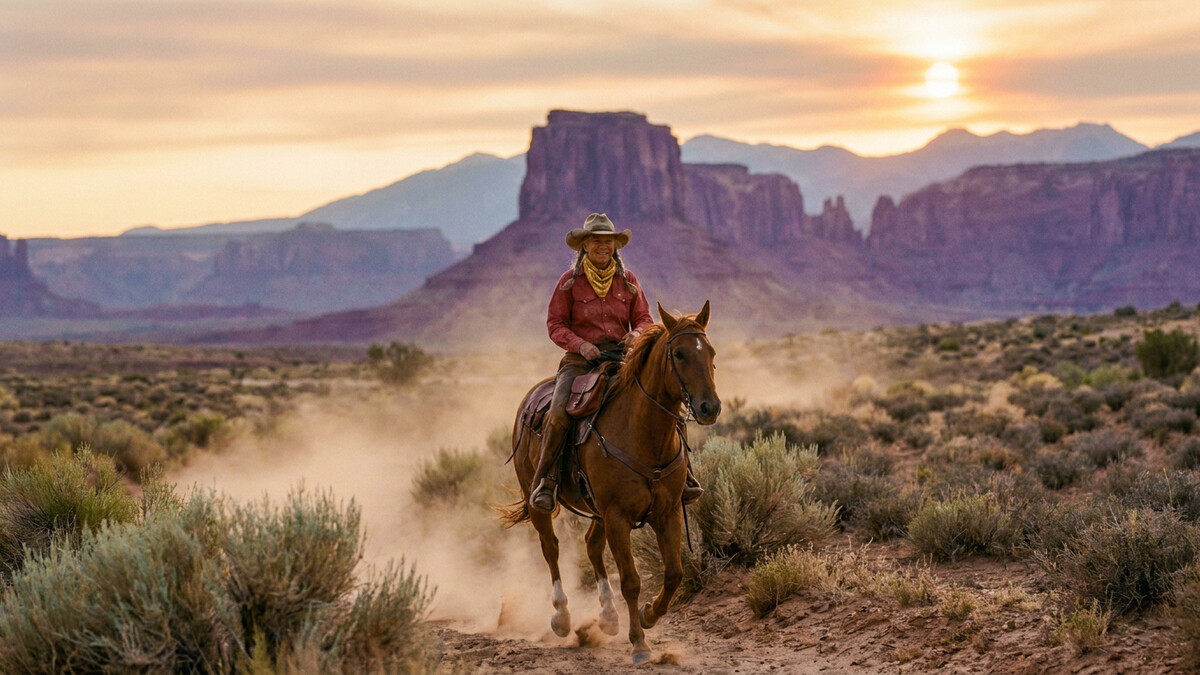
When Verla Christensen signed up to ride a leg of the Pony Express re-ride across the Utah desert in June, at seventy-two, the young man at the registration table looked at her birth date twice and asked if she was sure, and she said she had never been more sure of anything in her life, because she was carrying a letter for a dying friend.
He looked at her for a long moment.
"Ma'am," he said, "every rider carries the same mail. It's commemorative. We carry a few hundred letters in the mochila, and they get postmarked in Sacramento and mailed out."
"I know," Verla said. "I want one of them to be hers."
Every June, the Pony Express re-ride retraced the old trail from St. Joseph, Missouri, to Sacramento, California. Nineteen hundred miles, ten days and nights, carried in relays by volunteer riders on horseback, the way the original riders had done it in 1860 and 1861.
Each rider carried the mochila, the leather saddle cover with four locked pockets full of letters, for a few miles. Then they handed it off to the next rider at a relay point, and the next one carried it on. Day and night. Rain or shine. It never stopped.
Verla had watched it go through Tooele County every June for forty years. She had always wanted to ride it.
She had never had a reason good enough until now.
The friend was LaRue Jensen.
They had grown up on neighboring ranches outside Faust, Utah, in the wide, dry valley west of the mountains. They had been best friends since Verla was five and LaRue was eight and old enough to boss her. They had been in each other's weddings. They had buried each other's husbands.
LaRue was seventy-five. She had ALS. She had been diagnosed eighteen months ago. Now she was in a hospital bed in her front room, and she could not walk, and she could barely speak.
But she could still write a little, with her left hand, very slowly.
In April, she had written a letter. It had taken her eleven days. One page.
She had given it to Verla in a sealed envelope, and asked her, in her slow, slurred whisper, to mail it to her sister.
LaRue's sister was named Darlis. She was seventy-seven. She lived in Sacramento.
They had not spoken in fifty-four years.
Verla knew the story. The whole valley knew it, though it was never talked about anymore. In 1972, Darlis had been engaged to a young rancher named Dean Ashby. Two months before the wedding, Dean had broken it off. And six months after that, he had married LaRue.
Darlis had left Utah the week of their wedding and never come back. Not for her mother's funeral. Not for her father's. Not for anything. LaRue had written her a letter every Christmas for the first ten years. Every one had come back unopened.
Dean Ashby had died in 2018. LaRue had been married to him for forty-five years.
Verla did not know what was in the letter. She had not asked.
"Why the Pony Express?" Verla's daughter asked her, in May, when Verla started riding every morning to get her legs back. "Why not just put a stamp on it?"
Verla was quiet for a while.
"Because in 1960," she said, "for the centennial, they did the first big re-ride. Across the whole country. LaRue's father was one of the riders. Right through here, through Faust, at night." She smiled a little. "LaRue and Darlis rode with him, the last mile. Two little girls on ponies, nine and eleven, on either side of their daddy, carrying the mail. Holding hands across his horse. LaRue has the picture on her wall."
Her daughter did not say anything.
"Darlis wouldn't open a letter from LaRue," Verla said. "Not in fifty-four years. But I think she might open one that came by Pony Express."
Verla's leg was the night leg from Faust Station west to the relay point at the foot of the Onaqui Mountains. Four and a half miles of desert, two-track road, and sagebrush.
It was scheduled to run at about eight-thirty in the evening, on the third day of the re-ride.
She would ride her own horse. A sixteen-year-old sorrel mare named Penny, sure-footed and steady, who had carried Verla's grandchildren in 4-H for ten years.
LaRue's letter had gone into the mochila at the start in St. Joseph, with a few hundred others. The re-ride director had promised her that. It would be in the second pocket on the left. She would be carrying it across the desert, along with all the others.
On the night of the third day, at eight-forty, Verla sat on Penny at Faust Station in the dusk, in a red shirt and a yellow neckerchief, with her heart going like a drum.
The rider coming in from the east was a young woman from Tooele, galloping down the two-track in a cloud of dust. Verla could see her coming a mile off.
Verla's daughter was there. Her grandchildren. Twenty people from the valley. LaRue's hospice nurse had driven over with a cell phone, so LaRue could watch from her bed.
The rider from Tooele came in at a hard lope. She swung the mochila off her saddle in one smooth motion, and Verla took it and threw it over her own saddle, and settled into it.
"Go, Grandma," her grandson shouted.
Verla went.
She rode west into the sunset.
Penny settled into a long, easy lope on the two-track. The sagebrush went by gray-green on both sides. The Onaqui Mountains were purple ahead, with the last of the light on their tops.
Verla could feel the mochila under her, the stiff leather and the four locked pockets. The second one on the left.
She thought about two little girls on ponies in 1960, holding hands across their father's horse in the dark.
For three miles, everything was perfect.
Then, a mile and a half from the relay point, in a sandy wash where the two-track dropped down and climbed out again, Penny stumbled.
She caught herself. She went on. But her stride was wrong. Verla felt it at once, a hitch in the rhythm, a hesitation on the right front.
Verla pulled her up. She swung down out of the saddle, stiffly, and lifted the mare's right front foot.
The shoe was half off. Bent sideways. And the hoof was cracked.
Penny could not run on it. She could barely walk on it.
Verla stood in the sandy wash in the deepening dark, alone, a mile and a half from the relay point, with a lame horse and a mochila of three hundred letters that had to keep moving.
The rule of the re-ride was the oldest rule of the Pony Express.
The mail does not stop.
Verla looked west at the mountains, going black against the last red sky.
Then she pulled the mochila off her saddle and put it over her own shoulder, and took Penny's reins in her other hand, and started walking.