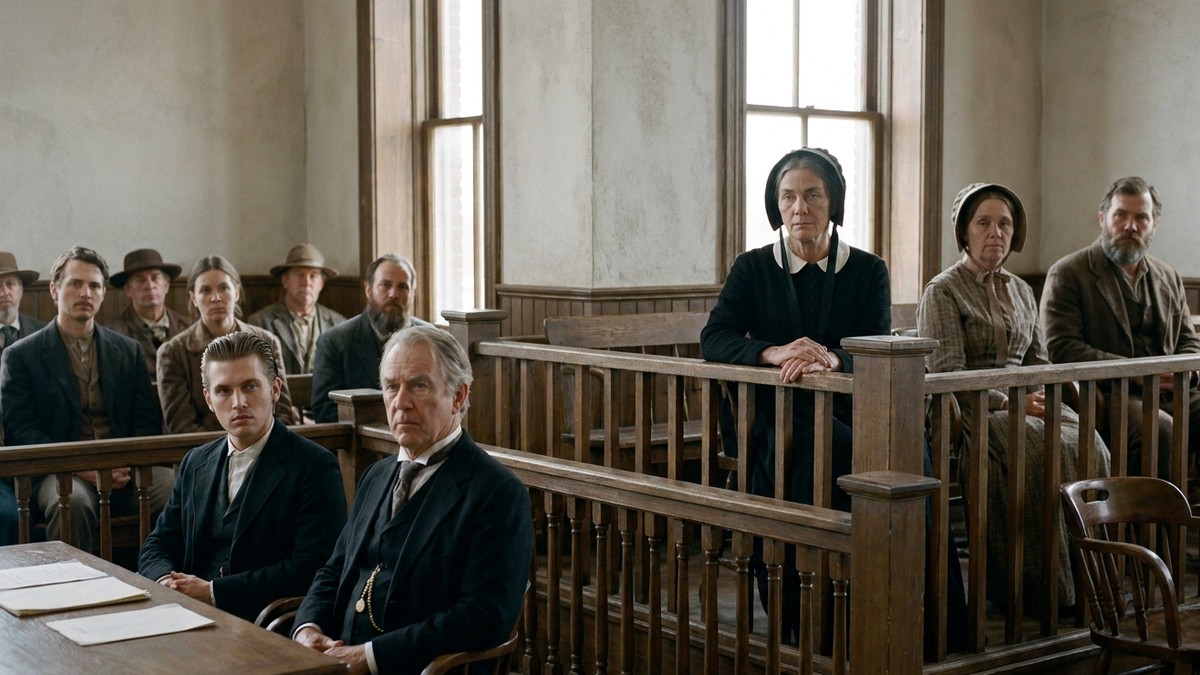
Part 2
Orrin Tate was talking about the weather when Constance Wheelock put the bill of sale down on the table in front of him.
"Mr. Tate," she said. "Would you read the date, please?"
Tate looked at the paper. He looked at it for a moment, frowning, and then he pushed it along the table to the man beside him.
"My eyes aren't good without my spectacles," he said. "You read it, Hargis."
Constance noticed that. She did not say anything about it.
"The twenty-ninth of February, 1870," Hargis read. "What of it?"
"There is no twenty-ninth of February, 1870," said Constance.
"It's a date," said Tate. "Day after the twenty-eighth. That's when he says he bought them."
"The day after the twenty-eighth of February, this year, was the first of March," said Constance. "February had twenty-eight days this year. It only has twenty-nine in a leap year. And 1870 is not a leap year."
One of the women, a young schoolteacher, put her hand to her mouth.
"How can you be sure?" said Hargis.
Constance folded her hands on the table.
"Because I was born on the twenty-ninth of February, Mr. Hargis," she said. "In 1812. I am fifty-eight years old, and I have had fourteen birthdays. I know every leap year since the day I was born. 1864 was one. 1868 was the last. The next will be 1872." She looked around the table at them all. "I have counted them all my life. There has never been a February the twenty-ninth in 1870, and there never will be."
Tate rang for the bailiff and asked for an almanac. She brought one up from the clerk's office, an 1870 farmer's almanac with a calendar in the front. They passed it around the table, all twelve of them, and counted the days of February with their fingers.
Twenty-eight.
"Then the bill of sale's a lie," said Hargis slowly.
"It was not written on the day it says," said Constance. "It could not have been. Whoever wrote it did not write it on the twenty-ninth of February, because there was no such day to write it on. He wrote it later. And he was in such a hurry to make it look like the day after the theft that he never stopped to count."
She tapped the paper.
"An honest man who bought four mules from a stranger would write the date he bought them," she said. "He would not have to invent one. There was no John Smith. There was no camp on the Little Laramie. There was only a young man who took Señor Olivas's mules on the twenty-eighth of February, and wrote himself a bill of sale when the marshal came."
They were out two hours. Not because anyone doubted, in the end. Because Orrin Tate wanted every one of them to count the days again, himself, in the almanac, so that nobody could say afterward that they had been talked into it by a woman.
Then they voted. Twelve to nothing.
The bailiff brought up the verdict form, and a pen and ink, for the foreman to fill in and sign.
Orrin Tate looked at the paper. He picked up the pen. And then he sat very still, holding it over the paper, and his big red face went redder.
Constance had been watching him for two days. How he never read the exhibits. How he passed every paper along the table. Spectacles, he said. But he had no spectacles.
She got up and came around the table, and stood at his shoulder, as if to look at the form.
"Shall I read it out, Mr. Tate," she said quietly, "while you write? My eyes are better than yours."
She read it, slowly, one word at a time, and spelled the long ones as if for her own sake. And Orrin Tate, bent over the table, wrote it down, letter by letter, in big careful capitals. Then she put her finger on the line for his name, and he signed it.
Nobody else at the table noticed. Or if they did, they never said.
When the jury came back into the courtroom, every seat was full. Josiah Vance sat behind his son with his arms crossed. Juan Olivas sat by the wall in his black suit with his hat in his hands.
"Has the jury reached a verdict?" said the judge.
Orrin Tate stood up.
"We have, Your Honor," he said. "Guilty." And then, before anyone could stop him, in his loud saloon voice that carried to the back of the room, "And I'd like it known, Your Honor, it was Mrs. Wheelock that found it. Not me. Not any of the men. Her. You can put that in your Chicago papers."
The courtroom went into an uproar. The judge banged his gavel. Josiah Vance stood up, and looked at his son, and sat down again very slowly.
Juan Olivas looked across the courtroom at the tall plain woman in the black bonnet in the jury box, and put his hand over his heart, and bowed his head to her.
Señor Olivas had his mules back by evening. He came to Constance's door the next morning, before he left for Santa Fe, and would not come in. He only stood on the step with his hat in his hand.
"In Santa Fe, I will tell them," he said. "A woman in Laramie counted the days."
Orrin Tate came to her door a week later.
He stood on the step with his hat in his hands, looking at his boots.
"Mrs. Wheelock," he said. "I'm fifty years old. I've run a saloon for twenty of 'em. I can count money faster than any man in this town. But I never learned my letters." He swallowed. "I wondered if you might teach me. I'd pay. Nobody needs to know."
"Nobody will know," said Constance. "Come Tuesday. Bring a slate."
He came every Tuesday for two winters.
And on the twenty-ninth of February, 1872, on Constance Wheelock's fifteenth birthday, there was a knock at her door at suppertime. When she opened it, Orrin Tate stood on her step with a cake from the Elkhorn, and a card in his own big careful capitals.
It said, HAPPY BIRTHDAY. I COUNTED.