Part 1
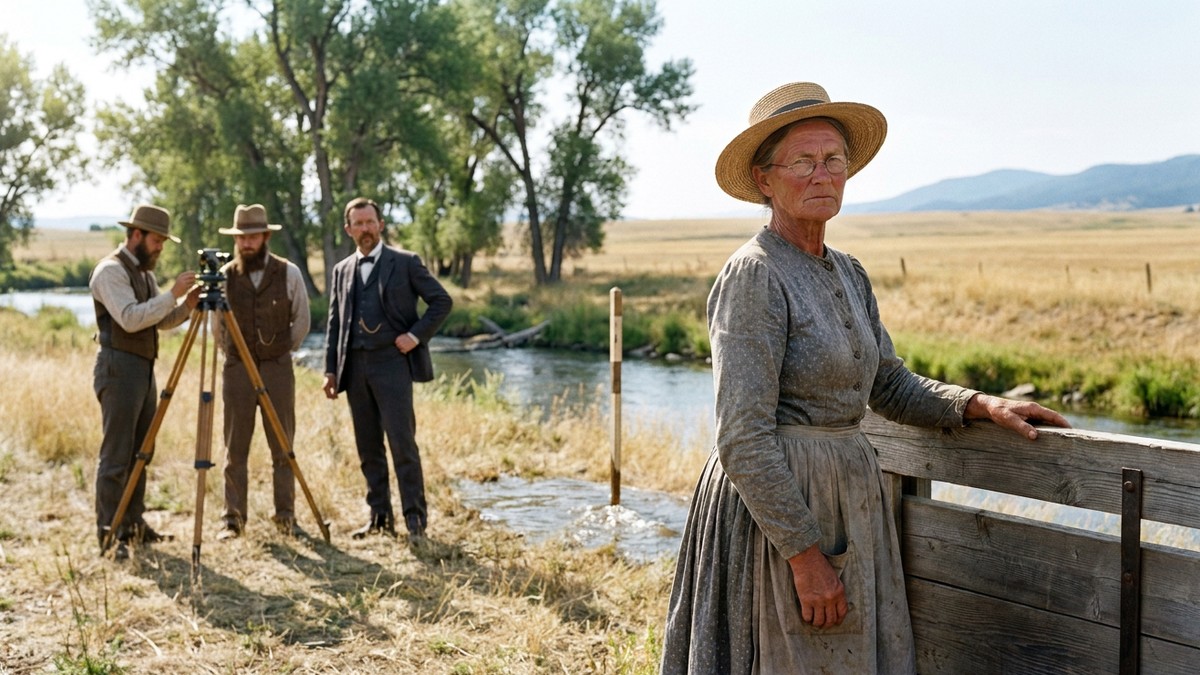
The surveyors came up Spring Gulch on a hot June morning, and by noon they had a stake in the middle of Prudence Oakes's creek.
It was June 1882, in Larimer County, Colorado, on the dry plains below the foothills where the farms lived or died by the ditches that carried mountain water out onto the land. In Colorado, the law about water was simple and hard. First in time, first in right. Whoever had first dug a ditch and put a creek's water to use owned the first claim to it, forever, and every later ditch had to wait its turn. In a dry year, the last in line got nothing.
Prudence was sixty-three. A widow, small and square and sunburned, with white hair under a straw hat and spectacles mended with thread. She had a hundred and sixty acres on Spring Gulch Creek, a frame house, an orchard of forty apple trees, a garden, two cows, and one ditch.
Her husband, Caleb, had dug that ditch with a shovel and a mule in the spring of 1868. Two miles long, from the creek to the orchard. It had watered the farm every summer for fourteen years.
The surveyors worked for the Larimer Valley Land and Canal Company. It was a new company, with money from Denver and Boston behind it, and it was building a great canal across the plains, thirty miles long, to water ten thousand acres of land it meant to sell to newcomers.
Its canal would take its water from Spring Gulch Creek. Above Prudence's headgate.
She walked out to the creek in her apron and found three men with a transit and a chain, and a fourth man in a good gray suit watching them, with his hat pushed back. He was perhaps forty, with a neat brown beard and an engineer's tanned hands.
"Franklin Brisbane," he said, and took off his hat. "Manager for the company, ma'am. I'm sorry for the trouble. We'll be off your land by evening."
"You're in my creek, Mr. Brisbane."
"Yes, ma'am. The company's headgate will be a mile above yours. I'll be straight with you. When it's finished, in a dry summer, there won't be much left in the creek below it."
Prudence looked at the stake in the water.
"My husband dug his ditch from this creek in 1868," she said. "Fourteen years ago. You know the law as well as I do. First in time."
"I know it," said Brisbane. "So do the company's lawyers. The law protects whoever put the water to use first, ma'am. It doesn't protect sentiment. That's why we've looked." He put his hat back on. "The district court is setting the priorities for every ditch on this creek this summer. Any claim not proved before the referee by the first of September is lost. The company filed its claim in 1880. We searched the county books, ma'am. There's no record of an Oakes ditch from 1868. None."
That night Prudence sat at the kitchen table and could not eat.
She knew Caleb had recorded the ditch. She remembered the day. He had ridden to the county seat in May of 1868 and come back pleased with himself, and said it was all written in the book now, and nobody could ever take the water.
But in 1870, the old county courthouse had burned. Half the record books had gone with it. She had not thought about that in twelve years.
Brisbane had not been lying. If the record was gone, the county books would show nothing.
And the referee would hear the company's claim, filed in 1880, with its lawyers and its maps. And hers, with nothing at all but an old woman's memory.
The canal was finished in the middle of July.
The company opened its headgate on the eighteenth. By the twentieth, Spring Gulch Creek below it had dropped to a trickle. By the end of July, the water in Caleb's ditch was a thin brown thread that sank into the sand before it reached the orchard.
The garden wilted first. Then the corn. Then the leaves on the apple trees began to curl and turn yellow at the edges, in the white July heat, and fall.
Prudence carried water to the trees from the well, two buckets at a time. Forty trees. She could reach ten in a day. It was not enough, and she knew it.
Her neighbors were sorry for her. Some of them told her to sell to the company before the price fell further. One of them, old Amos Fry, who had known Caleb, came by and stood in the orchard with his hat in his hands.
"I was there when he dug it, Prue," he said. "I'll swear to it before any referee. But they'll want paper. Without paper, it's my word and yours against their lawyers."
The hearing was set for the first of September, in the courthouse in Fort Collins.
On the night of the twentieth of August, eleven days before it, Prudence sat up late in the kitchen, in the heat, with the window open and the dead leaves rattling in the orchard. She was going through Caleb's things again. His Bible. His letters. His account books. His old army papers. She had been through all of them three times.
There was nothing.
She put the lamp out and sat in the dark. Out of habit, she got up to go to bed as she always did, across the kitchen and around the loose board by the stove that had creaked under her feet for fourteen years.
Caleb had never fixed that board.
She stopped.
She remembered him saying it, the first winter, laughing, when she asked him to nail it down. "Leave it, Prue. A man needs one place in his house where nobody steps."
Prudence Oakes lit the lamp again. Then she went and got the claw hammer.