Part 1
When the clerk of the court read out the name Mrs. Constance Wheelock, half the men in the Laramie courtroom laughed out loud.
It was March 1870, in Laramie, Wyoming Territory, a raw railroad town of eight hundred people on the Union Pacific line, with saloons and boardinghouses and a brick courthouse that still smelled of new plaster. Three months before, the territorial legislature had done something no government in the world had ever done. It had given women the vote, and the right to hold office. And now the judges had ruled that women could sit on juries too.
No woman, anywhere, ever, had sat on a jury before.
Constance was fifty-eight. A widow. She kept six cows on the edge of town and sold milk and butter door to door from a handcart, and she had lived in Laramie since the railroad came through in 1868. She was tall and plain and quiet, with iron-gray hair under a black bonnet, and the steadiest pair of hands in Albany County. She had been born on an awkward day, her mother used to say, and she had been particular about dates ever since.
She had not asked to be a juror. Her name had simply come out of the box.
The case was horse theft. Mule theft, to be exact.
On the night of the twenty-eighth of February, four big Missouri mules had vanished from the corral of a freighter named Juan Olivas, at his camp on the Big Laramie River. Señor Olivas was a man of fifty, from Santa Fe, who had hauled freight across the plains for thirty years. Without his mules, he could not work. Without work, he would lose his wagons, and his house in Santa Fe, and everything.
Four days later, the mules were found in a pasture outside town, belonging to a young man named Clayton Vance.
Clayton Vance was twenty-four. His father, Josiah Vance, owned the biggest cattle ranch on the Laramie Plains, and a share of the bank, and the friendship of half the men in the territory who mattered. Clayton was handsome and well dressed and had never done a day's work in his life.
His story was simple. He had bought the mules. Honestly, for two hundred dollars cash, from a drifter who called himself John Smith, on the twenty-ninth of February, at a camp on the Little Laramie. He had no idea they were stolen. John Smith had moved on. Nobody had seen him since.
And Clayton had a bill of sale to prove it.
The trial took three days.
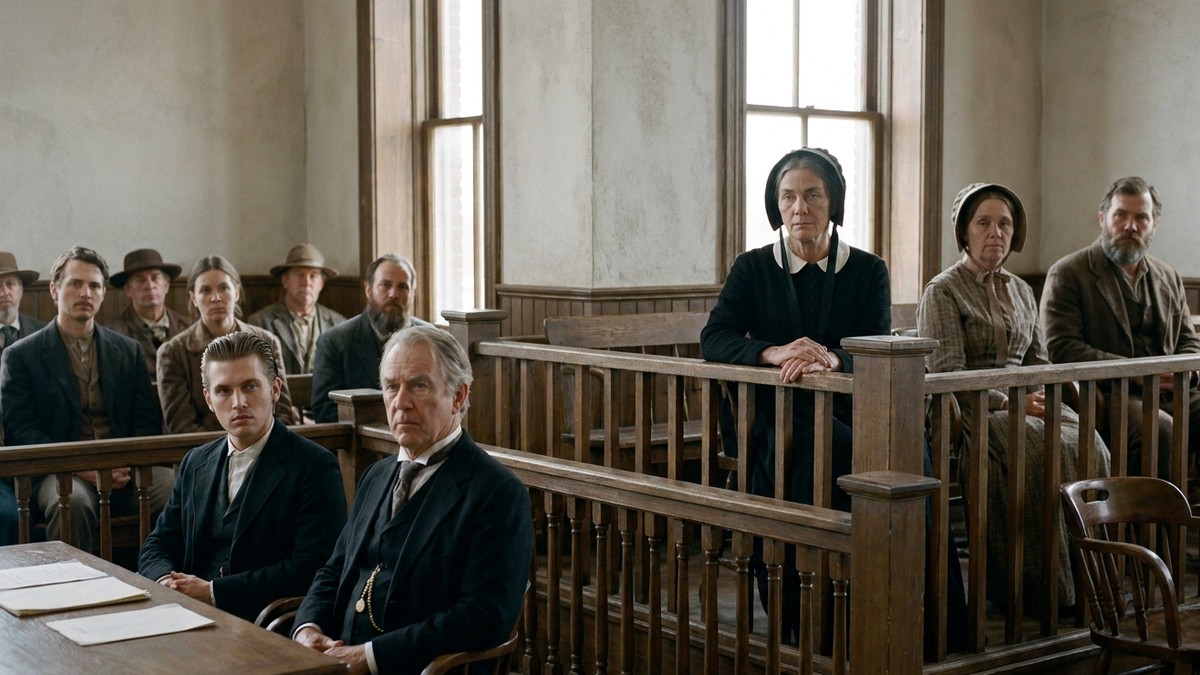
Constance sat in the jury box with five other women and six men. Some of the women wore veils, against the newspaper artists who had come from as far as Chicago to sketch them. Constance did not. She sat with her hands folded in her lap and listened to every word.
Juan Olivas testified on the first day. He was a small, grave, gray-haired man in a black suit, and he spoke English carefully and well.
"I know my mules as I know my own children," he said. "I raised them from foals, in Missouri. The big gray, Tomás, has a white scar on his left hock where a wolf caught him in 1866. The others, I can tell you every mark. I would know them in the dark." He looked at Clayton Vance. "I did not sell them to anyone. Not to this young man. Not to any John Smith."
He described each mule. The marshal led them past the courthouse window, one by one, and every mark was where Señor Olivas said it would be.
Then Clayton Vance's lawyer stood up.
He was a smooth man from Cheyenne, with a gold watch chain, and he was very good. He did not call Señor Olivas a liar. He agreed the mules were stolen. He was sorry for it. But the thief was John Smith, he said, not his client. His client was an honest buyer who had been cheated too.
And he held up the bill of sale.
"Received of Clayton Vance, two hundred dollars, in full payment for four mules, sound," he read aloud. "Signed, John Smith. Witnessed. Dated, the twenty-ninth day of February, 1870." He laid it on the table in front of the jury box. "Gentlemen. And ladies. A plain, honest bill of sale, for a plain, honest purchase. My client bought those mules in good faith the day after they were taken. He is guilty of nothing but bad luck."
The men in the courtroom nodded. Josiah Vance sat behind his son with his arms crossed, looking satisfied.
At the noon recess, Constance heard two of the male jurors talking on the courthouse steps.
One of them was the jury foreman, Orrin Tate, who kept the Elkhorn saloon. A big, red-faced man of fifty with a loud laugh.
"It's done," Tate said. "He'll walk. Even if the men wanted to send him to the penitentiary, the ladies won't. Look at him. Handsome young fellow, with his mother crying in the second row. Women are too soft for this business. That's why they never let 'em do it before."
"The freighter seemed honest," said the other man.
"Oh, he's honest. The mules are stolen. Nobody says they're not." Tate shrugged. "But you can't send a man to prison for buying mules with a bill of sale."
Constance stood in the doorway behind them and said nothing.
That afternoon the lawyers made their closing speeches, and the judge gave the jury its instructions, and the bailiff led the twelve of them up the stairs to the jury room, with the evidence on a tray.
It was a small bare room with a long table and twelve chairs and one window. Orrin Tate sat down at the head of the table and put his hat on it.
"Well," he said, "I don't suppose we'll be long."
The bill of sale lay on the tray in the middle of the table. Constance Wheelock reached out and picked it up.
She read it once. Then she read the date again.
The twenty-ninth day of February, 1870.
And she began, very quietly, to count on her fingers.