Thelma did not answer right away. She could not.
Philip came out of the house carrying a lamp. He saw the tall young man at the end of the driveway with the push mower.
"You must be Jaylen," he said. He set down the lamp and came across the yard and shook his hand. "I'm Philip. Thelma's son. I've heard a lot about you."
Jaylen looked at him. Then he looked at the truck.
"You're moving her," he said. "Today."
"To St. Louis," Philip said. "To a place where she'll be safe. She fell in March. She lay on the kitchen floor for an hour. I can't let that happen again." He said it kindly. He meant it. "I'm sorry about your graduation. I know she wanted to go."
Jaylen did not say anything for a long moment.
Then he parked the mower at the end of the driveway, walked up onto the porch, and put his arms around Thelma Rhodes, the way he had never once done in six years.
"It's okay, Miss Thelma," he said quietly. "It's okay."
He held her for a while. Then he let go and walked back down the driveway, past the moving truck, and around the corner of Walnut Street, without his mower, without looking back.
Thelma sat down on the porch steps.
Philip sat down beside her. They watched the movers carry out the kitchen table, the one where she and Jaylen had done six years of math. It had a ring on it from a lemonade glass. It had pencil marks in the grain where Jaylen had pressed too hard working out the quadratic formula in ninth grade.
"Mom," Philip said. "I'm sorry. I really am."
Thelma did not answer.
At eleven-thirty, the phone rang inside the half-empty house.
Philip answered it. It was a man's voice he did not know.
"Is this Philip Rhodes? This is Gary Sutton, the principal at Little Piney High School."
"Yes?"
"Mr. Rhodes, I'm calling about your mother. Our valedictorian, Jaylen Brooks, came to my house an hour ago. He asked me to call you." The principal paused. "He'd like to ask you a favor. He said he knows he has no right to ask. But he'd like you to bring your mother to graduation at two o'clock. And he asked me to tell you that if you do, he'll help you load every box on that truck himself tonight."
Philip did not say anything.
"Mr. Rhodes," the principal said. "I've been at this school nineteen years. I've never had a student come to my house on a Saturday morning. He was crying."
At one forty-five, Philip Rhodes helped his mother into his car in her new navy blue dress with the white buttons, and drove her eleven blocks to the Little Piney High School gym.
He did not know why he was doing it, exactly. The moving company would charge extra for waiting. The assisted living place had called twice.
He just knew that a boy had walked away from his mother's porch without his mower, and gone to the principal's house on a Saturday morning, and he wanted to see what kind of boy did that.
The gym was full. Two hundred families on the bleachers and in folding chairs. A hundred and four seniors in blue caps and gowns.
There was a seat saved in the front row. A chair with a piece of paper taped to it. Reserved, in a young man's careful printing. Philip helped his mother into it and sat down on the floor beside her, because there was not another chair.
At two-forty, the principal called the valedictorian to the podium.
Jaylen Brooks walked up in his cap and gown. He was six foot one. He put a single sheet of paper on the podium and looked out at the gym.
He did not read from the paper.
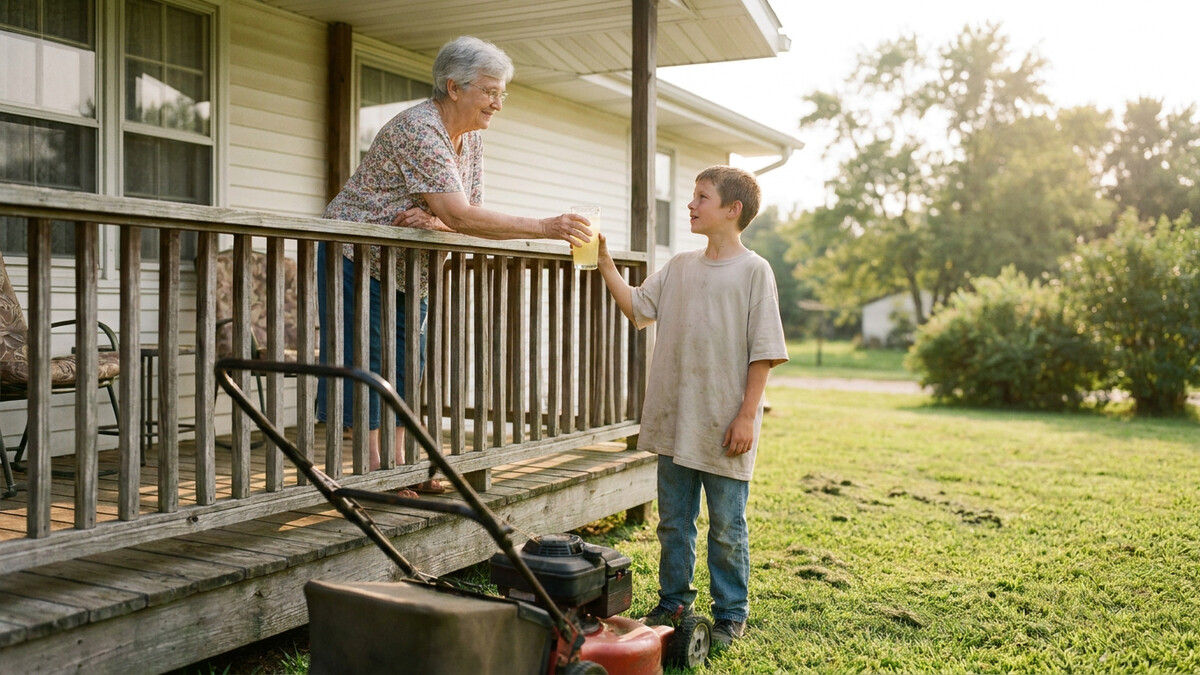
"Six years ago," he said, "the city sent a letter to an old lady on Walnut Street because her grass was eleven inches tall. I was twelve. My mom read about it at work and said, Jaylen, go help that lady. So I went."
He looked at the front row.
"She wouldn't let me do it for free. She said she didn't take charity. So she paid me in lemonade. And then she paid me in math."
A few people laughed. Jaylen smiled.
"I failed pre-algebra in seventh grade," he said. "I thought I was stupid. Every Saturday for six years, she sat at her kitchen table with me and showed me I wasn't. She taught me algebra and geometry and trigonometry, and she taught me how to use her husband's slide rule from 1971." He swallowed. "Last month, I got a perfect score on the calculus final. In the fall, I'm going to Mizzou to study civil engineering. Like her husband did."
The gym was very quiet.
"My mom is working a double shift at the hospital today," Jaylen said. "She couldn't get it off. She told me to say she loves me and she's proud. So when I wrote this speech, I was going to ask my family to stand up. And there wasn't going to be anybody."
He looked down at the front row.
"But there is," he said. "Miss Thelma Rhodes. Would you please stand up?"
Thelma sat very still in her chair.
Then Philip stood up off the floor beside her and held out his arm. She took it. He helped her to her feet.
She stood there in the front row in her navy blue dress, with her cane in one hand and her son's arm in the other, eighty-four years old, while a hundred and four seniors in blue caps and gowns turned around and looked at her.
The class of that year began to clap first. Then their parents. Then the teachers along the wall, three of whom Thelma had taught algebra in 1979.
Philip Rhodes looked at his mother's face. And for the first time all day, he understood exactly what he had been about to put in a moving truck.
The movers unloaded the truck that evening. Jaylen helped them carry every box back inside. Philip helped too.
The deposit at the place in St. Louis was not refunded. Philip did not seem to mind.
Instead, he hired a woman from the church to come by every morning and every evening, and he put a button on a cord around his mother's neck that would call him from anywhere in the house. He drove down from St. Louis every other Sunday.
In August, Jaylen left for the University of Missouri with two suitcases and a shoebox marked KEEP. Inside was Ernest Rhodes's slide rule.
On the first Saturday morning in September, Thelma heard a mower at nine o'clock.
She went out on the porch. A skinny boy of twelve was standing in the front yard, in a T-shirt three sizes too big, with an old push mower.
It was Jaylen's little brother, Marcus. He had a math worksheet folded in his back pocket.
Thelma looked at the worksheet. Then she looked at him over her glasses.
"How much do you charge, young man?"
Marcus grinned.
"Lemonade," he said. "My brother told me."