On the first Thursday in October, the four women of the Persimmon Hill Thursday Bridge Club decided that Lucille Thornton had been a widow long enough, and by the following Thursday, Lucille had been on four blind dates, received forty-one phone calls from strange men, and seriously considered moving to Mississippi.
It started over the second rubber of the afternoon, at Pauline Hatcher's dining room table, with a plate of pimento cheese sandwiches.
"Lucille," Pauline said, laying down a trump. "It has been three years since Wendell passed."
"I'm aware of that, Pauline."
"You need to get out of the house."
"I am out of the house. I'm here every Thursday losing to you."
"You know what I mean," Pauline said. She looked across the table at the other two, Frances and Jo Ann, and Lucille saw the look pass between them, the quick, sly look of three women who had already talked about something on the telephone.
Lucille set down her cards.
"No," she said.
"You don't even know what we're going to say."
"I've played bridge with you for thirty-one years, Pauline," Lucille said. "I know exactly what you're going to say."
Lucille was seventy-six. She had taught math at Persimmon Hill High School, in the piney hills of west-central Alabama, for thirty-five years. She had been married to Wendell Thornton, a quiet, kind man who sold farm insurance, for fifty-four. He had died of a stroke in his recliner during an Alabama football game, which the whole town agreed was how he would have wanted to go.
She was not lonely. Not exactly. She had her garden, her church, her grandchildren in Montgomery, and her Thursday bridge.
And she was the best bridge player in Persimmon Hill. The whole town knew that too. She had won the county duplicate tournament nine times. She could read a partner's signals from across the table like a newspaper headline, and she could tell when an opponent was bluffing by the way she touched her earring.
Pauline touched her left earring when she was bluffing. Frances cleared her throat. Jo Ann looked at the ceiling.
All three of them, that afternoon, had done all three things at once.
The first date was on Saturday.
Pauline had arranged it. It was her cousin's brother-in-law, a retired dentist from Tuscaloosa named Dr. Milton Crabtree, who was seventy-nine and a widower and "very distinguished."
He took Lucille to the Cracker Barrel off the interstate. He talked about teeth for an hour and forty minutes. He talked about crowns and bridges and a root canal he had performed in 1974 that he still thought about. When the waitress brought the check, he looked at Lucille's teeth and said, "You've had some work done. On the upper left. Not very good work."
Lucille paid for her own chicken and dumplings and drove home.
The second date was on Monday.
Frances had arranged it. He was a deacon from her church, a widower named Lamar Gaines, who was seventy-four and very sweet.
He brought his mother.
His mother was ninety-eight. She sat between them in the booth at the Dairy Bar and told Lucille all about Lamar's first wife, who had been "a real Christian woman and a wonderful cook." She asked Lucille if she could cook. She asked Lucille if she was a real Christian woman. She asked Lucille why her first husband had died, in a tone that suggested Lucille might have had something to do with it.
Lamar said, "Mama, please," four times.
Lucille drove home and ate a pint of butter pecan ice cream standing up at the kitchen counter.
The third date was on Tuesday. Jo Ann had arranged that one.
He never showed up.
Lucille sat at a table at the Catfish Shack for forty-five minutes in her good blue blouse. Then she ordered the fried catfish platter for one, with hush puppies and coleslaw, and ate it slowly and alone, and had a very nice time.
On the way home, her lawn mower started making a terrible noise in the back of her mind. Not the mower itself. The memory of it. She had dropped it off at Pettus Small Engine Repair two weeks ago, and Buford Pettus had said it would be ready by Friday, and she had forgotten to pick it up.
Buford Pettus was seventy-seven. He was a widower too. He was short and bald and grumpy, with grease under his fingernails and a voice like gravel in a bucket, and he had fixed every lawn mower and chain saw in Persimmon Hill since 1971.
He had also, in the spring of 1966, asked Lucille to the junior prom at Persimmon Hill High School, and she had said no, because she was already going with Wendell.
She had not thought about that in a very long time.
The fourth date was on Wednesday.
It was not really a date. It was a "mixer," Pauline said, at the Methodist church fellowship hall, for "mature singles." There were eleven women and two men. One of the men was Dr. Milton Crabtree, the dentist. He waved.
Lucille left after twenty minutes.
On Thursday morning, at seven o'clock, her telephone rang.
It was a man she did not know. He had a deep voice and said he was calling about the advertisement.
"What advertisement?" Lucille said.
"In the Persimmon Hill Messenger," the man said. "This week's paper. Page six. In the personals."
Lucille hung up. She put on her robe and her slippers and walked down her driveway in the cool October morning to the mailbox, where the Messenger was folded in its plastic bag.
She opened it to page six.
There it was. In a little box with a border of hearts.
LOVELY WIDOW, 70s, RETIRED SCHOOLTEACHER, SEEKS GENTLEMAN FOR DINNER AND CONVERSATION. MUST LIKE CARDS. CALL LUCILLE.
And under it, her home telephone number.
Lucille stood at the end of her driveway in her robe and read it three times.
Behind her, in the house, the telephone began to ring again.
It rang all morning. By noon, there were forty-one messages on her answering machine. Men from Persimmon Hill and Demopolis and Tuscaloosa and one from Meridian, Mississippi. A man who said he was a "retired cowboy." A man who said he had "a boat and a heart full of love." A man who just breathed for a while and hung up.
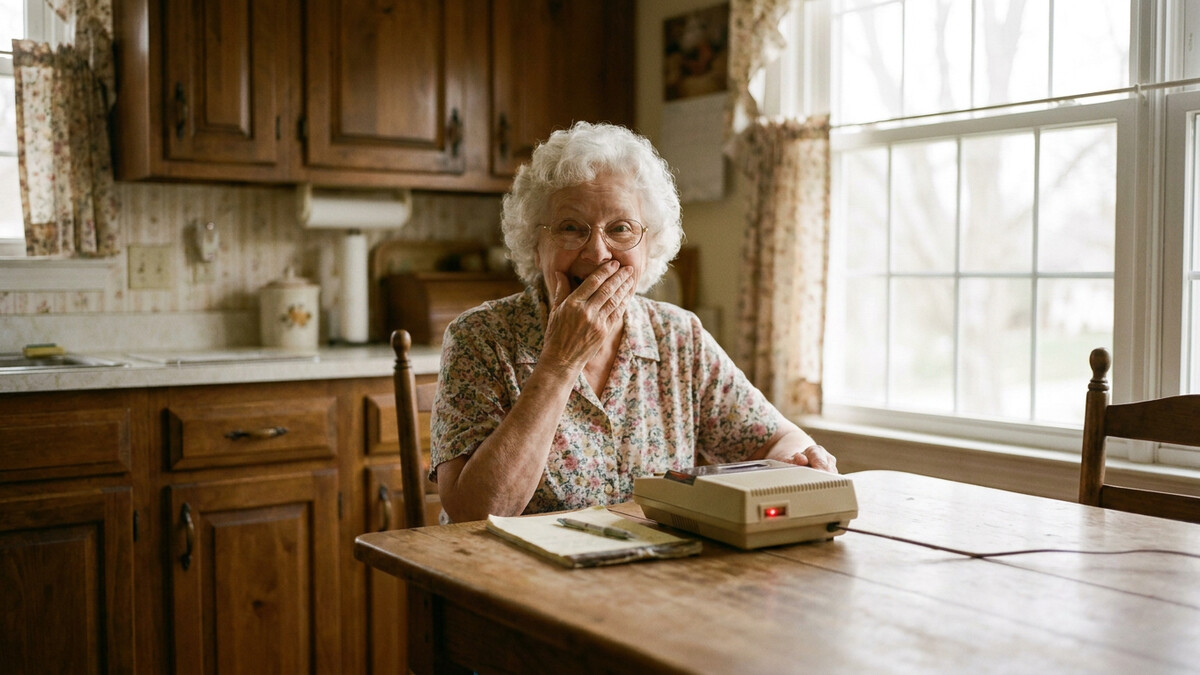
At one o'clock, Lucille Thornton sat down at her kitchen table with a pen and a notepad and the answering machine, and started listening to every single one of them.
At message number thirty-eight, she stopped.
She played it again.
And then she sat very still at the table, with her hand over her mouth, and the tape hissing quietly in the machine.