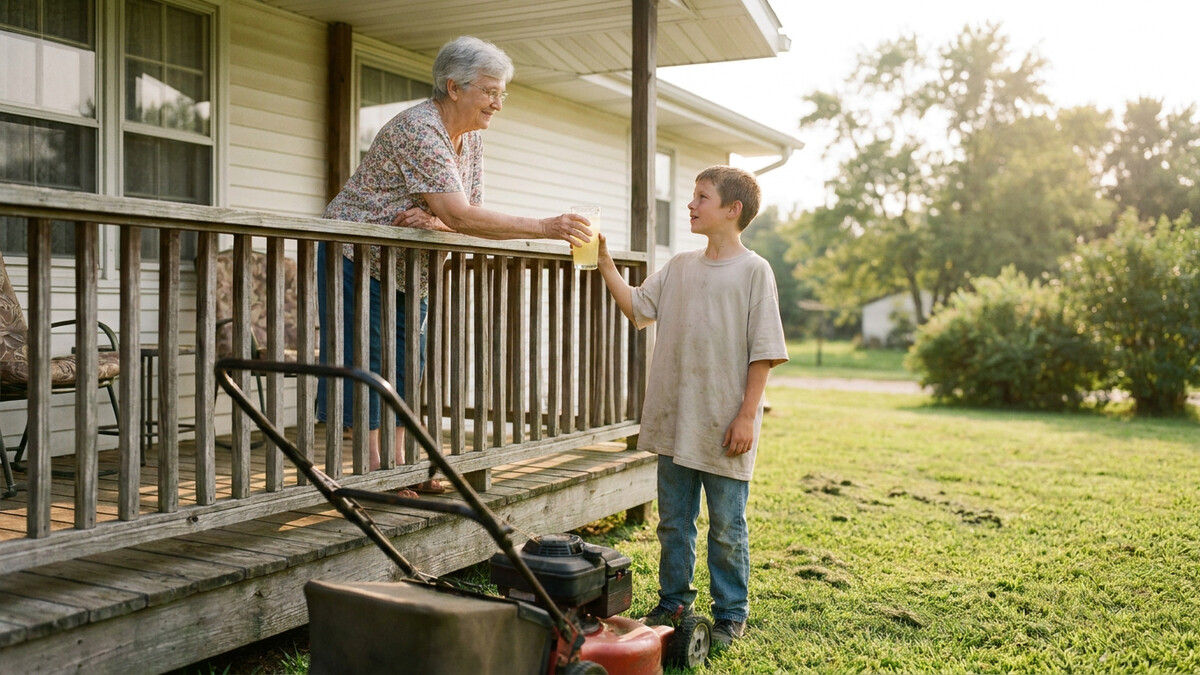
The summer Thelma Rhodes turned seventy-eight, the city of Little Piney, Missouri, sent her a letter saying her grass was eleven inches tall and she would be fined fifty dollars a week until she cut it, and the next morning a twelve-year-old boy she had never met was standing in her front yard with a push mower.
"Ma'am," he said. "I'm Jaylen. From around the corner. My mom said you might need some help."
Thelma looked at him from the porch. A skinny boy in a T-shirt three sizes too big, with a borrowed mower that was older than he was.
"How much do you charge, Jaylen?"
"Nothing, ma'am."
"Nothing is too much," Thelma said. "I don't take charity."
The boy thought about it.
"Then you could pay me in lemonade," he said.
That was six summers ago.
Thelma was eighty-four now. She had taught algebra and geometry at Little Piney High School for thirty-eight years, from 1964 until 2002. Her husband, Ernest, had been a civil engineer for the state highway department. He had died in 2019, the spring before the letter about the grass.
After he died, she had let a lot of things go. The grass. The gutters. The mail. Her hip had gone bad, and she could not push a mower, and she did not want to ask anybody.
Jaylen Brooks had come every Saturday morning since. From May until October. For six summers.
He would not take money. Not once. She tried. She left twenty-dollar bills under the lemonade glass. He left them on the porch rail.
So in the second summer, she started paying him another way.
It began because he was sitting on her porch steps one Saturday drinking lemonade with a math worksheet folded in his back pocket. Summer school. Pre-algebra. He had failed it in the spring.
Thelma saw the worksheet and held out her hand.
"Let me see that."
He was embarrassed. He gave it to her anyway.
She looked at it for a long time. Then she looked at him over her glasses, the way she had looked at a thousand fourteen-year-olds in thirty-eight years.
"Jaylen," she said. "You're not bad at math. You're bad at being taught math. That's different. Come inside."
He came inside.
They sat at her kitchen table for an hour, with a pencil and a pad of yellow paper and two glasses of lemonade. She showed him how a variable was just a box with a secret in it. She showed him how an equation was a seesaw. She showed him how to check his own work so he would never have to wonder if he was right.
He passed summer school with a B-plus.
After that, every Saturday, he mowed her lawn from nine to ten, and from ten to noon, they sat at her kitchen table and did math.
They did algebra in eighth grade. Geometry in ninth. Algebra II in tenth, with Ernest's old graph paper. In eleventh grade, they did trigonometry, and Thelma got out Ernest's slide rule from 1971 and showed him how engineers used to do it before calculators.
In twelfth grade, Jaylen Brooks took calculus at Little Piney High School and made a perfect score on the final exam. The first one in the history of the school.
He was going to the University of Missouri in the fall. To study civil engineering. He had a scholarship that paid almost everything.
And in April, the principal called his mother to tell her that her son had the highest grade point average in his class.
He was the valedictorian. He would give the speech at graduation.
His mother, Danielle, worked as a nurse's aide at the hospital in Rolla, thirty miles away. She worked double shifts most weekends. She had raised Jaylen and his little brother, Marcus, by herself since Jaylen was four.
She cried on the phone with Thelma for twenty minutes.
"Miss Thelma," she said, "I don't know how to thank you."
"I didn't do anything," Thelma said. "He mowed my lawn."
"He told me what you did," Danielle said. "Every Saturday. For six years. He told me everything."
Graduation was on a Saturday in May, at two o'clock, in the high school gym.
Thelma had bought a new dress for it. Navy blue, with white buttons. She had not bought a new dress since Ernest's funeral. She hung it on her bedroom door on Friday night and looked at it for a long time.
But on Friday night, her son called from St. Louis.
Her son, Philip, was fifty-nine, a lawyer, and a good man who worried about his mother from two hours away. He had been worrying harder since she fell in the kitchen in March. She had not broken anything. She had just lain on the floor for an hour before she could get up.
"Mom," he said. "I've found a place. A good one. Ten minutes from our house. Assisted living. They have an opening, and it won't last. I've got a moving company coming to the house tomorrow morning at nine. I'll be there at eight."
Thelma sat down on the edge of her bed.
"Tomorrow?" she said. "Philip, tomorrow is Saturday."
"I know, Mom. I'm sorry it's so sudden. But they won't hold the room. I already paid the deposit."
"Philip," Thelma said. "Tomorrow at two o'clock, I'm going to a graduation."
"Mom, it's just a graduation. Whose graduation?"
Thelma looked at the navy blue dress on the door.
"The boy who mows my lawn," she said.
There was a pause on the line.
"Mom," Philip said gently. "I know that boy's been good to you. But the truck's coming at nine. We'll be on the road by noon. You can send him a card."
At eight o'clock on Saturday morning, Philip's car pulled into the driveway on Walnut Street.
At eight forty-five, the moving truck came.
Two young men in gray T-shirts started carrying boxes out of Thelma's house. Her dishes. Her books. Her winter coats. Ernest's graph paper and his slide rule, in a shoebox marked KEEP.
Thelma stood on the porch in her housecoat with her cane and watched them.
At nine o'clock, just like every Saturday morning for six years, a tall young man came around the corner of Walnut Street, pushing a mower.
He stopped at the end of the driveway. He looked at the moving truck. He looked at the boxes on the lawn. He looked at Thelma, standing on the porch in her housecoat with tears running down her face.
"Miss Thelma?" Jaylen Brooks said. "What's happening?"