Agnes didn't call Bill Haskell again.
She took the number for the Coast Guard station off the card that had been stuck to her refrigerator since 1994, under a magnet shaped like a lobster. She dialed it with steady hands.
A young man answered. He sounded about twenty-two, and busy, and polite.
"My name is Agnes Pelletier," she said. "My father was the keeper on Ledge Island for twenty-five years. I'm calling about the Mary Beth. I need you to listen to me for one minute. After that, you can hang up on me if you want."
There was a short pause on the line.
"Yes, ma'am," the young man said. "Go ahead."
She told him. She did it the way her father would have, plain and in order, like an entry in the log.
High water at 1:15. The call at 1:52, at the first of the ebb.
The Gut between the ledges, which ran southwest at two knots or better for the first two hours of the ebb, against a northeast wind. The Christensen boy in March of 1958, found on the Sisters after six hours of searching to the east.
And the horn. Three short blasts, twice, from the southwest, not five minutes ago.
"Sound can fool you in fog," she said. "I know that. I'm not asking you to trust my ears. I'm asking you to look at the tide. The water and the horn are saying the same thing."
The young man was quiet. She could hear him writing.
"Ma'am," he said, "can you spell the Sisters for me? And the Gut?"
She spelled them.
"Stay by your phone," he said. "Please."
It was twenty-six minutes before the phone rang.
Agnes spent them at the window. She didn't sit down. She stood with her hand flat on the cold glass and watched the fog and listened.
She heard the thump of the Coast Guard boat's engines change. She heard them slow, and then grow louder, and then begin to move.
Not east anymore. South, and then west, around the end of Ledge Island toward the place where the Sisters lay under the falling tide.
The horn came again, once, very faint.
Then the Coast Guard boat's own horn answered it, long and loud, and Agnes put her other hand over her mouth.
The phone rang at 4:51.
It was a different voice this time, an older one, a man with a Down East accent and the sound of engines behind him. He said he was Chief Rios, the coxswain on the forty-seven-footer, and he was calling from the boat.
"We've got him, Mrs. Pelletier," he said. "He's alive."
Agnes sat down then. The chair was right behind her, and she was glad of it.
"The Mary Beth fetched up on the middle ledge of the Sisters," the chief said. "Exactly where you said she'd be. Half swamped. He'd put on his survival suit before she struck and climbed up onto the rocks. He was blowing the horn every five minutes to save the battery. He's cold. He's beat up. But he's talking."
"Thank you," Agnes said.
"No, ma'am," said the chief. "Thank you. We were working the box the computer gave us. It wasn't wrong for the wind. It just didn't know about your Gut." He paused. "I'd like to come by sometime and look at your father's logs, if you'd let me."
"Any time," Agnes said. "Bring coffee."
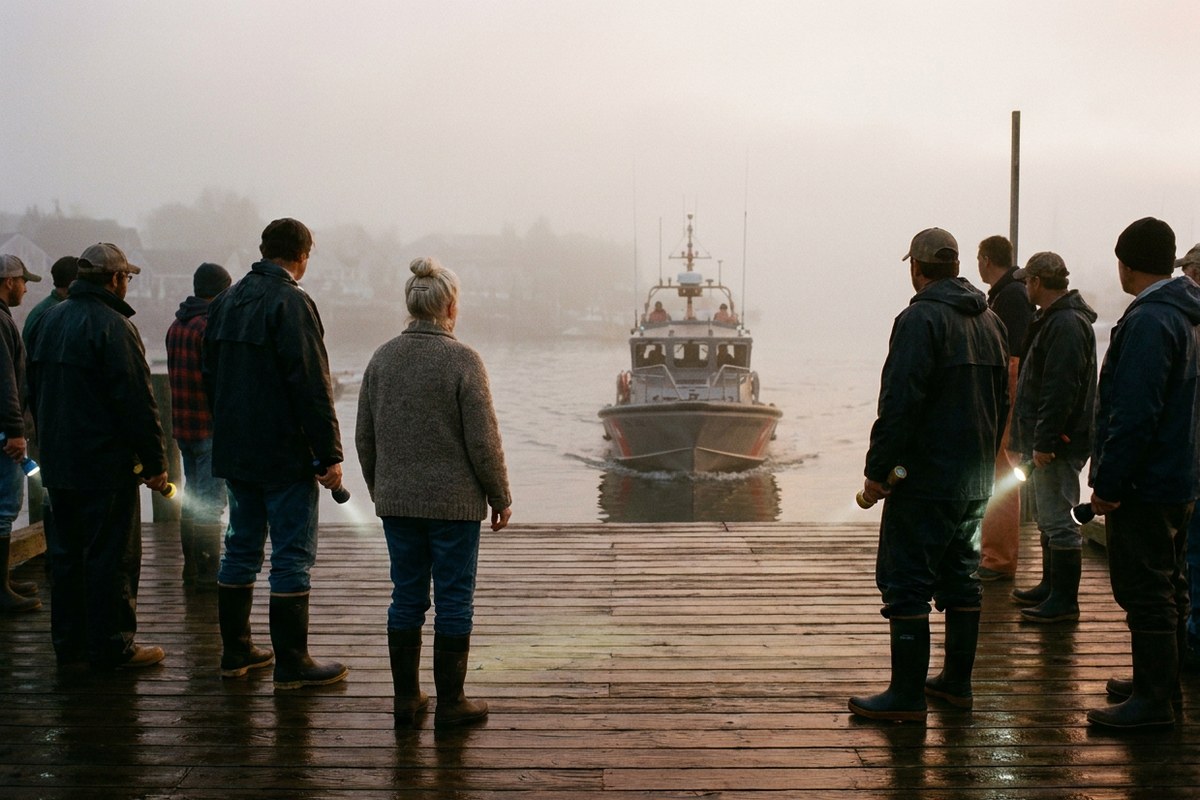
They brought Owen in to the town wharf at 5:40. Agnes was there. So was half of Port Anson, standing in the fog in their boots and oilskins with flashlights, because in a harbor town, word goes around faster than a boat.
The forty-seven-footer came out of the fog with its lights on and nosed in against the wharf. Owen came up the ladder wrapped in a gray blanket, with a Coast Guardsman on either side of him and a bruise on his forehead the size of an egg.
Bill Haskell stood at the back of the crowd with his hat in his hand. When Agnes looked at him, he nodded once, the way a man nods when he's been wrong and knows it.
Owen saw Agnes and stopped.
"Mrs. Pelletier," he said. His teeth were still chattering. "They said it was you."
"It was my father," Agnes said. "I just read his book."
Owen looked at her a long moment. Then he put his arms around her, blanket and all, and held on.
He smelled like salt water and diesel. Agnes held on too.
"Your grandmother made me promise to keep an eye on you," she said into his shoulder.
"I figured she did," Owen said. "She made me promise that too."
That night, when the house was quiet and the fog had started, finally, to lift off the harbor, Agnes went to the bookcase.
She took down the last of her father's logs. The book for 1971, the year the light was automated and he came ashore for good.
He'd only filled half of it. The rest of the pages were blank, waiting for a keeper who never came.
She sat at the kitchen table with her father's book and a ballpoint pen.
On the first empty page, under his last entry, in her own hand, she wrote it down the way he would have.
February 23. Fog, wind NE 15. Beal boy adrift.
Searched E. Found him 1640 hrs on the Sisters, SW of Ledge, alive.
Note for the next keeper. Look where the water goes.