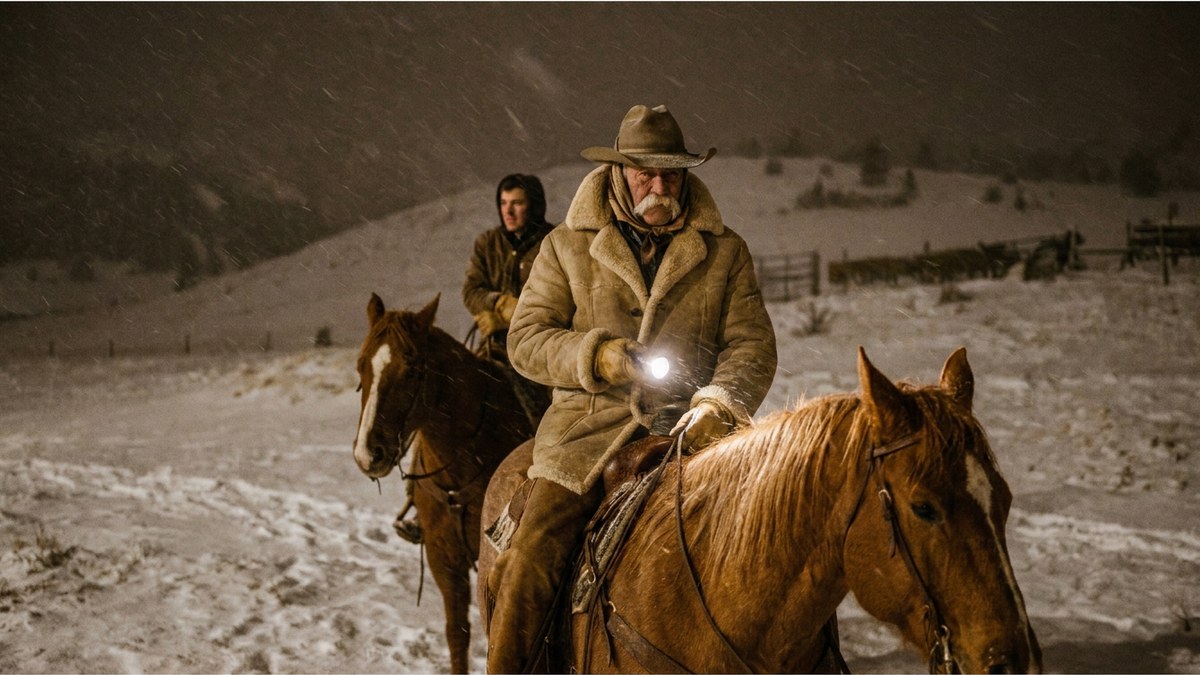
The new owner said the drones could find every cow on the place, and Hap Tolliver said, "Not in a March blizzard they won't."
Spencer Whitlock smiled at him. It was a nice smile. Spencer was thirty-eight and had made a great deal of money selling a software company in Denver, and he smiled at waitresses and bankers and ranch hands the same way.
"Hap," he said, "every one of those heifers has a GPS tag in her ear. I can see where they are on my phone, right now, to within ten feet. And the drones have thermal cameras. They can find a cow in the dark."
"I know they can," Hap said. "I've seen your drones. They're real nice."
"So what's the worry?"
Hap looked out the window of the ranch office at the sky over the Bighorns. It was the color of an old nickel, low and heavy, and the wind had swung around to the north about an hour ago and started to pick up.
"I'd bring the heavy heifers in tonight," Hap said. "Close to the calving barn. The ones due this week. All of them."
"The forecast says six inches."
"The forecast," Hap said, "has never calved a heifer."
Hap was seventy-four. He'd been the cowboss on the Rafter T, outside Powder Gap, Wyoming, for thirty-one years, under the Thompson family. When old Mrs. Thompson finally sold out last summer, Spencer Whitlock had bought the place, cattle and all, and kept Hap on mostly because Mrs. Thompson had made it a condition of the sale.
Hap knew that. He'd made his peace with it.
Spencer was not a bad man. He worked hard. He was honest.
He'd spent his own money on new pipe corrals and a heated calving barn and solar water tanks, and those were good things. He just believed, the way smart young men from the city sometimes believe, that a phone could know a ranch better than a man who'd ridden every acre of it for three decades.
"I'll tell you what," Spencer said. "Let's compromise. We'll keep an eye on the app tonight. If anything looks off, we'll go get them."
Hap nodded.
He didn't argue. He'd learned a long time ago not to argue with weather or with owners. He just went out to the barn, after supper, and saddled his old sorrel gelding, Dollar, and left him standing in a stall with the saddle on and the cinch loose.
Then he went home to his little house by the creek and set his alarm for one in the morning, and lay down in his clothes.
There were two hundred and ten first-calf heifers on the Rafter T that spring.
First-calf heifers are young. They're having their first babies, and they don't always know what they're doing, and they're the ones most likely to need help. In March, on the high plains of northern Wyoming, a calf born into a blizzard has about an hour to get up and dry and nursing before the cold kills it.
That's why ranchers calve in barns when they can. That's why they bring the heavy heifers close.
Seventy of the heifers on the Rafter T were due in the next ten days. That night, they were in the big pasture along Cottonwood Draw, two miles from the barn.
The snow started at nine.
Hap lay in the dark and thought about the spring of 1996. A March storm much like this one, out of the north, and the Thompsons' heifers turning their tails to it and walking south down Cottonwood Draw in the night until they piled into the creek. They'd lost thirty-one calves and eleven heifers before morning.
That summer, Hap had built a half mile of drift fence across the bottom of the draw with his own hands. He doubted Spencer even knew it was there.
Hap's alarm went off at one. He didn't need it. He'd been awake since midnight listening to the wind.
He went to the window. He couldn't see the barn.
He couldn't see the yard light forty feet from his porch. The snow was coming sideways in a solid white wall, and the wind was screaming around the corners of the house loud enough to drown out the clock.
It was not six inches.
He pulled on his coat and his wild rag and his overshoes and went out. The wind nearly took him off his feet. He found the fence along the lane with his hands and followed it to the main house.
The lights were on in Spencer's office. Spencer was sitting at his desk in a sweatshirt with his laptop open and three phone screens lit up beside it, and his face was white.
"The tags stopped reporting an hour ago," he said, before Hap was all the way in the door. "All of them. The power's out across the county, and the cell tower's on backup, and the gateway that collects the signals is down."
"What about the drones?"
"Grounded. Wind's gusting sixty. They'd go to pieces." Spencer looked up at him. "Hap, I don't know where they are. I don't know where any of them are."
Hap looked at the dark screens.
"I do," he said, and went to get his horse.
Spencer stood up so fast his chair went over. "Hap. You can't go out there. You're seventy-four years old. You can't see your hand in front of your face. You'll get lost and freeze to death, and they'll find you in April."
Hap was already pulling his gloves back on.
"Then you'd better come with me," he said, "and help me keep from getting lost."