They went out together into the storm at 1:30 in the morning. Hap on Dollar. Spencer on a young bay mare he'd bought in the fall and ridden maybe six times.
Before they left the barn, Hap tied a long rope from his saddle horn to Spencer's.
"Don't let go of that," Hap said. "If you can't see me, you can feel me. If you get turned around, stop and pull."
"Where are we going?"
"South," Hap said. "To the bottom of Cottonwood Draw."
"How do you know they're there?"
Hap swung up into the saddle. It took him a minute. His knees weren't what they'd been.
"Because they're cows," he said. "And it's a north wind."
The wind was at their backs. That was the only mercy in it.
Hap rode with his head down and his collar up and let Dollar find the way. The old sorrel had been on the Rafter T for nineteen years. He knew the ground in the dark the way Hap knew the inside of his own kitchen.
When the snow got too deep, he went around. When there was a fence, he stopped.
They followed the fence line south along the edge of the big pasture. Hap kept one glove on the top wire whenever he could reach it.
Something solid. Something that didn't move.
"Cows won't face a storm," he called back to Spencer over the wind. "They turn their tails to it and walk. They'll walk till something stops them. A fence, or a creek, or a cutbank. In 1996, it was the creek. We lost thirty-one calves in one night."
He didn't have to say the rest of it. He felt the rope go tight as Spencer understood.
"Then what stops them now?" Spencer shouted.
"Drift fence," Hap shouted back. "I built it that summer. Half a mile, across the bottom of the draw. If they're anywhere, they're piled up against it."
They found the first heifer at 2:10.
She was standing in the lee of the drift fence with her tail to the wind and snow piled on her back. Behind her stood another one, and another, and then Hap's flashlight found them all at once, a long dark line of cattle pressed up against the wire with their heads down, steaming in the cold.
Seventy heavy heifers. Right where he'd said.
And one of them, a little way off from the others, was down on her side in the snow, straining.
Hap was off his horse before Spencer had even stopped. He went down on his knees in the snow beside her. The calf was coming, the front feet already showing, and the heifer was worn out.
"Come here," Hap said. "Hold the light. Right there."
Spencer held the light. His hands were shaking.
Hap pulled his gloves off with his teeth. He waited for the heifer to push, and when she did, he pulled with her, steady, down toward her hocks, the way he'd done a thousand times in thirty-one years.
Once. Twice.
The calf came out all at once in a rush, wet and steaming, onto the snow.
Hap cleared its nose and mouth with his fingers. He rubbed it hard with a feed sack from his saddlebag. The calf coughed, shook its head, and bawled.
Spencer Whitlock made a sound Hap had never heard a grown man make, half laugh and half something else.
"Now we move them," Hap said, standing up. "Before any more of these girls decide tonight's the night."
It took them until six in the morning to bring the seventy heifers to the calving barn.
They drove them with the wind at their backs along the fence line, slow, Hap in front and Spencer behind. Hap carried the new calf across the front of his saddle wrapped in his own coat, with its mother bawling and following right behind Dollar's tail the whole two miles.
Twice, Spencer lost sight of Hap in the snow. Both times, he pulled on the rope, and both times, the rope pulled back.
Four more heifers calved in the barn before noon. All four calves lived. So did the first one.
The storm blew out the next afternoon. It had dropped twenty-six inches on Powder Gap and drifted it to the eaves of the barns.
Two ranches down the valley lost calves that night. One lost a lot of them. The Rafter T didn't lose one.
Spencer came to Hap's little house by the creek on the second evening with a bottle of good whiskey and two glasses. He sat at Hap's kitchen table for a long time without saying much.
"I'm going to keep the drones," he said finally. "And the tags. They're good tools, Hap. They are."
"They are," Hap agreed.
"But I want you to teach me the rest of it. All of it. Where they go in a north wind. Where they go in a south wind. Where the drift fences are. Everything you know about this place." He turned his glass in his hands. "And I want you to write it down. So the next man has it."
Hap thought about that for a while.
"I'll teach you," he said. "But I'm not much for writing."
"Then I'll write it," Spencer said. "You talk."
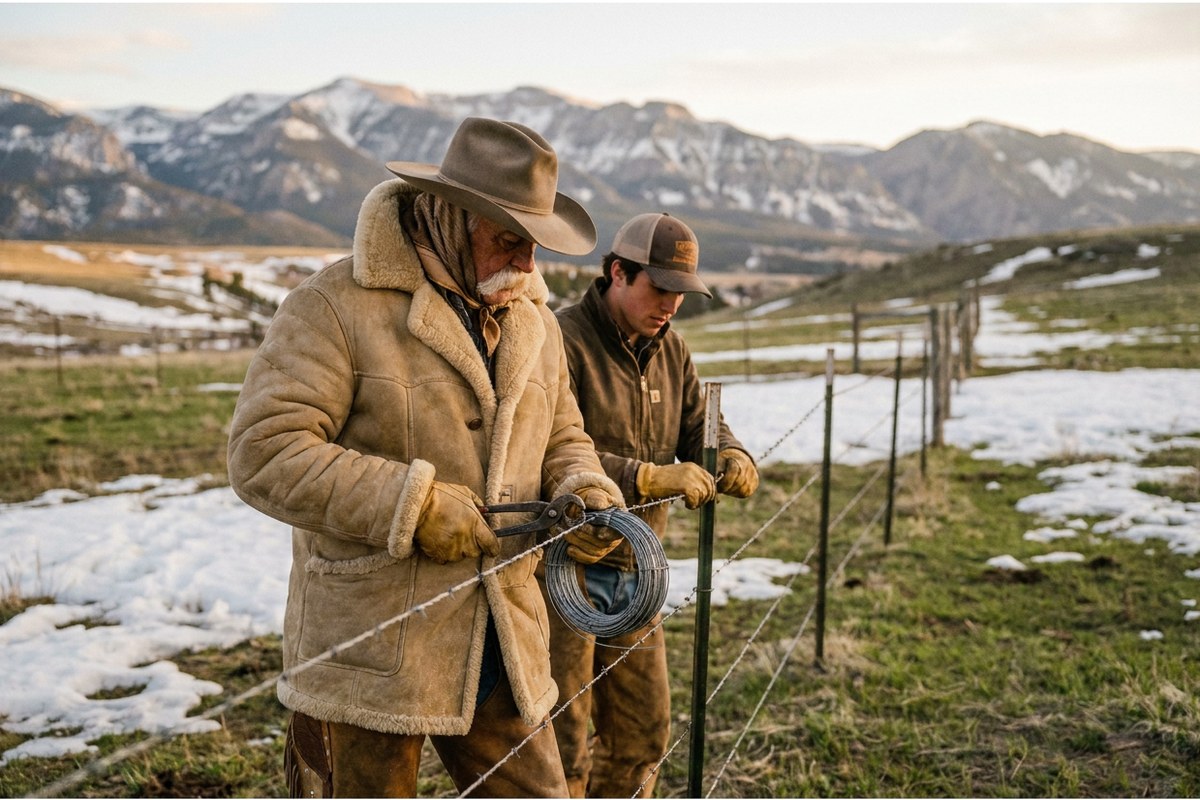
On the first warm afternoon in April, Spencer rode out with Hap to fix the drift fence across the bottom of Cottonwood Draw. Two posts had broken under the weight of the cattle that night. They set new ones together.
When the last staple was in, Spencer stood back and looked at the half mile of wire running across the draw.
He took out his phone. He took a picture of it. Then, under the picture, in the notes, he typed one line.
Hap's fence. Don't ever take it down.