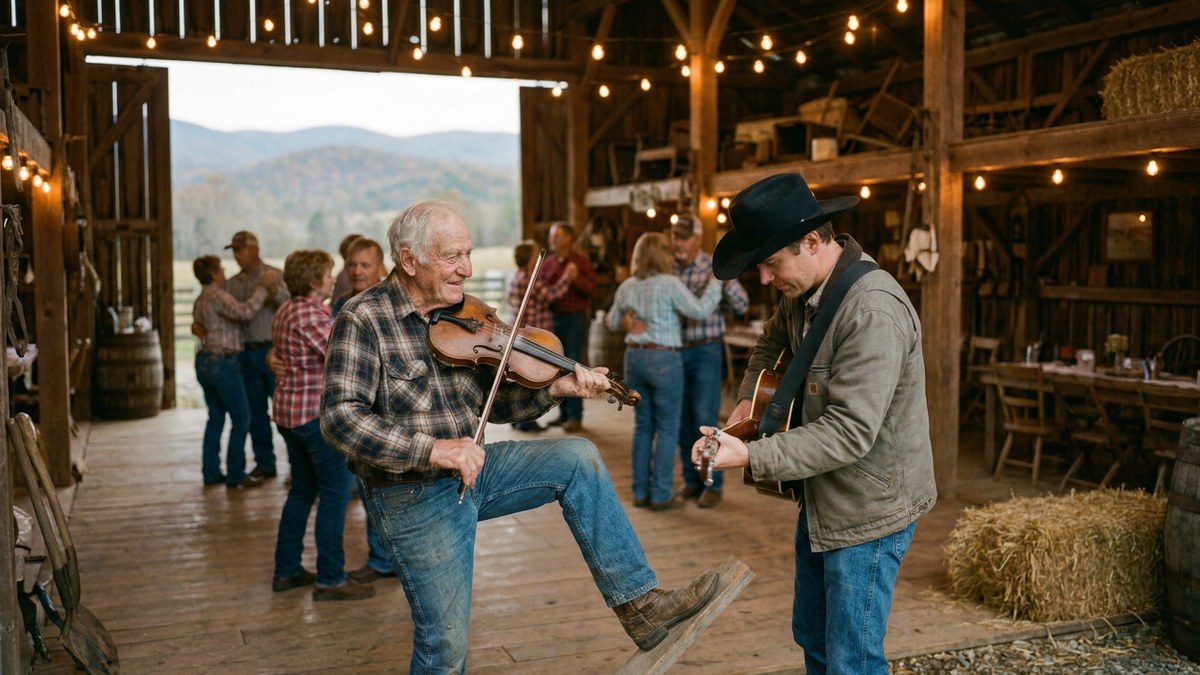
The band leader asked Virgil to move his chair so the speakers would fit.
"Sorry, sir," the young man said. "We need that corner. Our sound guy says it's the only place the speakers don't feed back."
Virgil Tate looked up at him. The band leader was maybe twenty-eight, tall, in a pressed flannel shirt and a black hat that had never seen a cow. He had a wireless microphone clipped to his collar and a guitar on his back that cost more than Virgil's truck.
"I've sat in this corner since 1979," Virgil said.
"Yes sir. I'm sure you have." The young man smiled, friendly enough. "There's a real nice spot by the cake table."
Virgil was eighty-four years old. He picked up his chair, a straight-backed oak chair with a cane seat that the Ruritan Club had let him keep in that corner for forty-seven years, and carried it across the barn to the cake table.
He didn't say anything. At eighty-four, you learn which arguments are worth your breath.
The Hickory Gap Ruritan barn sat at the bottom of a hollow in the Blue Ridge, twenty miles from Galax, with a gravel lot and a tin roof and a dance floor of wide pine boards worn smooth by sixty years of boots. Every third Saturday the club held a dance. Tonight's was the big one, the March dance, and every dollar from the door was going to the Hickory Gap Volunteer Fire Department for a new pumper truck.
The old truck had been built the year Virgil turned fifty.
For thirty-four years, the band at the third Saturday dance had been Virgil and his brother Arlis. Virgil on fiddle, Arlis on guitar, and whoever wanted to sit in on banjo or bass. They'd played the old tunes, the ones their daddy had played on the porch on Saturday nights when they were boys. "Soldier's Joy." "Sally Ann." "Cripple Creek." "Old Joe Clark."
Then Arlis died, in October of 2014, and Virgil put his fiddle in its case and didn't take it out in public again.
The club hired bands after that. Some were good. Tonight's band was called Colt Ridley and the Ridgeline, and the posters said they'd played in Nashville.
Virgil's granddaughter Lacey brought him a plate of barbecue and sat down beside him at the cake table.
"You okay, Papaw?"
"I'm fine."
"That boy moved your chair."
"That boy's got a job to do." Virgil ate a bite of barbecue. "He's not wrong about the speakers. They'd feed back. I'd have put them there myself."
Lacey looked at him sideways. She was thirty, a nurse at the hospital in Galax, and she'd grown up falling asleep under the bandstand while Virgil and Arlis played until midnight.
"You brought it, didn't you," she said. "It's behind the seat of the truck."
Virgil didn't answer.
He'd carried the fiddle behind the seat of his truck every day for twelve years. His late wife, Pearl, used to say a fiddle shut up in a closet will die of loneliness, and he'd believed her. He just couldn't bring himself to play it where people could hear.
His hands had gotten stiff. His left hand mostly, in the mornings, and in cold weather. And without Arlis beside him laying down the rhythm, it felt like trying to walk with one leg.
Colt Ridley's band set up on the bandstand. Electric guitar, bass, drums, a keyboard, and a fiddle on a stand beside the drums. The fiddle player was a young woman named Shelby who'd waved at Virgil when she came in. She'd come up to him once at a fiddlers' convention years ago, when she was twelve, and asked him how he did the shuffle on "Sally Ann."
He'd shown her. She'd gotten it in an afternoon.
At seven o'clock the barn was filling up. Families with little kids. Old couples who'd been coming for forty years.
Teenagers who'd come because their parents made them. The fire chief, Roy Sheets, stood by the door with a coffee can collecting money, and the can was already half full.
Out on the floor, old Junior Lyons was testing his microphone. Junior had called square dances at the Ruritan barn since 1972. He was eighty-one and had a voice like a church bell.
Colt came over to the cake table. He seemed in a good mood.
"Big crowd," he said to Virgil. "I hear this is the dance of the year."
"It is."
"We're going to open with some Luke Combs," Colt said. "Get the young folks out there. Then some Zac Brown. We'll do a couple of square dances for Mr. Lyons later. Shelby's got those." He grinned. "Don't worry, sir. We'll play something modern. Folks want stuff they can actually dance to. Not that old stuff."
Lacey opened her mouth. Virgil touched her arm, and she closed it.
"Good luck to you, son," Virgil said.
At seven forty, Colt's phone rang.
Virgil watched him take it by the bandstand. Watched him turn away to hear over the noise. Watched his free hand go up to the back of his neck and stay there.
Colt came back across the barn ten minutes later, and his face was white.
"That was Shelby's husband," he said. Not to Virgil, really. To the room. To himself. "She slipped on the wet steps loading her car. She's at the hospital in Galax. Her left wrist is broken in two places."
Lacey was already reaching for her phone, the nurse in her switching on.
Colt stared at the bandstand, at the empty fiddle stand beside the drums. Across the barn, Junior Lyons was asking somebody when the squares would start.
Roy Sheets was counting the coffee can. A little girl in a pink dress was bouncing on her toes at the edge of the dance floor, waiting.
"I've got a contract for four hours," Colt said quietly. "Half the songs are fiddle songs. Mr. Lyons can't call a square without a fiddle. There's three hundred people in this barn, and they paid for a dance, and the money's for the fire truck."
He looked around the room like a man looking for a door.
Then his eyes stopped on the cake table, and the old man sitting beside it, and the empty corner where the old man's chair used to be.