Colt walked across the barn slowly. When he got to the cake table, he took his hat off.
"Mr. Tate," he said. "I owe you an apology, and I need a favor, and I know which one I ought to say first."
"Say the apology," Lacey said.
"Lacey," Virgil said.
"No, she's right." Colt turned the hat in his hands. "Shelby told me who you were when we pulled in tonight. She said you were the best old-time fiddler in Grayson County and I'd better be polite to you. And then I went and moved your chair." He shook his head. "I'm sorry, sir. That was a sorry thing to do."
Virgil studied him for a long moment.
"I haven't played in front of people in twelve years," he said. "My hands aren't what they were. And I never played without my brother."
"I'll play with you," Colt said. "Whatever you need. I'll follow you."
"You know 'Soldier's Joy'?"
Colt hesitated. "I've heard it."
"That's not the same thing, son."
Virgil got up and walked out to the truck with Lacey behind him.
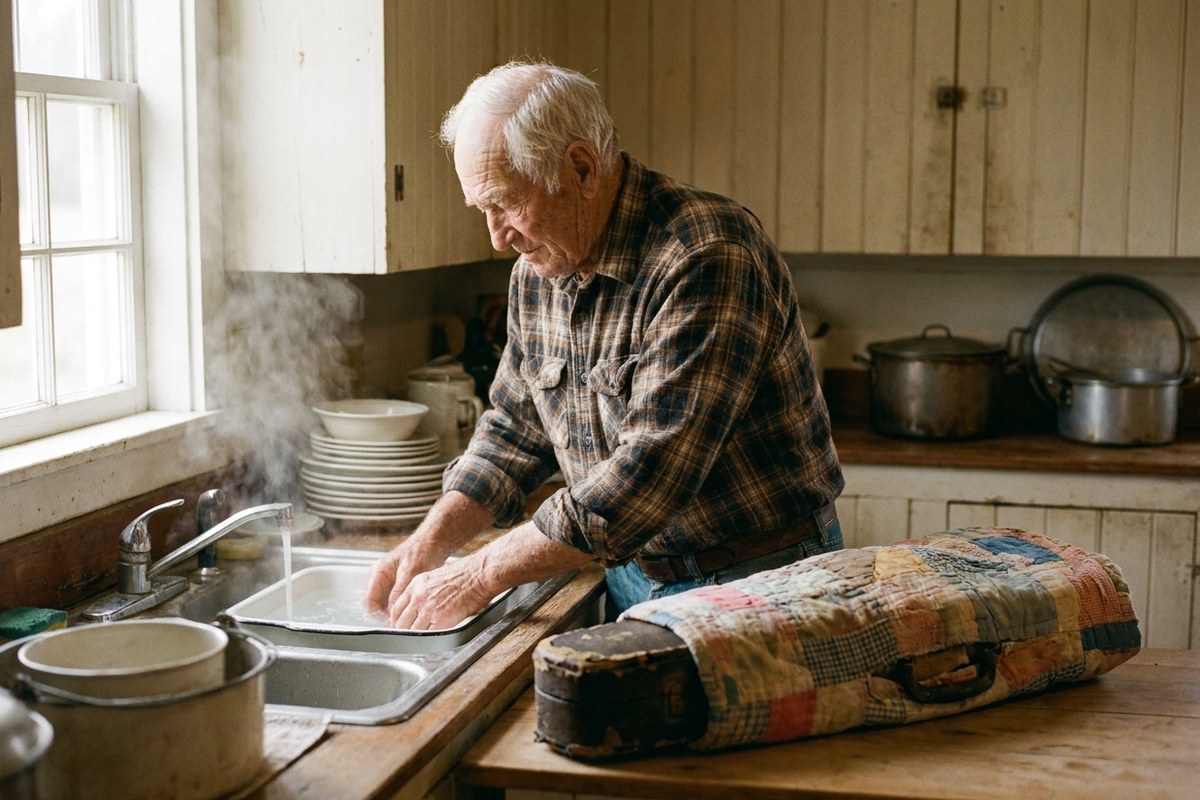
The fiddle case was where it always was, behind the seat, wrapped in an old quilt of Pearl's. He carried it inside.
He didn't open it yet. Instead he went back to the kitchen, where the Ruritan ladies were washing barbecue pans, and asked Wanda Crouse for a dishpan of hot water.
She knew exactly what he wanted it for. She'd been washing pans at the barn since Arlis was alive.
Virgil sat on an upturned bucket and put both hands in the water up to the wrists. He held them there for five minutes while the steam rose around his face.
His knuckles loosened. He worked his fingers open and shut, open and shut, the way the doctor had told him to do every morning and he usually forgot.
Colt crouched beside him with his guitar.
"'Soldier's Joy' is in D," Virgil said, without looking up. "Two parts. Each part twice. You play D, and when the tune goes up, you go to A, and then back to D. That's the whole thing."
"That's it?"
"That's it. The hard part is you play it the same way for three minutes and never rush." Virgil lifted his hands out of the water and dried them on Wanda's dish towel. "Arlis rushed for thirty years. I'd stomp my foot to slow him down. You watch my foot."
When Virgil walked up on the bandstand, the barn got quiet in pieces.
The old couples noticed first. Then their children. Then Junior Lyons, who stood up very straight at his microphone and said, "Well, I'll be."
Virgil opened the case. The fiddle was his daddy's, made in Mount Airy in 1931, with a crack in the top that had been glued twice.
He tuned it slowly, by ear. Then he sat down, because his knees didn't care for standing, and he looked at Colt.
"Ready, son?"
"No sir."
"Good. A man who says he's ready is fooling himself." Virgil set the fiddle under his chin. "Watch my foot."
He started "Soldier's Joy" the way his daddy had, alone for the first four bars, his bow rocking across two strings at once. His left hand was stiff for the first part and loose by the second. Colt came in on the D chord on the fifth bar, too fast, and Virgil stomped his foot twice on the pine boards, and Colt slowed down.
By the second time through, Junior Lyons was calling.
"Bow to your partner, bow to your corner. All join hands and circle to the left."
The dance floor filled up so fast that people had to wait their turn at the edges.
Virgil played "Soldier's Joy" and "Sally Ann" and "Cripple Creek." He cross-tuned the fiddle for "Old Joe Clark," the two low strings brought up to A and E so the old tune would ring, and the young drummer watched him do it with his mouth open. The drummer started tapping along on a snare with brushes after that, soft, the way a man taps on a kitchen table.
Colt watched Virgil's foot all night. By the third tune, he'd quit rushing.
At the break, Roy Sheets came by with the coffee can. People had been coming up all night to drop extra money in it. It was full to the brim.
"Pumper truck's paid for, Virgil," Roy said. "Down payment, anyhow. I'll take it."
The little girl in the pink dress came up to the bandstand and asked if the fiddle man would play the "Cripple Creek" song again, and Virgil said he believed he could manage it.
After the last set, near midnight, Colt sat down beside Virgil on the bandstand while his band packed up.
"Mr. Tate," he said. "I learned guitar off videos on my phone. I never had anybody to teach me. Not one person." He looked at his hands. "Would you show me the old tunes? Shelby too, when her wrist heals. I'll pay you."
"You won't pay me," Virgil said. "You'll come to my house on Wednesday nights and bring your own coffee."
"Yes sir."
"And you'll move those speakers to the other corner next month. They'll feed back, but your sound man will figure it out." Virgil put his fiddle back in its case. "I believe I want my chair back."
Colt grinned. "Yes sir."
Lacey drove him home. At the house, she carried the fiddle in from the truck and set it on the kitchen table, and Virgil didn't tell her to put it back behind the seat.
The next Wednesday night, Colt Ridley knocked on the door at seven o'clock with a thermos of coffee and his guitar.
They sat on the porch in the cold until ten, playing "Soldier's Joy" over and over, the old man's bow hand and the young man's guitar side by side, until the young man had nearly quit rushing.
"My brother would've liked you," Virgil told him when they were done. "You rush the turnaround just like he did."