The best-of-show quilt was gone from the exhibit hall, and the lock wasn't broken.
Wilma Ostrander stood in front of the empty display stand at seven fifteen on Saturday morning with her coffee going cold in her hand. The aluminum rod was still there, eight feet up.
So were the twelve plastic clips that had held the quilt to it. They hung in a neat row, every one of them unclipped and left closed, like somebody had taken them off one at a time and then tidied up.
The blue ribbon was gone too. The little card underneath still read, in Pat Kruse's careful printing: Best of Show. "Prairie Roses." Bernice Hartwig, Clayborne.
"I locked that door myself last night at nine," Pat said behind her. Pat had chaired the Linden County Quilt Guild spring show for eleven years and had never lost so much as a pincushion. "I checked it twice. The keypad shows it was opened this morning at six fifty, when I came in. That's all."
"Who has the code?" Wilma asked.
Pat closed her eyes. "Me. The fairgrounds manager. The guild officers. And every white-glove volunteer in the building."
Wilma was seventy-three. She'd been quilting since she was nine years old and judging quilt shows across Iowa for thirty-one years. She'd judged county fairs and guild shows and once, in a hotel ballroom in Des Moines, a contest with four hundred entries and a television camera.
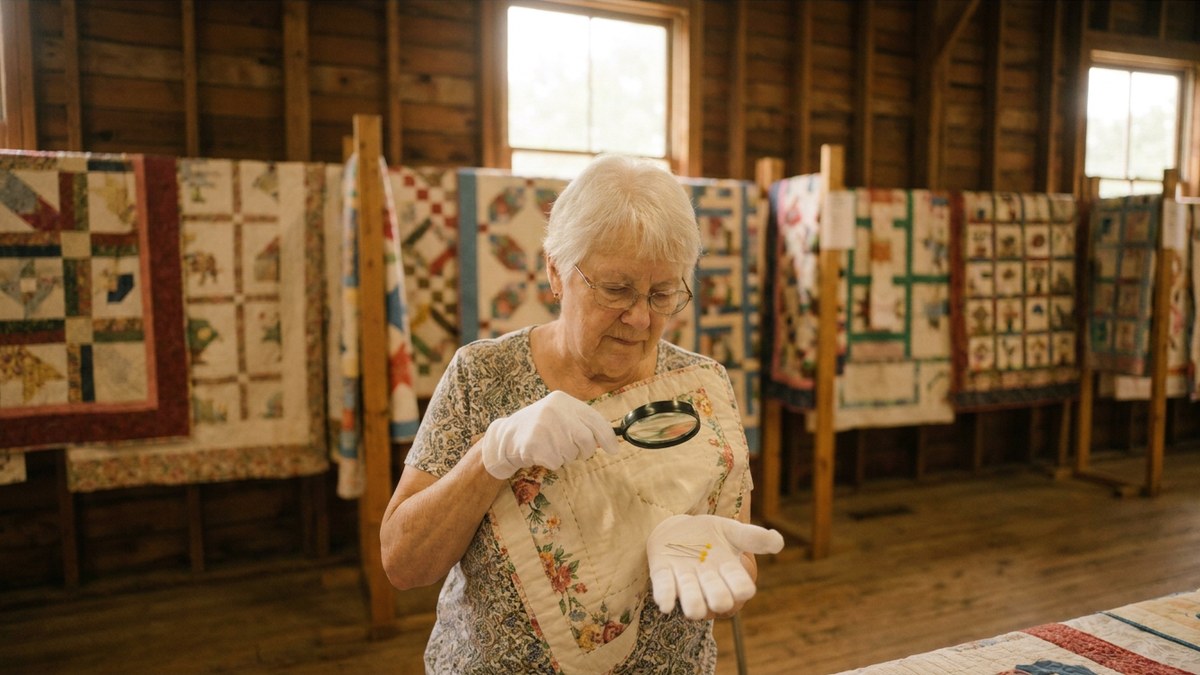
She had judged this show on Friday morning, alone, with a clipboard and white cotton gloves and a magnifying glass on a cord around her neck.
"Prairie Roses" had been the best quilt in the building by a long way. A queen-size medallion quilt. Twelve hand-pieced rose blocks in the center, so precise that the points met like the ends of a compass. Then a wide machine-pieced border, and hand quilting over all of it, feathers and cables, nine stitches to the inch.
She'd given it the ribbon without a second thought.
Then Bernice Hartwig had come to the award table at noon, and cried, and hugged Wilma, and told the reporter from the Clayborne paper that every stitch of it was hers. "Two years," she'd said. "Two years of my life in that quilt."
And Wilma, standing behind her, had thought for no reason at all about Alma.
Alma Hartwig had been Bernice's sister-in-law. She'd also been Wilma's closest friend in the guild for forty years, until she died last October.
Alma was left-handed. It showed in her hand piecing if you knew where to look.
A right-handed quilter's running stitches lean one way, and Alma's always leaned the other, like grass in a wind from the west. Wilma used to tease her about it.
Wilma had noticed something like that in the rose blocks on Friday morning. She'd noticed it, and written down nine stitches to the inch, and moved on to the borders. Plenty of quilters were left-handed.
Now she stood in front of the empty stand, and she thought about it again.
The sheriff sent a young deputy named Ostrowski at eight. He walked the building and checked the windows and the back doors, and looked at the keypad, and wrote things in a notebook. He checked the trunks of the vendors' cars in the lot, politely, with the vendors' permission.
Nothing.
Bernice arrived at eight thirty, and when she saw the empty rod, she sat down on a folding chair and put her face in her hands.
"Who would do this?" she said. "Who would do this to me?"
Wilma sat with her. Pat brought tea. The doors opened at nine and the visitors came in, and the show went on around the empty stand, because there wasn't anything else to do.
At ten, Wilma saw Gracie Moeller.
Gracie was fifteen. She was Alma's granddaughter, a tall quiet girl with her grandmother's dark eyes, and she was working the show as a white-glove volunteer.
Her job was to walk the aisles in white cotton gloves and turn back the corners of quilts so visitors could see the backs without touching. She'd done it at every show since she was twelve.
She was standing at the far end of the hall in her gloves, looking at the empty stand from a long way off. When she saw Wilma watching, she turned and walked quickly the other way.
Wilma had taught Gracie to hand piece when she was ten. So had Alma, the same summer, at the same kitchen table. Gracie had been left-handed too.
The show closed at five. Pat locked the building at six, and checked the door twice, and then a third time while Deputy Ostrowski watched.
Wilma went home and didn't sleep much.
On Sunday morning, she was back at the hall at seven, before Pat. She waited in her car until Pat came. They went in together.
The judge's display was at the near end of the hall. It was a tradition at the Linden County show.
The judge hung one of her own quilts, not for competition, just to show. This year Wilma had hung her Double Wedding Ring, the one she'd made for her own fortieth anniversary.
Pat stopped so suddenly that Wilma nearly walked into her.
Pinned to the center of the Double Wedding Ring, with four yellow glass-headed pins, was a single square of fabric. A rose block. Hand pieced, the points meeting like the ends of a compass.
It had come out of "Prairie Roses."
Not torn, and not cut. Taken out of the quilt top by hand, every seam and quilting stitch picked loose one at a time, so carefully that the edges were perfectly clean.
Wilma knew those pins. She'd seen them in a red tomato pincushion on Alma Hartwig's sewing table for forty years.