Wilma unpinned the block with her gloves on and carried it to the window.
Pat was already reaching for her phone to call Deputy Ostrowski. Wilma put a hand on her arm.
"Give me one hour," she said. "If I'm wrong, you can call the whole sheriff's department."
Pat looked at her for a long moment and put the phone away.
Wilma turned the rose block over and held her magnifying glass to the back.
The seams of a hand-pieced block tell you almost everything about the hands that made it. How tight the stitches are. How even.
Whether the quilter knots at the start or takes a backstitch. Which way the thread leans.
These stitches were fourteen to the inch. Tiny and perfectly even, and every one of them leaning the other way, like grass in a wind from the west.
And in the seam allowance at the bottom corner, where only a quilter would ever look, there was a single letter worked in thread the same color as the fabric. A small A.
Wilma sat down on the edge of the stage.
Alma had signed every block she ever pieced that way, for sixty years. She'd told Wilma about it once, at a retreat in Amana, a little embarrassed.
It's just for me, she'd said. So I know which ones are mine.
Bernice had said every stitch was hers. But Bernice was right-handed, and Bernice had never pieced a block by hand in her life. She'd always said she didn't have the patience.
Then Wilma thought about the quilt itself.
Picking one block out of a finished quilt, by hand, without leaving a mark, would take most of a night. You'd need good light and small scissors and a seam ripper and steady hands. You'd need to know exactly where the quilting crossed the seams.
You couldn't do it in a car, or a closet, or a hurry.
And the deputy had searched every car. And the lock had never been broken. And the clips on the rod had been closed up neatly, one at a time, by somebody who'd been taught to leave a show the way she found it.
The deputy had looked in the volunteer room on Saturday. He'd seen a row of plastic tubs full of white garment bags, which is exactly what a volunteer room at a quilt show looks like.
Wilma stood up and walked to the back of the exhibit hall, to the volunteer room, where the white-glove volunteers kept their coats and their lunches and the big plastic tubs of garment bags for packing quilts at the end of the show.
Gracie Moeller was sitting at the folding table with her gloves in her lap.
She didn't look surprised to see Wilma. She looked like she'd been waiting.
"It never left the building," Wilma said quietly. "Did it."
Gracie shook her head. She got up and went to the last tub at the end of the row, under three empty garment bags, and lifted out a long white cotton bag and laid it on the table. Inside, folded the right way, with tissue paper between the folds the way Wilma herself had taught the volunteers, was "Prairie Roses."
There was a square hole in the center of the quilt top, as clean as a window.
"I stayed after Pat locked up Friday night," Gracie said. Her voice was very small. "I hid in here. I took it down and did the block in here, all night, and went out the back door at five. It locks behind you. Then I came back in at nine with the other volunteers. Last night I was the last one out, so I pinned the block to your quilt on my way."
"Why, honey?"
Gracie looked at the hole in the quilt.
"Grandma made the roses," she said. "All twelve. She did them two summers ago, after her hands started shaking. She said it was her last big one. When she got too sick to finish it, she asked Aunt Bernice to do the border and the quilting." Gracie wiped her eyes with the back of her wrist. "And Aunt Bernice did. She did a good job. But then she entered it with only her name. And she got the ribbon, and she told the paper every stitch was hers, and I stood right there and heard her."
"So you took it."
"I didn't know what else to do. I'm fifteen. Grown-ups don't listen to me." Gracie looked up at her. "But you knew Grandma's stitches. I knew you'd look at the back. I just needed you to look."
Wilma found Bernice in the parking lot at eight thirty, sitting in her car.
She didn't make a scene. She got into the passenger seat and set the rose block on the dashboard, back side up, with the little A in the corner.
Bernice looked at it for a long time. Then she started to cry, not the way she had on Saturday, but quietly, the way people do when they've been carrying something heavy for a while.
"I meant to put her name on it," she said. "I did. The entry form only had one line. And then I thought, Alma won Best of Show in this county seven times. I never won it once. Not once in fifty years." She pressed her hand over her mouth. "I put two years into that border and that quilting, Wilma. I wanted one ribbon. Just one, that was mine."
"You earned half of one," Wilma said gently. "That's a lot of ribbon, Bernice. That quilting is the best I've seen in this county in ten years."
Bernice laughed through her tears. "You'd say that anyway."
"I wouldn't. I'm the judge."
The ribbon stood. Wilma made sure of it, and Pat agreed, and the guild officers agreed.
Pat didn't call the sheriff. Gracie apologized to Pat in person and volunteered to run the white-glove table for the next two shows, which Pat said was a punishment for Pat as much as anybody.
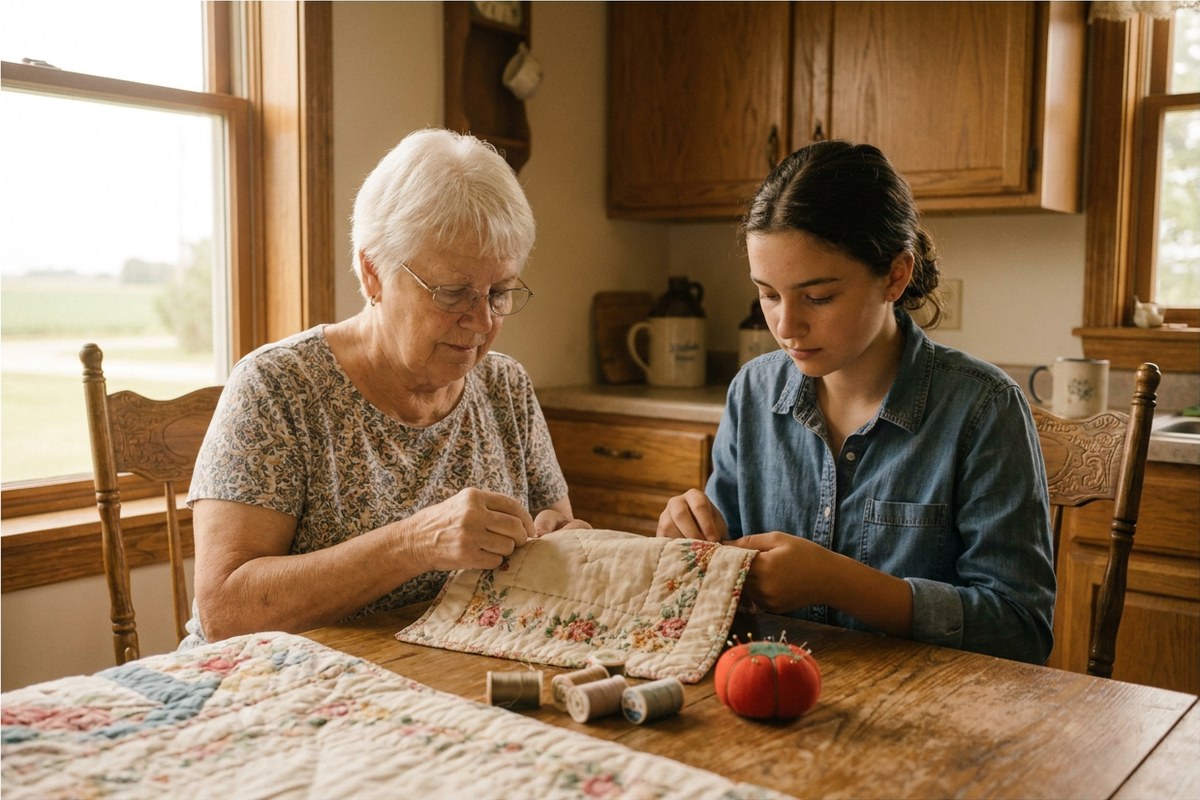
That week Gracie and Bernice sat at Bernice's kitchen table in Clayborne, and Gracie stitched her grandmother's rose block back into the quilt by hand, left-handed, while Bernice quilted the feathers back over it.
Then they made a new label together and stitched it to the back corner.
At the state guild show in Des Moines that summer, "Prairie Roses" hung in the front row with a blue ribbon on the rod above it. In the bottom corner, where anybody could turn it back with a white glove and read it, were two names in careful thread.
Pieced by Alma Hartwig. Quilted by Bernice Hartwig.
And below them, in Gracie's left-handed stitches, very small, a single letter that only two quilters in the room would know to look for. A.