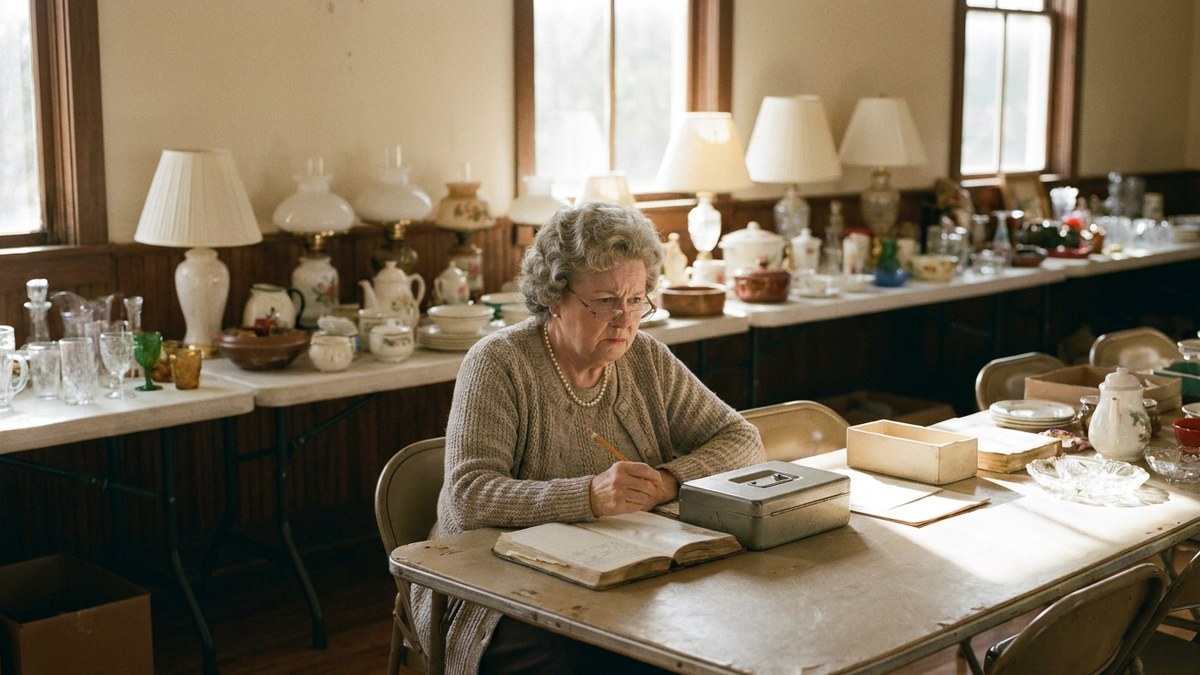
The cash box came up eleven dollars and forty cents short the first Saturday, twenty-three dollars and fifteen cents short the second, and on the third Saturday, it was off by exactly forty-two dollars and eighty-five cents.
Lorene Pettis wrote each number in her ledger in pencil, and underlined it twice.
She'd been the church secretary at Shiloh Crossroads Baptist in Cotton Creek, Georgia, for thirty-four years. She'd kept the books for every bake sale, every Vacation Bible School, every building fund, every wedding, and every funeral dinner since 1992. She had never once had a cash box come up short.
She was sixty-six years old, and now she'd had three in a row.
The spring rummage sale ran every Saturday in Lent, from eight in the morning until two in the afternoon, in the fellowship hall. It was the biggest fundraiser of the year. The money went to the youth group's summer mission trip to rebuild flood houses in eastern Kentucky.
Folks in Cotton Creek gave all winter. Furniture, clothes, dishes, lamps, old books, a church organ once. On Saturdays, the fellowship hall filled up with folding tables and bargain hunters from three counties.
Lorene ran the cash box. She always had. She sat at a card table by the door with a gray metal box and a ledger and a roll of masking tape for price stickers, and she counted the money in and out like it was gold.
She started each Saturday with a hundred dollars in small bills in the box for change. She counted it at the end of the day, before she gave it to the treasurer. Every Saturday in her life, it had matched her ledger to the penny.
Now, three Saturdays running, it didn't.
"Somebody's stealing from the Lord," said Brother Hollis Odom, who was a deacon, when she told him after church. "In the Lord's own house."
"Maybe," Lorene said.
"What else could it be?"
Lorene didn't say. She was looking at her ledger.
She'd noticed something on the second Saturday, and she was sure of it by the third. If somebody was stealing, they were a strange kind of thief.
A thief takes bills. Twenties, tens. Round numbers that fold easy and fit in a pocket.
But every shortage in her ledger had cents in it. Eleven-forty. Twenty-three fifteen.
Forty-two eighty-five. Somebody hadn't just been grabbing money. Somebody had been counting out an exact amount, coins and all, the way you'd count it out to pay for something.
The second thing she noticed was the time.
Lorene took her lunch every Saturday at 11:30. She went to her car and ate a pimento cheese sandwich and listened to the gospel station for half an hour. While she was gone, someone else watched the cash box.
That someone was Marvella Odom, the deacon's wife.
Marvella was sixty-eight, round and sweet and kind, and she'd sung alto in the choir for forty years. She'd brought a casserole to every sick family in Cotton Creek since the Carter administration. Lorene had known her all her life.
Lorene sat at her kitchen table on Sunday night and looked at the ledger for a long time, and she didn't like where her mind kept going.
The third thing she noticed was on the church prayer list.
It was printed in the bulletin every Sunday. Lorene typed it herself. There were the usual names on it that spring.
Sister Bea's knee replacement. The Collier baby. A young man in the Army overseas.
And near the bottom, for the last six weeks, one line that Lorene had typed without really thinking about it.
Pray for Brother Willis Dukes, insurance troubles.
Willis Dukes was eighty-four. He lived alone in a little white house on the road out of town, right next door to the Odoms.
He'd been a deacon himself, years ago, before his eyes went. His wife had passed in 2019.
Lorene remembered something else. The Cotton Creek Pharmacy, on the square, closed at noon on Saturdays.
She didn't want to do it. She did it anyway, because thirty-four years of keeping the Lord's books had taught her that wanting not to know a thing was never a good enough reason.
On the fourth Saturday of Lent, before the doors opened at eight, she took the hundred dollars of change out of the gray metal box. She sat at her card table and copied the serial number of every bill onto a sheet of notebook paper. Then she put the bills back, closed the box, and folded the paper into her purse.
At 11:30, she went out to her car for lunch, the same as always.
She didn't eat her sandwich. She sat with the engine off, where she could see the fellowship hall door through the windshield.
At 11:41, Marvella Odom came out of the fellowship hall with her purse on her arm, walking fast. She got into her old Buick, backed out of the lot, and turned toward the square.
Lorene watched her go. Her stomach went cold.
At 11:58, Marvella's Buick pulled back into the lot. Marvella hurried inside.
Lorene sat in her car for another five minutes. Then she went back in, sat down at her card table, and opened the cash box with her hands not quite steady. She counted.
Thirty-eight dollars and sixty cents short. Two of the twenties on her list were gone.
The fellowship hall door opened behind her. It was Brother Hollis Odom, Marvella's husband, with the pastor right behind him.
"Lorene," the pastor said quietly. "Hollis tells me the deacons want to call the sheriff about the cash box. They want to know who's been minding it."
Lorene looked at her list of serial numbers. Then at Brother Hollis, who had no idea in the world what he was asking.
She closed her purse.