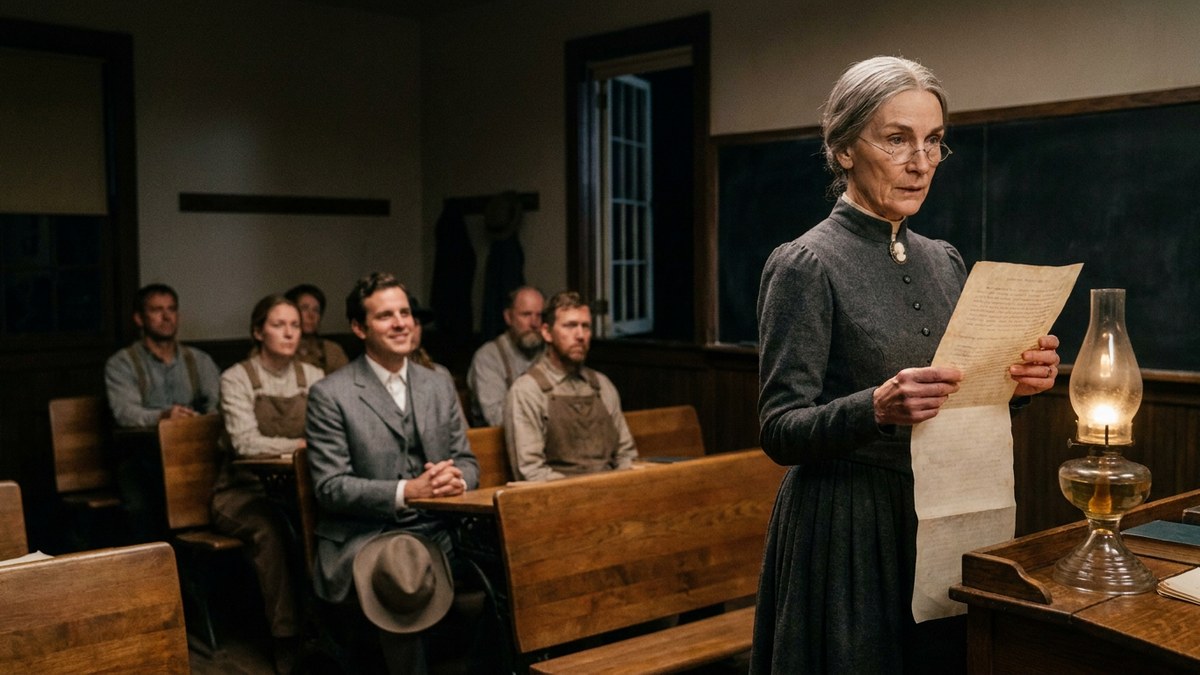
Adelaide did not need to read it. She knew her own handwriting from across a room.
Every head in the schoolhouse turned toward her. Gus Marten looked at his boots.
She took off her spectacles and folded them, very carefully, and set them on the desk.
"Read it, Mr. Fane," she said. "I'd like to hear it said properly."
He read it. Adelaide Corwin, Liberty Township, the fifth of June, 1882.
When he finished, he smiled at the room.
"It seems even the schoolteacher signs what she's shown," he said.
"She does," Adelaide said. "On her own porch, without her spectacles, because a stranger said something kind about her schoolhouse. I have told every child in this room not to sign a paper they had not read in full. I didn't follow my own lesson. That is the plain truth, and you may all hold it against me as long as you like."
Nobody in the room said a word.
"But I'll tell you what I learned," she went on, "sitting up last night with twenty-three orders and a lamp. It isn't the order that will ruin you. It's the note."
She picked up one of the promissory notes and held it up.
"Mr. Fane can't collect these himself and stay in Iowa," she said. "He doesn't mean to. His foreman carries them to the bank at Marshalltown on Saturday morning and sells them for cash. Once the bank has paid for them in good faith, the bank can collect from each of you. And Mr. Fane is in Missouri by then."
She looked around the room.
"Saturday morning," she said. "So we have tonight and tomorrow."
Gus stood up in his child's desk, which nearly came up with him.
"What do we do, Miss Corwin?"
"We get there first," she said.
She made the plan the way she used to make a lesson. On the blackboard, in chalk, with a number by each line.
One. The two fastest horses in the township to Marshalltown tonight, Gus Marten and the Kessler boy, with a letter in her hand to every banker in town. The letter would list every name, every note, every amount, and say plainly that each note had been got by a false promise and would be disputed in court.
Two. A rider to the depot at Le Grand, to telegraph the same message to the banks at Tama and Grinnell, in case the foreman went the other way.
Three. Every man would write down, tonight, in his own words, exactly what Fane had promised him at his gate. She would help any man who wanted help. Twenty-three statements, signed in front of the Grange master.
Four. Nobody would pay a single cent until they had all met again.
"And five," Adelaide said, with the chalk still in her hand. "Not one of you will be ashamed of being fooled. I was fooled first."
Dexter Fane did not stay for the statements. Somewhere around number three he put his hat on and walked out into the dark.
The old man who had sat in the back of the room all evening did not leave with him.
His name was Lyman Shaw. He was the foreman of the third crew, nearly seventy, gray as a mule, and he had not said a word all night. He came up to the desk while the others were writing.
"Ma'am," he said. "I put up rods for forty years before I worked for that man. I did it honest. I want you to know the rods are good copper and good work. Every one of them will carry a strike to ground."
"I believe you," Adelaide said.
"I didn't know about the small print. Not until the first bill. And then I told myself it wasn't my business, because I was paid by the foot."
He put his own copy of the crew's tally book down on the desk.
"There's every foot we put up, and every house," he said. "If it helps you."
It helped.
Gus and the Kessler boy reached Marshalltown at four in the morning and woke two bankers in their nightshirts.
When Fane's foreman walked into the First Bank on Saturday at nine o'clock with a satchel of notes, the cashier had Adelaide's letter in his hand. So did the cashier at the second bank. So did the cashiers at Tama and Grinnell, by telegraph.
Nobody would buy a single note.
By Monday the foreman was willing to talk. Lyman Shaw's tally book told the Grange exactly what the rods had cost to put up. The township settled the whole business in the schoolhouse, in one evening: every farmer paid the seventeen dollars he had been promised, and not a penny more. Any man who wanted the extra rods taken down could have them taken down. Most kept them.
Fane's company got its seventeen dollars a house. It did not come back to Liberty Township.
Lyman Shaw stayed.
The Grange hired him for the rest of the summer to check every rod in the township, ground the cables right, and fix what the crews had done in a hurry. He boarded with Gus Marten. In August he put a single rod on the schoolhouse, free, and would not take a cent for it.
Adelaide paid her own seventeen dollars on the first of July. She counted it out at Lyman's table on the Martens' porch, and she read his receipt before she signed it. Every line. Twice.
Then she took out her red pencil and corrected his spelling of "received."
> What really happened: In the 1870s and 1880s, as Midwest farm families built frame houses, traveling lightning rod salesmen sold thousands of rods door to door, and some ran a well-known swindle. A first man promised a cheap rod "as an advertisement," the farmer signed an order with a hidden per-foot price, and a second crew installed far more rod and asked for a large promissory note. Farm papers warned readers, and some farmers protected themselves by quickly notifying local banks not to buy the notes. Sources: History Nebraska (Nebraska State Historical Society); Tyrone Herald, 1891.