Part 2
She found him at the gap, a little after midnight, because his horse had left a trail and the wind had not yet filled it.
He was lying at the foot of a cutbank in a coulee below the ridge, curled up in the lee of the bank where the wind could not quite reach, half buried in drifted snow. The bay had slipped on the ice at the edge of the coulee and gone down with him, and rolled, and got up and run. Asa had not got up.
His left leg was broken below the knee. She could see it, even in the lantern light, the wrong angle of it under his trouser.
"Lettie," he said, when the light touched his face. His lips were blue. "You shouldn't have come."
"Hush," said Lettie Shaw. "I'm here now."
It took her an hour to get him on her horse.
She splinted the leg first, with his rifle and the scabbard and strips cut from her petticoat, while he told her through his teeth what to do and where to pull. She gave him the whiskey. Then she got her shoulder under his arm and her horse down on its side in the snow, the way he had once shown her a man could make a horse lie down, and rolled him into the saddle, and tied him there with the rope.
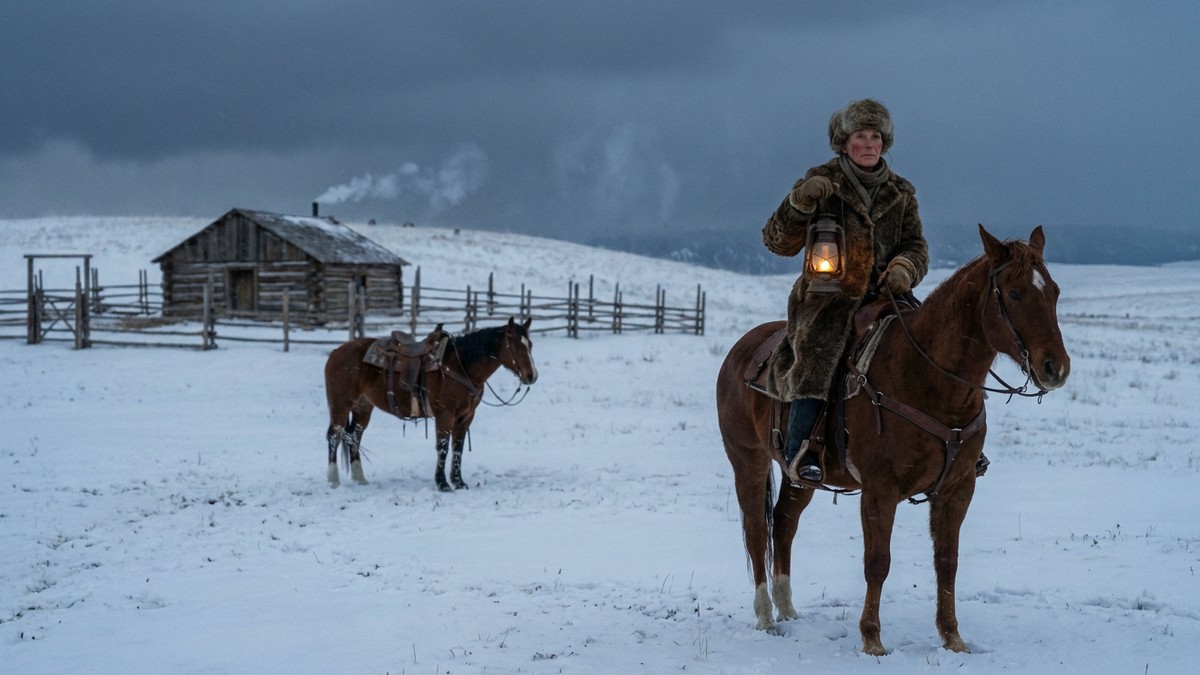
Then she led the horse home. Six miles, on foot, along the ridge, into the wind, with the lantern and the snow.
They reached the cabin at dawn. She could not remember the last two miles.
The leg was a clean break, Asa said, when he could talk again. It would knit, if he kept off it. Six weeks. Eight.
"And the line?" said Lettie.
Asa looked at her from the bunk.
"Nobody's riding it," he said. "Nobody will till March. The cattle will drift south with every storm, and Ridley will lose half of them in the breaks, and it'll be my fault." He closed his eyes. "Thirty-five years, and I never lost a line."
Lettie pulled on the buffalo coat.
Then she went out and saddled the bay.
She rode the line every day for nine weeks.
East along the ridge, twelve miles, to the stone cairn. Then back. Twenty-four miles a day. She left in the dark and came home in the dark, and in between she cooked and cut wood and hauled water and changed Asa's splint and fed him and fed the horses.
She turned the cattle as he had taught her. Slow. Always slow. From the downwind side, with her horse, not her voice. At night she told him every cow she had seen and where, and he lay in the bunk and listened and told her where they would be tomorrow.
He was nearly always right.
In the third week of February, the worst storm of the winter came down out of the north. Three days of it, without stopping. Lettie rode out into it on the first morning, because Asa said the big bunch would be at the gap, and they were. Four hundred head, bawling, heads down, moving south with the wind toward the breaks and the river ice.
She turned them. Alone. It took her all day, back and forth across the gap in the blowing snow, slow, always slow, until her face was frozen and her horse was staggering. She turned them into the shelter of the north coulees, and she came home in the dark with her eyelashes frozen together, and Asa had to talk her through getting off the horse.
At the beginning of March, the leg was knitting, but Asa had a fever.
It came and went. Some days he was clear. Some nights he did not know her. The flour was low. The bacon was gone. And there would be no wagon for a month.
On the night of the fifth of March, Lettie took the axe.
She took the poles from the second bunk, and lashed them into a travois, the long sledge the Lakota and the Crow used, two poles with a platform of rawhide and canvas between them. She hitched it behind the bay. She laid Asa on it in every blanket they owned, under the buffalo coat, and tied him down.
Then she closed the door of the Antelope Springs line camp and turned north.
Forty miles. Three days. She walked most of it, leading the bay, with her own horse following. She camped two nights in the snow in the lee of cutbanks, with a fire and the horses close for warmth, and lay down next to Asa on the travois under the buffalo coat. On the third evening, she came over the last rise and saw the Bar T headquarters below her on the river, with smoke coming out of the chimneys.
Sam Ridley came out on the porch and stared.
Asa's fever broke at headquarters, in a real bed, with a doctor sent for from Buffalo. The leg healed crooked, but it healed. He walked with a cane after that.
At the spring roundup in May, the Bar T counted its cattle. It had been a hard winter. Every line had lost cattle in the breaks to the south. Every line but one.
Sam Ridley came to the bunkhouse where Lettie and Asa were staying, with his hat in one hand and an envelope in the other.
"Mrs. Shaw," he said. "I told you a line camp was no place for a woman."
"You did."
"The Antelope Springs line lost eleven head this winter. Eleven. Every other line lost two hundred or more." He held out the envelope. "That's forty dollars a month, from the twenty-eighth of December. In your name. Not Asa's."
Lettie took it. She looked at Asa.
"And next winter?" said Asa, from his chair.
Ridley put his hat back on.
"Next winter," he said, "I'm sending two riders to Antelope Springs. Same as always." He nodded at Lettie. "Mrs. Shaw, and her husband."