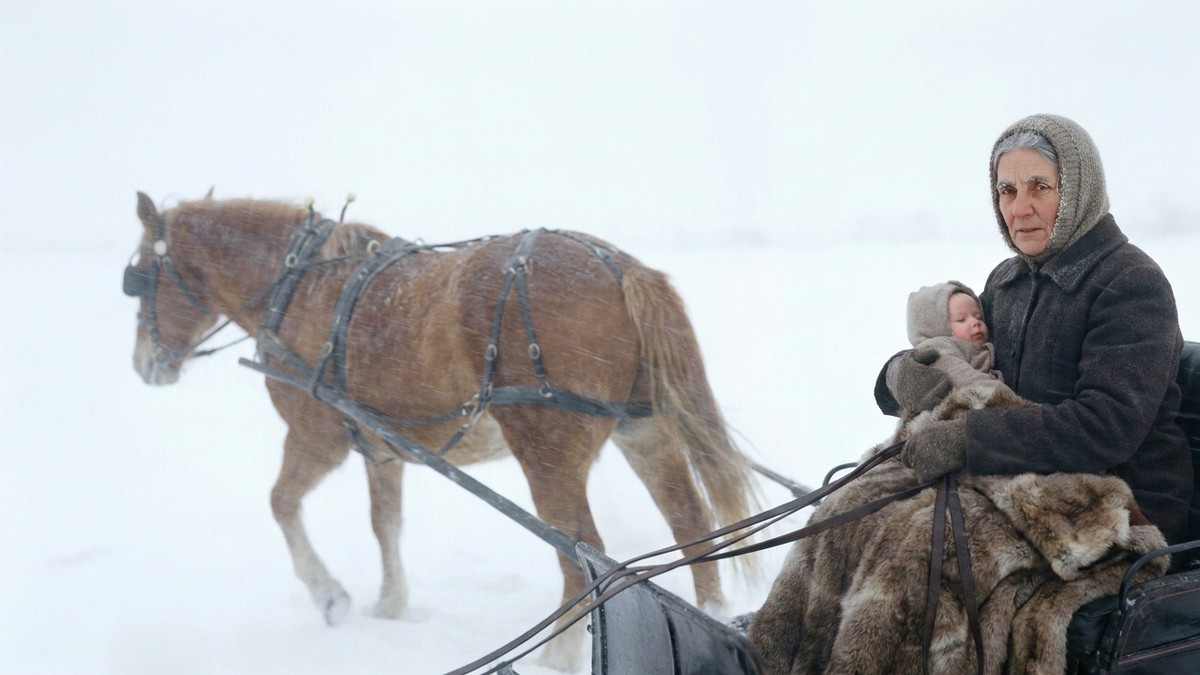
Part 1
Ezra Bower had tried to sell the old mare for two years, and his wife Clarissa had talked him out of it every time.
It was January 1888, on a quarter section of corn and wheat in Saline County, Nebraska, six miles north of the town of Dorchester. The Bowers had come out from Ohio in 1872 and built a frame house, a barn, a windbreak of cottonwoods, and a life. Their son had married and taken a farm of his own two miles east. Their daughter Mary had married and gone to Lincoln, and in the fall of 1887 she had come home to have her first baby, and stayed on for the winter with her mother.
Clarissa was fifty-eight. She was small and brisk, with sharp brown eyes and gray hair scraped back under a knitted hood, and very firm opinions about horses.
The mare's name was Dolly.
Dolly was twenty-two years old. A big, plain, rawboned sorrel with a white blaze and one ear that flopped. She had pulled the Bowers' wagon all the way from Ohio. She had broken the first sod on the quarter section. She had carried both their children to school for ten years, two at a time, bareback.
Now she was slow. She was stiff in the mornings. She ate as much as a young horse and did half the work.
"She's useless, Clarissa," said Ezra. "Worse than useless. She's a mouth. Let me sell her to the Hansen boy for twenty dollars and buy a horse that can pull a buggy faster than a man can walk."
"She's not useless," said Clarissa. "She's old. There's a difference, Ezra. You'll learn it yourself one day."
"She doesn't know her own mind anymore. Last week she tried to turn into the Kruger lane. Wouldn't go straight for the reins at all."
"She thought we were going to the Krugers'. We used to go there every Sunday."
Ezra threw up his hands. But he did not sell the mare.
Clarissa had a reason for keeping Dolly that she had never quite explained to Ezra, because he would have laughed.
It was something her father had told her. Her father had been a plainsman in his youth, a freighter on the Santa Fe Trail in the 1830s, and he had driven mules and horses through every kind of weather between Missouri and New Mexico.
"Clarrie," he had said once, when she was a girl, "if you're ever caught out in a whiteout, where you can't see your horse's ears, there's one thing you do. You give that horse its head. Let the reins go slack. Don't steer her. Don't think you know better. A horse knows the way to her own barn better than you know your own name. Trust her. She'll take you home."
Clarissa had been a girl in Ohio, where there were no whiteouts, and she had never needed it. But she had never forgotten it.
The twelfth of January, 1888, began as the warmest day in weeks.
After a long bitter cold spell, the morning came up soft and gray and almost mild. The snow on the fields was melting at the edges. The men went out to do chores in their shirtsleeves. Children all over Nebraska walked to school without their heavy coats.
And at nine o'clock that morning, Mary's baby, Jenny, three months old, began to cough.
It was a bad cough. A hard, barking, croupy cough that turned her little face dark red and left her gasping. Clarissa had heard croup before. She did not like the sound of this.
"Dr. Pell," she said. "In Dorchester. I'll take her."
Ezra had taken the team and the wagon to their son's place that morning, to help butcher hogs, and would not be back till chores. There was only Dolly in the barn. Clarissa hitched her to the buggy, and bundled Jenny in two shawls and a fur robe, and left Mary at home in bed with a fever of her own, and drove the six miles to Dorchester in the mild gray morning.
Dr. Pell gave her a bottle of syrup and a steam kettle, and showed her how to make a tent over the baby's cradle with a sheet. It would pass, he said. Keep her warm. Keep the steam going.
Clarissa started home at a quarter past two.
At half past three, three miles from home, the sky to the northwest went black.
It came up over the horizon like a wall. A great, rolling, blue-black cloud, low to the ground, moving faster than any cloud Clarissa had ever seen. Before she could even turn the buggy, she heard it. A roar, like a train.
Then it hit.
The wind struck the buggy broadside so hard it nearly went over. The air was full of snow. Not falling snow. Driven snow, fine as flour, hard as sand, coming sideways out of the northwest in a solid white wall. The temperature dropped like a stone. In ten minutes, Clarissa could not see the road. In twenty, she could not see the fence posts. In half an hour, she could not see Dolly's ears in front of her.
She could not see her own hands on the reins.
She had the baby inside her coat, against her chest, wrapped in the robe. She could feel Jenny breathing. Rough, rattling, but breathing.
Clarissa sat on the buggy seat in the white roar, three miles from home, with her heart pounding.
And then she heard her father's voice, as clear as if he were sitting beside her on the seat.
Give that horse its head, Clarrie.
Clarissa Bower took a breath. And she let the reins go slack.