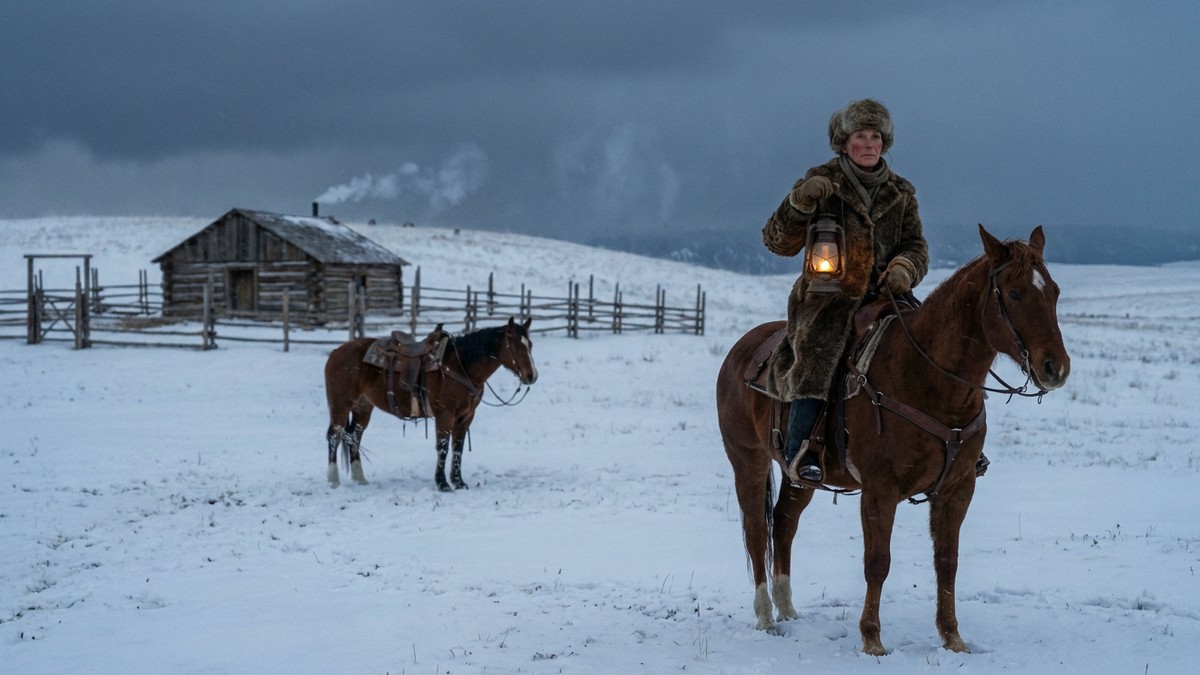
Part 1
The foreman of the Bar T told Lettie Shaw that a line camp was no place for a woman, and Lettie went anyway.
It was November 1883, in Wyoming Territory, on the open range along the Powder River, where the big cattle outfits turned their herds loose on the grass all winter and hoped for the best. The Bar T ran eleven thousand head. Its headquarters sat on the river. Forty miles south, on a bare ridge above a frozen creek, stood a one-room log cabin called the Antelope Springs line camp.
Every winter, the Bar T sent two men to live there from November to April. Their job was to ride the line, the long invisible boundary between the Bar T range and the open country to the south, and turn back every cow that tried to drift across it. Cattle drifted with the wind, in winter. If nobody turned them, they drifted south into the badlands and the breaks, and froze, or starved, or fell through the river ice, and were lost.
This winter, the Bar T sent Asa Shaw. And Asa took his wife.
Lettie was fifty-six. Asa was sixty-one. They had been married thirty-five years, and he had been a cowhand for every one of them. They had no children living, no land, and no savings. They had each other, and two good horses, and Asa's wages of forty dollars a month.
"I'm not saying it to be hard, Mrs. Shaw," said the foreman, Sam Ridley, at headquarters. He was a big, weathered, sensible man of forty-five. "I'm saying it because nobody can reach you down there. Once the snow comes, there's no wagon in or out till March. If anything goes wrong, you're on your own. Forty miles on your own."
"I've been on my own before, Mr. Ridley," said Lettie. "I'd sooner be on my own with Asa than on my own without him."
Ridley looked at Asa. Asa shrugged.
"She can ride as well as I can," he said. "Better, some days."
So Ridley hired Asa, and only Asa, and paid Asa's wages, and let Lettie come along.
The line camp was twelve feet by fourteen. A dirt floor. One window, with greased paper instead of glass. A sheet-iron stove, two bunks, a table, a shelf of supplies. Outside, a pole corral, a lean-to shed, a stack of hay, and a woodpile.
The supplies had been hauled down in October and had to last till spring. Flour, beans, bacon, coffee, sugar, dried apples, a crock of lard, a sack of potatoes, two boxes of cartridges.
Every morning, before light, Asa saddled his horse and rode the line. East along the ridge, twelve miles, to the stone cairn that marked where the next camp's line began. Then back again. Twenty-four miles a day, in any weather, turning back every cow and steer that had drifted south in the night.
Lettie kept the camp. She cut wood. She hauled water from the hole Asa chopped in the creek ice. She baked bread in a Dutch oven on the stove. And she listened to the silence.
She had never known silence like it. No birds. No wind, some days. No voices, nothing but the snow and the sky and the creak of the stove. Some evenings she stood in the door of the cabin and looked south across the white and could not see a single thing that a human being had made.
She hated it, at first. Then she did not. By Christmas she could tell the hour by the color of the snow.
Some days she rode with him.
Asa showed her where the cattle liked to cross. The coulees they followed. The gap in the ridge where the wind funneled down and pushed them south in a storm. How to come at a bunch of them from the downwind side and turn them back without running them, because a running cow in deep snow could burst her lungs.
"Slow," he said. "Always slow, Lettie. You turn 'em with your horse, not your voice."
She learned it. She had always been a quick learner.
On the twenty-eighth of December, the weather turned.
It had been clear and still for a week, bitter cold, with the snow squeaking under the horses' hooves. That morning, the sky in the north went the color of slate, and the wind came up.
Asa saddled up as usual.
"It'll blow tonight," he said. "Cattle will move. I want to turn the big bunch at the gap before it gets bad." He kissed her. "Back by dark."
He was not back by dark.
At dark, the wind was screaming and the snow was coming sideways, and Lettie stood in the door of the cabin with a lantern, staring east into nothing.
At nine o'clock, she heard a horse.
It was Asa's bay, coming in out of the storm alone, with its saddle twisted sideways and the reins trailing and ice on its legs to the knees.
Lettie set down the lantern. She went into the cabin and put on Asa's old buffalo coat, and his fur cap, and his heavy mittens. She took the second lantern and a coil of rope and the flask of whiskey from the shelf.
Then she went out to the corral and saddled her own horse, in the dark, in the screaming wind, and rode east along the ridge to look for him.