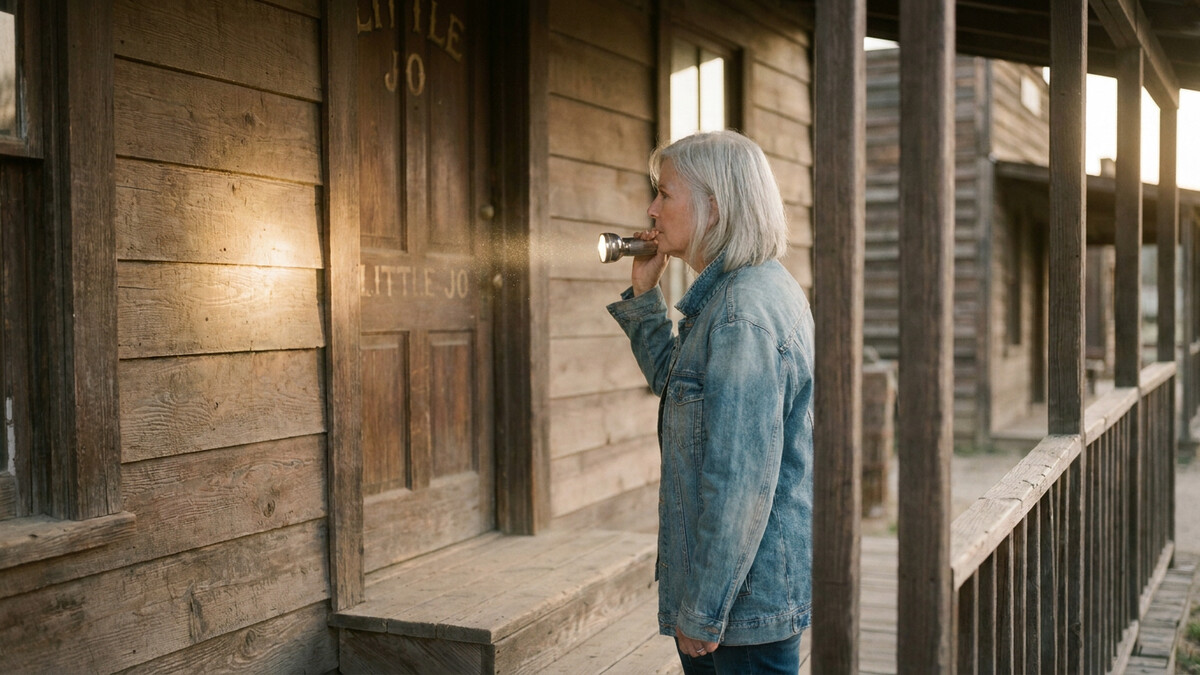
Jo sat down on the wooden chair. She did not mean to. Her legs just stopped holding her up.
She sat in Augie Marchetti's little room above the Silver Dollar for a long time, with the flashlight in her lap, looking at the jar.
Then she untied the red ribbon.
There were thirty-three letters. One for every Christmas from 1964 to 1996. Each one was dated. None had a stamp. None had an address beyond the four words on the front.
She opened the first.
Dear Little Jo. Your family left in such a hurry I didn't get to say goodbye. I asked at the mine office where your daddy went, but they didn't know. I have your jar. I'm keeping it safe. When you come back, it's here. Merry Christmas, kid. Augie.
She opened the second. 1965.
Dear Little Jo. The piano sits quiet now. The miners ask about you. I tell them you're in college. You will be someday. I put one more silver dollar in your jar for Christmas. Augie.
She opened them all, one after another, sitting in the dusty light from the one window.
Every year, a few lines. The town getting smaller. The miners going away. The mill shutting down. His sister in Las Vegas. His knees. A new pool table in 1978. A flood in 1983. The year the hotel closed. And every year, at the end, the same thing.
I put one more silver dollar in your jar for Christmas.
The last letter was from 1996. The handwriting was shaky now.
Dear Little Jo. I'm getting old. The doctor says my heart is no good. I want you to know I never spent a dime of your money. If I go before you come home, I'm leaving the key to this room with Father Delgado at St. Brendan's. It's all yours. You played "Moon River" better than Henry Mancini. Augie.
Jo put the letter down on the table and cried for the first time since her husband's funeral.
She called St. Brendan's that afternoon. Father Delgado had died in 2009. The parish was closed now, part of a bigger one in Austin, sixty miles away. The secretary there was kind and very sorry and had no idea about any key.
It did not matter. Jo had already opened the door.
She carried the jar downstairs that night. It took her three trips up and down the stairs to bring it down a little at a time, in coffee cans, because the whole thing was too heavy to lift. She spread a clean bar towel on the mahogany bar under the one working light and poured the coins out.
They rang on the wood like church bells.
Jo had counted money for thirty-eight years. She counted these the way she had been taught in the cage. Stacks of twenty. Faces up. Eyes on every coin.
Four hundred and eleven silver dollars.
She picked one up and held it to the light. Lady Liberty in profile, with her hair bound up. On the back, an eagle with spread wings. And below the eagle, above the word DOLLAR, two tiny letters.
CC.
Jo set it down very slowly.
She picked up another. Then another. She began sorting them into two piles on the bar towel. The ones with the little CC. And the ones without.
When she was done, the CC pile had seventy-three coins in it.
She sat on a dusty barstool and stared at them.
Every cage cashier in Nevada learned the CC by heart in their first week. It stood for the United States Mint in Carson City, Nevada, which had made silver dollars from 1878 to 1893, out of silver from the Comstock Lode. Not many were made. Fewer survived. Collectors paid a great deal for them, sometimes hundreds of dollars for an ordinary worn one, sometimes far more for a rare year.
In the 1960s, miners in Paradise Gulch had dropped them in a little girl's tip jar without looking. A silver dollar was a dollar.
Jo looked at the dates. Most of them were common. But she knew the dates, too. Every cage cashier in Nevada knew them.
Three of the coins in the pile were dated 1889.
She put her hand flat on the bar to steady herself.
She did not sell them right away. She drove them to a coin dealer in Reno whom the casino had trusted for twenty years, an old man named Mr. Feeney, and sat across from him while he looked at every one through a loupe.
It took him two hours. When he was done, he took off his glasses and rubbed his eyes.
"Mrs. Varga," he said. "Where did you get these?"
"Playing the piano," Jo said. "When I was nine."
He told her what they were worth.
It was enough for the roof. It was enough for the furnace and the wiring and the windows. It was enough to sand the mahogany bar, and tune the old piano, and open the doors of the Silver Dollar again.
It was not enough to keep. She did not want to keep it.
"It was always my college money," she said to Theresa on the phone that night. "Augie said so. I'm just going to use it for the school I want."
The new roof went on in February, a week ahead of the county deadline. The inspector came out, climbed a ladder, came back down, and signed the papers without a word. Then he stood in the doorway a while, looking at the long mahogany bar.
"My granddad drank here," he said finally. "When the mine was running."
"So did mine," Jo said.
The Silver Dollar reopened on the first Saturday in May. It was not quite a saloon anymore. Jo served coffee and pie and sandwiches and lemonade. On the wall behind the bar, in a frame, she hung Augie Marchetti's first letter, and below it, one silver dollar with a tiny CC on the back.
Theresa drove down from Reno with the grandchildren. About forty people came. Old folks who remembered the mine. Young families who did not. A few of the old miners' sons, gray-haired themselves now, standing at the bar the way their fathers had.
At two o'clock, Jo sat down at the old upright piano in the corner. It had been tuned for the first time in thirty years. The keys were yellow. The bench creaked.
On top of the piano, she set the big glass pickle jar. Empty, and washed clean.
"Any requests?" she asked the room.
There was a long silence. Then, from the end of the bar, an old man in a feed cap cleared his throat.
"My dad used to ask for 'Danny Boy,'" he said. "He said there was a little girl who played it here. He said she played it better than anybody."
Jo looked at him. Then she put her hands on the keys and played it.
When she finished, the old man walked up to the piano without a word, reached in his pocket, and dropped a silver dollar in the jar.
It rang against the glass. Jo did not look up. She just smiled, and started in on "Moon River."