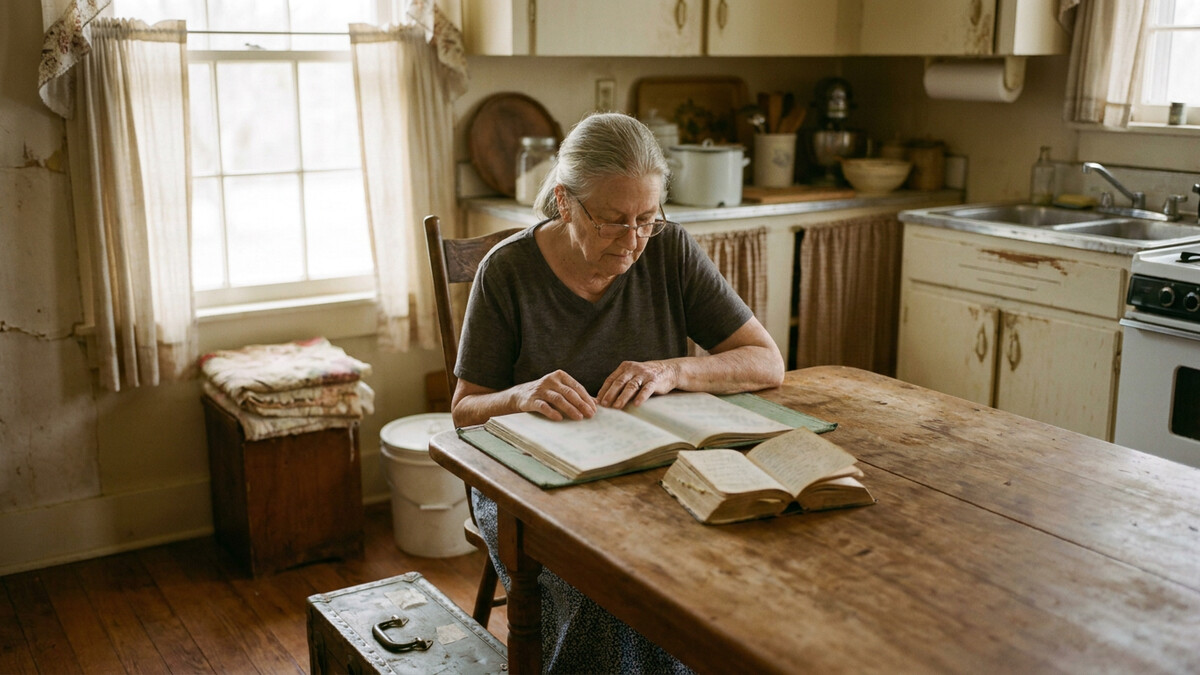
The Bluestone County sheriff's night ledger for 1974 had been missing from the courthouse for fifty-two years, and Imogene Fortney found it on a Tuesday afternoon in the bottom of her late husband's Army footlocker, wrapped in a feed sack, under his dress uniform.
She knew what it was the second she saw the green cloth cover. She had seen a hundred of them. She had typed up the reports that went into them for twenty-six years.
On the first page, in her husband's handwriting, it said: Deputy C. Fortney. Night shift. January to December 1974.
Her own name. Her family's name.
And a ledger the county had been looking for since the fall Peggy Ann Lusk disappeared.
Imogene was seventy-nine. She had been the dispatcher and stenographer for the Bluestone County sheriff's office in Coal Branch, West Virginia, from 1968 until 1994. She had taken down statements in Gregg shorthand faster than most people could talk. She had typed them up on an IBM Selectric with carbon copies in triplicate. She knew how a sheriff's office worked from the inside, the parts in the reports and the parts that were never written down.
Her husband, Clyde, had been a deputy from 1970 until his heart gave out in 2001.
He had been a quiet, good-natured man who whittled birds and sang bass in the Methodist choir. He had also, in the last twenty years of his life, been sad in a way she had never been able to reach. He would sit on the porch some nights and look down the hollow toward the river and not say anything at all.
She had always thought it was the war.
She opened the ledger on her kitchen table.
Anyone in Coal Branch over the age of sixty knew the story of Peggy Ann Lusk.
In November of 1974, she was twenty-three years old, a teller at the Coal Branch Savings and Loan, engaged to a boy from the tipple crew. On Friday, November 22, she closed out her window at six, put the day's cash deposit in a canvas bank bag to drop at the night depository in Bluestone, the county seat, eleven miles down the river road, and drove off in her blue 1971 Plymouth.
She never reached Bluestone.
The bank bag held forty-one thousand dollars. It was never found. Neither was the Plymouth. Neither was Peggy Ann.
The sheriff then was a man named Roy Harlow, brother of the man who owned Harlow Coal, the mine that ran the whole town. Sheriff Harlow said the evidence was clear. Peggy Ann had taken the money and run off, maybe to Ohio, maybe further. Her fiancé swore she would never do that. Her mother went to her grave in 1989 saying the same thing.
But the town had believed the sheriff. Towns usually do.
And when people asked to see the night ledger for November 22, 1974, the sheriff's office said it had gone missing in a basement flood.
Imogene turned to November.
Clyde's handwriting was neat and square. Times, calls, mileage. A domestic on Pruett Hollow. A cow on the river road. A drunk at the VFW.
November 22, 1974. Clyde had been on the night shift.
6:40 p.m. Patrol, River Road toward Bluestone.
7:15 p.m. Called to Bluestone Bridge by Sheriff Harlow.
7:20 p.m. Returned to station at sheriff's order.
And then nothing until 11:00 p.m. A blank space, the size of three or four lines.
But in the margin beside that blank space, written very small in pencil, there were marks Imogene had not seen in a long time. Little curves and hooks and slanted lines, joined together, running down the edge of the page like a strand of barbed wire.
She sat back in her chair.
It was Gregg shorthand.
She had taught it to Clyde herself. In the spring of 1966, when they were courting, at the Methodist church. She was nineteen and taking secretarial classes in Bluefield. He was twenty and thought it was the most wonderful thing he had ever seen, a secret alphabet. She taught him the basics so they could pass notes in the hymnal during the sermon without Preacher Akers catching them.
He had never been very good at it. His shorthand was clumsy, like a child's.
But it was readable. And there was not another soul in Coal Branch, or maybe in the whole county anymore, who could read it.
Imogene got out her reading glasses. Then she went to the bookshelf and got down her old Gregg dictionary, the green one from 1965, which she had not opened in thirty years. Her hands remembered it before her mind did.
She began to read.
The first line in the margin said: Saw headlights in river below bridge. Blue Plymouth.
The second said: Sheriff's nephew W. at the bridge. His truck. Front end smashed. Smelled of whiskey.
Imogene put her hand flat on the table.
W. would be Winston Harlow Jr., the mine owner's son. He had been thirty-five in 1974. The whole town knew he drank. He had died in a hunting accident in 1983. His son, Winston Harlow III, was now chairman of the county commission, a decent, quiet man in his sixties who had paid for the new roof on the library.
The third line said: Sheriff took bank bag from Plymouth before it went under. Told me go back to the station. Said if I said one word, I would never work in this county again. Said he would make sure Imogene lost her job too.
Imogene took off her glasses. She sat in her kitchen for a long time and listened to the clock.
Clyde had been twenty-eight years old, with a baby on the way and a wife who loved her job.
She put her glasses back on.
The last line in the margin was written in shorthand so small and shaky she had to hold the page up to the window to read it. It was not dated. It looked like it had been added much later, in a different pencil.
She read it twice. Then she read it a third time, because she did not want it to say what it said.
The money is in the Harlow Coal safe. The girl is in the river under the bridge. I was a coward. Imogene, if you ever read this, do what I couldn't.