Part 2
In the morning, Ansel Brandt did not go out to the fields.
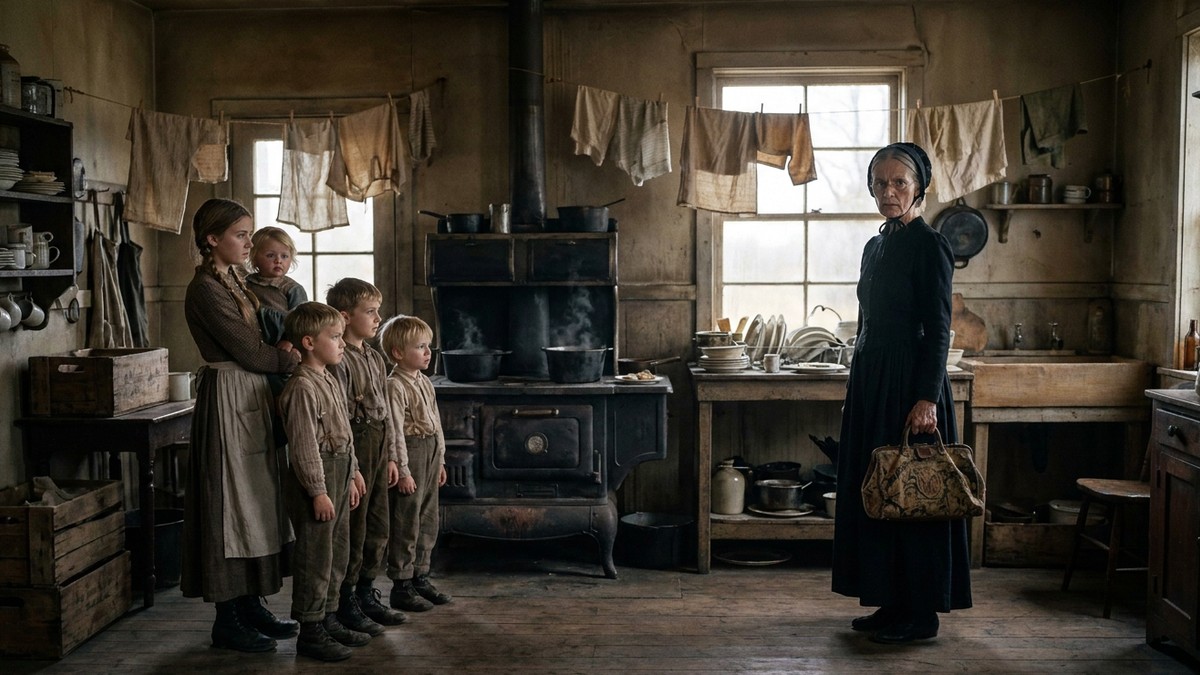
He waited in the kitchen until the children had eaten and gone off down the lane to the school on the creek, all but the baby, who was asleep in her cradle by the stove. Then he sat down at the table across from Miss Jerusha Voss, who was peeling potatoes, and put Clara's photograph on the table between them.
"I heard you singing last night," he said.
Her knife stopped.
"The lamb and the moon," said Ansel. "Clara sang it to all six of them. She told me her mother sang it to her. And to her sister." He looked at the gray, stern face across the table. "Her sister Jerusha. Eight years older. Who raised her after their mother died. Who told her, the night before our wedding, that I'd drag her to the end of the earth and bury her there. And never wrote to her again."
Jerusha Voss set down the knife and the potato. She folded her hands on the table.
"Voss was our mother's name," she said. "I took it for the minister's letter. He knew who I was. He agreed to it. I asked him to." She looked at the photograph. "I didn't think you would ever know. I thought I would come, and see the children, and do what I could, and go home. And you would never know."
"Why?" said Ansel. "Why come at all? After fifteen years?"
The baby stirred in the cradle and sighed.
"Because I was right," said Jerusha. Her voice was very low. "That's the worst of it, Mr. Brandt. I told her you'd take her to the end of the earth and bury her. And you did. Didn't you? Here." She looked out the window, at the mountains. "I was right, and I've been right for fifteen years, and it's the most wicked thing I have ever done."
She reached into the pocket of her apron and took out a bundle of letters, tied with a faded blue ribbon. There were a great many of them. The envelopes were worn soft.
"She wrote to me every Christmas," said Jerusha. "Every year. Fifteen letters. She told me about the farm. About you. About every baby, when it came. She sent me a lock of Lottie's hair." She put the bundle down. "I read every one. I never once answered. I was too proud. I was waiting for her to say I'd been right, and she never did. She only said she was happy. Every year. And that she missed me." Her voice broke. "And then the minister came to my door with your letter, and said she'd died in March. After the baby. And the baby was named Anna. For our mother."
She put her hands over her face.
Ansel Brandt sat across the table from her. He found that he was not angry. He had thought he would be.
"She wasn't buried at the end of the earth, Jerusha," he said at last. "She was buried on a hill above the river, under a cottonwood, where she could see the whole valley. She chose the place herself, years ago. She said it was the most beautiful place she'd ever lived." He pushed the photograph gently across the table toward her. "She was happy. She wasn't lying to you. She was happy every day, right up until the fever. And she never stopped wanting you to come."
That afternoon, he took her up the hill to the grave.
It was a clear, cold October day, with the cottonwood leaves gone gold and the whole Gallatin Valley spread out below, the river shining, the wheat stubble pale, the Bridger Mountains white at the top with the first snow. Jerusha stood in front of the plain wooden marker in her black bombazine, with her umbrella in her hand.
Then she knelt down in the dry grass, stiffly, and untied the blue ribbon from the bundle of letters, and laid the letters on the grave one by one, all fifteen.
"I'm sorry, Clarie," she said. "You were right. It is beautiful."
Ansel walked a little way off, and stood with his back to her, and looked at the mountains.
The month's trial ended on the last day of October.
That evening, after supper, Jerusha came into the front room with her carpetbag packed and set it by the door. The children went quiet at the table. Lottie, who was fourteen and knew everything now, because Ansel had told her that afternoon, began to cry.
"Your train is Thursday," said Ansel.
"Yes."
He stood up. He went to the shelf above the stove and took down Clara's sewing box, and opened it, and took out a small gold brooch shaped like a lamb. He held it out to her.
"She said this was your mother's," he said. "She said it should have gone to the eldest daughter. She kept it for you, all these years. In case you came." He swallowed. "I didn't send for a mother for my children, Jerusha. I said that, and I meant it. But they have one now. If she'll stay."
Jerusha Voss looked at the brooch. Then at the six children at the table, staring at her. Lottie with her wet face. The twins. Nell, with both braids done. Benny, peeking out from behind the cradle where Annie slept.
She took the brooch, and pinned it to her black bombazine, over her heart.
Then she picked up her carpetbag, and carried it back into the little room off the kitchen, and set it down, and unpacked it.
That night, when the children were in bed, Lottie called out from the loft in the dark.
"Aunt Jerusha? Will you sing the one about the lamb?"
And Jerusha sang it. All the verses. And Ansel Brandt, sitting by the stove downstairs with his pipe gone cold in his hand, found that he could listen to it now.