Part 1
The housekeeper Ansel Brandt hired by mail stepped off the Bozeman train with one carpetbag, a black umbrella, and a face like a locked door.
It was October 1886, in the Gallatin Valley of Montana Territory, a wide green valley of wheat farms and cattle ranches below the Bridger Mountains. Ansel was fifty-two. A widower. He farmed three hundred acres on the East Gallatin River, and he had six children, the oldest fourteen and the youngest two, and since his wife Clara had died in March, of a fever, after the last baby, he had been losing ground every single day.
In August, he had written to the Methodist minister in Clara's old hometown in Ohio. Did the minister know of a respectable woman, a widow or a single woman of good character, who would come west to keep house for a widower and six children? Wages, fifteen dollars a month and her board. Fare paid.
In September, the minister wrote back. He knew of just such a woman. A Miss Jerusha Voss, of the next county, fifty-six, unmarried, who had kept house for her late father for many years, and was now alone. She would come for a month's trial.
Miss Voss was tall and spare and gray, in black bombazine, with steel spectacles and her hair scraped back so hard it seemed to pull her eyebrows up. She shook Ansel's hand once, firmly, on the depot platform. She did not smile.
"Mr. Brandt," she said.
"Miss Voss. Thank you for coming so far."
"I was told there were six children."
"There are."
"Then we had better go," said Miss Voss, "before they burn the house down."
It was nearly what had happened, the week before. Ansel did not tell her that.
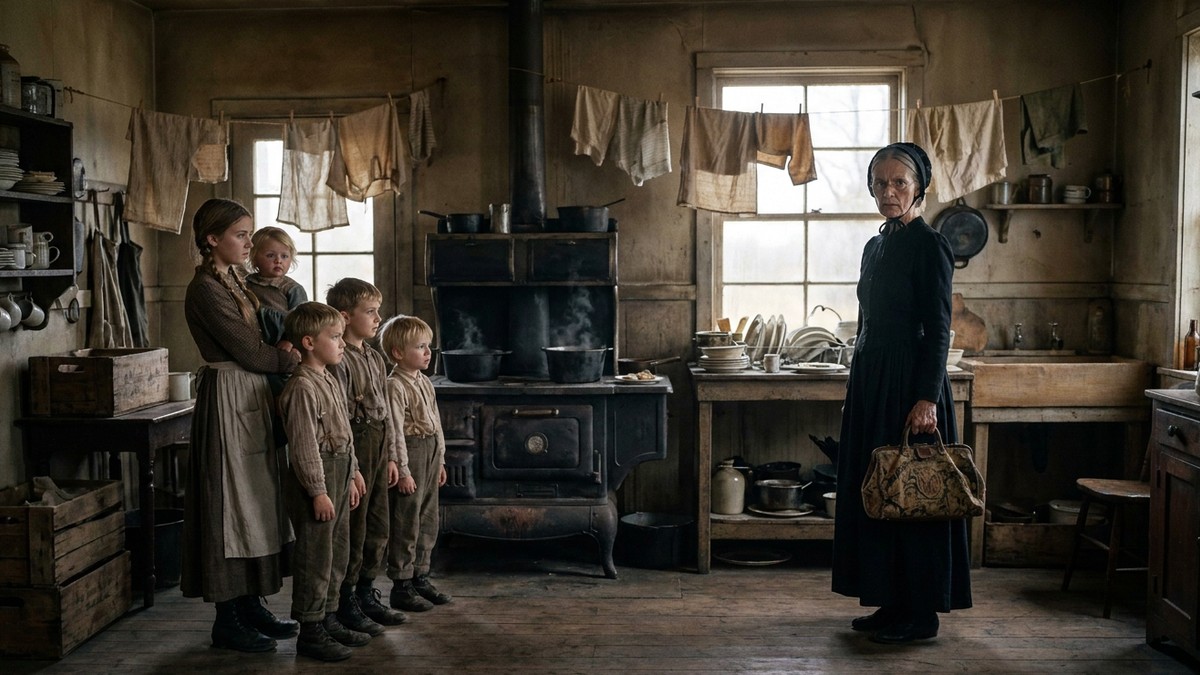
The house was a frame farmhouse of four rooms, that had been neat and white and full of flowers when Clara was alive. Now the yard was full of weeds and broken tools. The porch was piled with muddy boots. Inside, the kitchen was black with smoke. There were dirty dishes stacked on every surface. The floor had not been scrubbed since spring. Wet laundry hung on a line across the front room, and had hung there so long it smelled of mildew.
And there were the children. Six of them, lined up in the kitchen, staring at her. Lottie, fourteen, thin and tired, holding the baby, who was two and had a cold. The twins, Sam and Jacob, eleven, with dirt on their faces. Nell, nine, with one braid done and the other not. And Benny, six, hiding behind Lottie's skirt.
Miss Voss looked at the kitchen. She looked at the children. She took off her bonnet and set it on the only clean spot on the table.
"Which of you can fetch water?" she said.
The twins put up their hands.
"Then fetch it. Every bucket in the house. And you," to Nell, "come here and let me finish that braid." She turned to Lottie, and took the baby out of her arms, as easily as if she had done it a thousand times, and felt its forehead. "And you, young lady, sit down. You look as if you haven't sat down since March."
Lottie burst into tears.
Ansel did not know what to make of Jerusha Voss.
She worked like a mule. In a week the house was clean, top to bottom. In two weeks, the children were clean, and fed three hot meals a day, and in bed at eight, and going to the school on the creek in mended clothes. She scrubbed. She cooked. She baked bread so good that Sam and Jacob fought over the crusts. She sat up three nights with the baby, Annie, when her cold went to her chest, and brought her through it. When Ansel told her the baby was named for Clara's mother, Anna, Miss Voss turned away to the stove and did not answer.
But she never smiled. Not at him. She was polite and cool and correct, and she spoke to him only when she had to, and called him Mr. Brandt, and when he thanked her for anything, she said, "It's what I'm paid for."
He began to think she disliked him. He could not think why.
At the end of the third week, it came to a head.
He came in from the fields one evening and found her in the front room, standing in front of the little shelf above the stove, where he kept Clara's things. Her Bible. Her sewing box. A small framed photograph of her, from their wedding in 1871, the only picture of her he had.
Miss Voss was holding the photograph in both hands. She did not hear him come in.
"Please put that down, Miss Voss," said Ansel.
She put it down. She turned. Her face was white.
"I'll thank you to leave my wife's things alone," he said, more sharply than he meant to. He was tired. He had been tired for eight months. "I didn't send for someone to go through her belongings. I didn't send for a mother for my children. I sent for a housekeeper. Do you understand?"
"Perfectly, Mr. Brandt," said Miss Voss.
She went into the kitchen. He heard her setting the table for supper, very quietly.
That night, after the children were in bed, he could not sleep. He got up and went into the front room for a drink of water, in the dark, and stopped.
There was a light under the door of the little back room off the kitchen, where Miss Voss slept. And through the door, very softly, he could hear someone singing.
It was a lullaby. An old German one, about a little lamb and the moon. He had not heard it in eight months.
He had only ever heard one person sing it in his life. Clara had sung it to every one of their six children. She had told him once that her mother had sung it to her, and to her big sister, back in Ohio. The sister she never spoke of anymore.
Ansel Brandt stood in the dark kitchen, with the cup in his hand, and felt the floor tilt under his feet.