Part 2
Harriet Bassett stood in the doorway with the lamp and did not say anything for so long that Angélique thought she would close the door.
Then she stepped back.
"Come in out of the cold, Mrs. Fayant," she said. "Please."
They met the next morning in the back room of the store, by the big stove. Harriet had gone door to door before breakfast. Fourteen women came, and some of their older daughters. They stood around the stove in their shawls and looked at Angélique, and at the coil of wire in her hands, and at the red sash, and some of them looked at the floor.
Angélique did not make a speech. She held up a loop of wire.
"This is a snare," she said. "For the hare. The snowshoe hare, the white one, in the willows on the creek. There are thousands of them this winter. They are hungry too, and they come down out of the hills to eat the willow bark. I have taken two or three every morning since November."
She showed them how to make the loop. A running noose of fine brass wire, the size of a woman's fist, with a little twist at the end so it would slide shut and hold. She passed them out, one to each woman, and made them make one, and another, and another, until their fingers were sore and every one of them could do it without looking.
Then she took them down to Spring Creek.
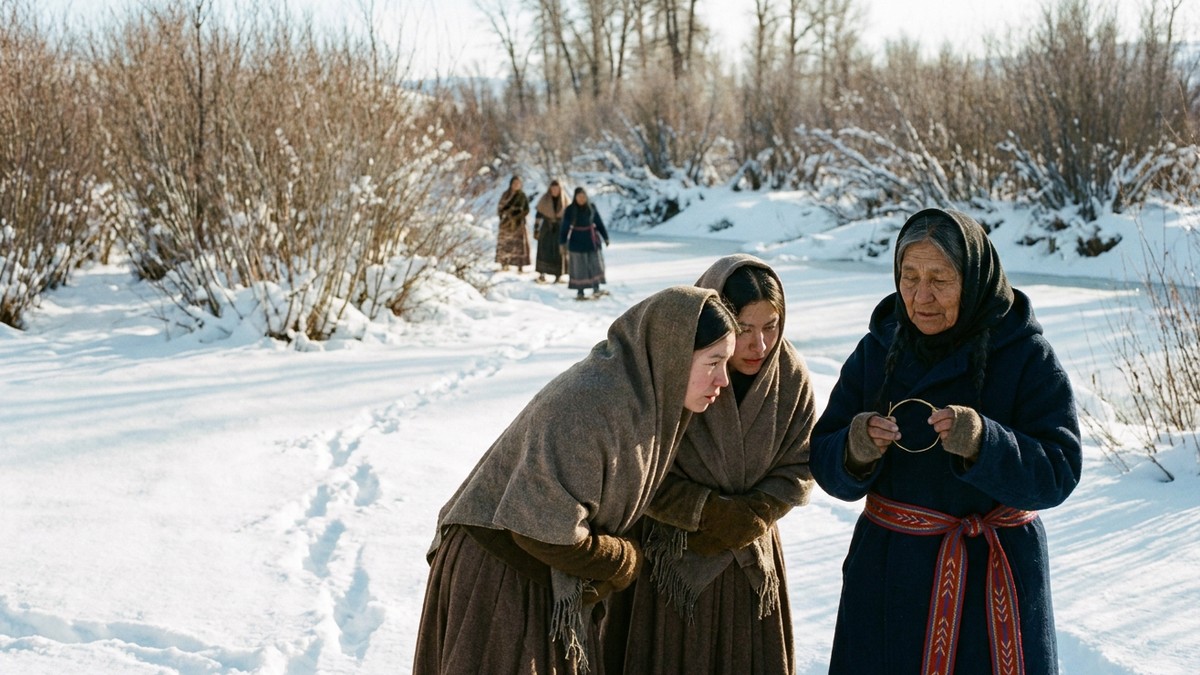
It was ten below zero, with the sun glittering on the ice. Fourteen women and nine girls on borrowed snowshoes, in a line behind a Métis widow in a red sash, floundering along the willow thickets. Men came out of the saloons to watch. Some of them laughed.
Angélique showed them the runs. The narrow paths through the snow under the willows, packed hard by the feet of the hares, where they came and went every night. She showed them how to set the snare across the run, at the height of a hare's head, a hand above the snow, tied to a willow stem. How to bend the willows on either side so the hare would not go around. How to leave no scent. How to come back at first light, every morning, before the foxes and the owls.
"Not one or two," she said. "Many. Every woman, twenty snares. Every morning, you walk your line."
That afternoon they set two hundred and eighty snares along three miles of Spring Creek.
The next morning, they took forty-one hares.
The morning after, fifty-six. Angélique taught them to skin a hare in one long pull, like taking off a glove, and to dress it, and to make the stew her mother had made, with the bones and wild onion and whatever was left in the cellars. She taught them to save the hides, and cut them in long spiral strips, and twist them, and weave them into blankets, which were warmer than any wool.
She taught them to chop holes in the ice of the deep pools on Spring Creek and fish for trout with a line and a scrap of hare meat. She showed them where the rose hips still hung red on the bushes along the creek, under the snow, and how to steep them for the children, so their gums would not bleed.
And she went down into her own cellar, and brought up the rawhide bags of pemmican she had made in the fall, the whole of it, enough to keep herself until spring. She carried them to the schoolhouse. Every child in Lewistown got a piece the size of a biscuit every school day, for three weeks, until it was gone.
Willie Bassett got the first piece.
The freight wagons came in on the fourteenth of March, when the snow finally broke, fourteen ox teams strung out along the road from the Missouri, with the drivers cracking their whips and the whole town running out to meet them.
Not one child in Lewistown had starved that winter.
The ranchers had lost nearly everything. Some of them gave up and went back east in the spring. But the town lived. On hares and trout and rose hip tea and a Métis widow's pemmican, and on fourteen women who walked their snare lines every morning in the dark for six weeks.
In April, the Ladies' Aid held its spring supper in the church hall.
Angélique did not expect to go. She had never been asked to anything the Ladies' Aid did. But on the afternoon of the supper, Harriet Bassett came to her door, in her best dress, with Willie by the hand.
"Mrs. Fayant," she said. "There's a place set for you. At the head of the table, beside me. If you'll come."
"I said once, in the store, that we didn't know you," said Harriet. "That a town needs to know who it can count on." She took a breath. "I know now. We all do. I'd like to say so, in front of everyone. If you'll let me."
Angélique took her pipe out of her mouth. She looked at Harriet Bassett, and at Willie, who was fat-cheeked again and staring at her red sash.
"You know, Mrs. Bassett," she said, "my people were here first. On this creek. Before the store. Before the church. Before the town had a name."
"I know," said Harriet Bassett. "I should have come to your door years ago. Instead of you coming to mine."
Angélique Fayant put away her pipe. She put on her good black dress, and her red sash over it. And she went to the supper, and sat at the head of the table, and when Harriet Bassett stood up and told the whole room what she had done, the whole room stood up too.