Part 1
The ladies of Lewistown said good morning to Angélique Fayant on the street, very politely, and never once asked her into their homes.
It was the winter of 1886, in the Judith Basin of central Montana Territory, in a raw new town of log and frame houses on Spring Creek, below the Judith Mountains. Angélique was sixty-two. A widow. Métis, born on the Red River in 1824 to a French Canadian father and a Cree mother, she had spent her whole life following the buffalo hunts across the northern plains, from Manitoba to the Milk River.
In 1879, when the buffalo were nearly gone, she and her husband Baptiste had come south with forty Métis families to settle on Spring Creek. They were here first. Before the stores. Before the ranchers. Before the town had a name.
Then the town had grown up around them. Baptiste had died in 1884. And now Angélique lived alone in a two-room log house at the edge of town, with her red wool sash, and her beadwork, and her tea, and her three hens.
The newcomers did not dislike her. Not exactly. They did not know what to make of her.
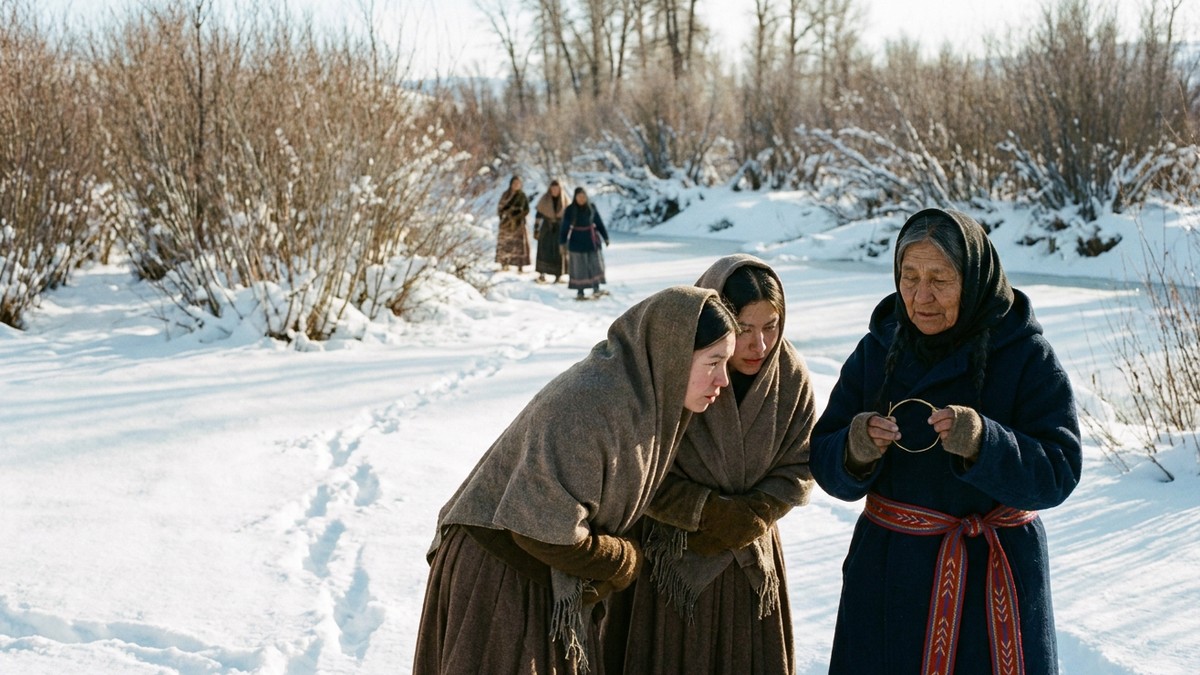
She dressed in black, like any widow, but she wore a bright woven sash around her waist, red and blue and gold, in arrow patterns, as every Métis woman and man wore. She spoke French and Cree and Michif, the language of her people, which was a little of both. Her English was good, but it had French in it. She went to the Catholic mission, not to the new Methodist church in town. She did her own butchering. She smoked a clay pipe in the evenings, on her step.
Mrs. Harriet Bassett, the storekeeper's wife, was the leader of the Ladies' Aid. She was a handsome, sensible woman from Iowa, about forty, with five children.
"I've nothing against her," Angélique heard her say once, in the store, to another woman, not knowing she was in the back. "Truly I haven't. We just don't know her. We don't know her people, or their ways. A town needs to know who it can count on."
Angélique paid for her flour and her tea and went home.
They had been here first. But she did not say it.
The trouble that winter began in November, with the snow.
It came early, and deep, and it did not stop. Then, in January of 1887, it rained, and the rain froze, and the whole Judith Basin lay under a crust of ice as hard as a floor. The cattle on the open range could not paw through it to the grass. They began to die by the thousands. Ranchers who had been rich in October were ruined by February.
And the freight wagons stopped.
Every barrel of flour, every sack of sugar, every can of beans in Lewistown came in by ox-team freight wagon, a hundred miles from the steamboat landing on the Missouri. In good weather, the trip took a week. That winter, the wagons could not move at all. The last one came in on the twentieth of December. After that, nothing.
The store shelves emptied. By the middle of January, the Bassetts' store had no flour, no sugar, no beans, no rice. The town lived on what it had in its own cellars, and the cellars were running low. Fresh meat was impossible to get, because the cattle were dying and the game had gone into the mountains.
By the end of January, there were children in Lewistown who were hungry.
Angélique was not hungry.
Every morning she went out on her snowshoes at first light, along the willow thickets on Spring Creek, with a coil of fine brass wire. She came home with two or three snowshoe hares. Sometimes more. She skinned them and dressed them and stewed them with dried berries and wild onion, and she cut the hides in long spiral strips and wove the strips into a blanket, the old way.
In her cellar, she had what was left of the pemmican she had made in the fall. Dried meat, pounded fine, mixed with melted fat and dried chokecherries, packed in rawhide bags. A pound of it could keep a man walking for a day. Her mother had made it, and her grandmother, and every Métis woman back to the beginning, and it would keep for years.
She had enough for herself. She did not have enough for a town.
On the first of February, she saw the Bassett children.
There were five of them, coming home from the schoolhouse through the snow. The littlest, a boy of six named Willie, was crying. Not loudly. Just quietly, steadily, as a child cries when it has been hungry for weeks and does not expect anything to change.
His big sister was carrying him on her back.
Angélique stood on her step with her pipe and watched them go by.
That evening she sat a long time by her stove, with her beadwork in her lap, not working on it.
Then she put on her coat and her sash and her snowshoes, and took a lantern, and walked across town in the dark to the Bassetts' store. It was closed. There was a light in the window upstairs.
She knocked on the door. Harriet Bassett opened it, in her wrapper, with a lamp, and stared at her.
"Mrs. Bassett," said Angélique. "Your children are hungry. So are others. I know how to feed them." She held up the coil of brass wire. "But I cannot do it alone. I need your women."