Brody's hands were shaking so badly he dropped his phone. He picked it up and dialed and set it on the floor, and the dispatcher's calm voice came out of it into the silent diner.
Martha spoke to the dispatcher without looking at the phone. She gave the address of the Tide Line and the boy's age, and said he was unresponsive and not breathing normally, and that she was starting compressions.
Then she put the heel of one hand on the center of the boy's chest, laid her other hand on top of it, locked her elbows, and began.
She counted out loud. Her voice was steady and even, like a metronome, like somebody counting stitches. She didn't look up.
The diner had gone so still you could hear the grill hissing in the kitchen.
Dee came running with the red box. It was an automated defibrillator. The owner had put it on the wall three years ago, after a regular collapsed in the parking lot, and in three years it had never once been opened.
Martha didn't stop counting.
"Open it," she told Dee. "It'll talk to you. Do exactly what it says."
Dee opened it. A recorded voice began giving instructions. Dee's hands were trembling, and she fumbled with the pads.
"Brody," Martha said, still counting. "Cut his shirt. Kitchen scissors. Behind the counter."
Brody stared at her for one second. Then he vaulted the counter.
They did it together, the way Martha told them. Brody cut the T-shirt up the middle.
Dee peeled the backing off the pads and put them where the pictures showed. The machine said not to touch the patient, and Martha lifted her hands and leaned back on her heels and told the room to stand clear.
The machine said it was analyzing. Then it said a shock was advised.
Then it said to press the flashing button.
"Dee," Martha said. "Push it."
Dee pushed it.
Afterward, the people in the diner couldn't agree on how long it took the ambulance to come. Dee said it was forever.
The two brothers said it was two minutes. The cook, who'd come out of the kitchen with a spatula still in his hand, said it was five minutes and twenty seconds, because he'd been watching the clock over the pie case the whole time.
By the time the paramedics came through the door, Dylan was breathing on his own.
Martha told them everything in about thirty seconds, in a language Dee only half understood. Times, rhythms, how many shocks.
The paramedic in charge was a woman about forty. She listened, nodded, and then looked at Martha a little closer.
"Ma'am," she said. "Are you a nurse?"
"I was," Martha said. "A long time ago."
They took Dylan out on the stretcher. Ray went with him in the ambulance. The brothers stood on the sidewalk in the early sun, not saying anything.
Martha tried to get up off the floor and found that her new hip had finally caught up with her. Brody saw it. He came over without a word and gave her his arm, and he helped her up and walked her to table six and sat her down.
Then he stood there with his ball cap in his hands.
"Who are you?" he said finally.
Martha picked up her coffee. It was cold. She drank it anyway.
"Martha Quinn," she said. "Lieutenant, United States Navy Nurse Corps, 1968 to 1970. The hospital ship Repose, off the coast of Vietnam."
Dee sat down hard in the chair across from her.
"Then thirty-one years in the emergency room at the county hospital in Tampa," Martha said. "Retired in 2003. I've seen a lot of young men turn gray, son. I don't like to see it. I don't like to see it at breakfast."
Brody's face had gone red all the way down his neck.
"I'm sorry," he said. "About the grandma stuff. All of it. I didn't mean it."
"I know you didn't," Martha said. "You did fine, Brody. You did what I told you. You were quick with the scissors."
He looked at her like he couldn't decide whether to laugh or cry, and then he did a little of both.
Dylan had a heart rhythm problem he'd been born with and never known about. That was what the doctors at the hospital told Ray. They said it was the kind of thing that hid for years and then showed up all at once.
They kept him a week. They put a small device in his chest to watch over it.
They also told Ray that the woman in the diner had done everything right, in the right order, without wasting a second.
The roofing crew finished the condo job three weeks later. Every morning until then, when Martha came in for her pancakes, her breakfast was already paid for.
She told Dee to stop letting them do it. Dee said she'd told them. Brody said she could take it up with him, and Martha said she'd consider it.
On the crew's last morning in Pelican Point, the door of the Tide Line opened at six-fifteen, and Dylan walked in.
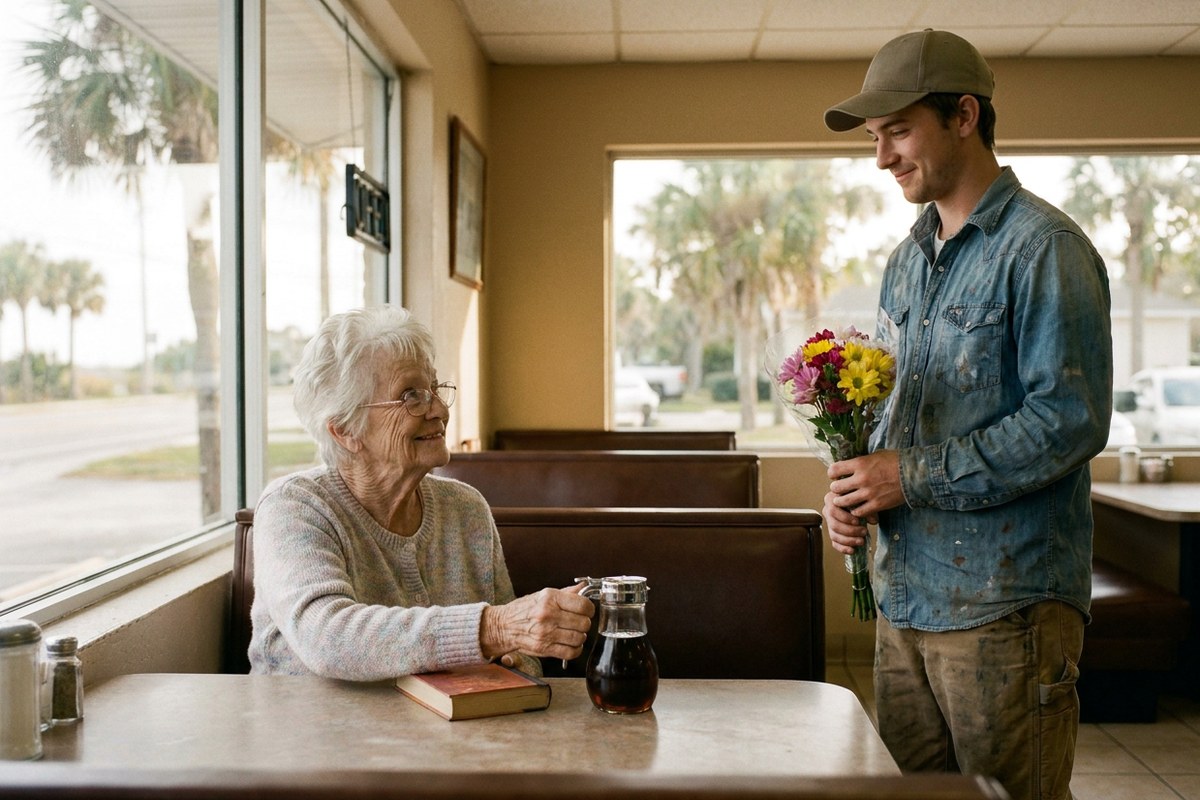
He was still thin and still a little pale. He wasn't gray. He had a ball cap from the feed store in Georgia in one hand, and a small bunch of grocery store flowers in the other, and he looked terrified.
He walked to table six and stood there.
"Ma'am," he said. "I was wondering if I could eat breakfast with you. Before we go."
Martha looked up from her library book. She looked at him for a long moment, the way she looked at everybody.
Then she closed the book, set it on the windowsill, and pushed the syrup across the table to him.