Part 2
He walked.
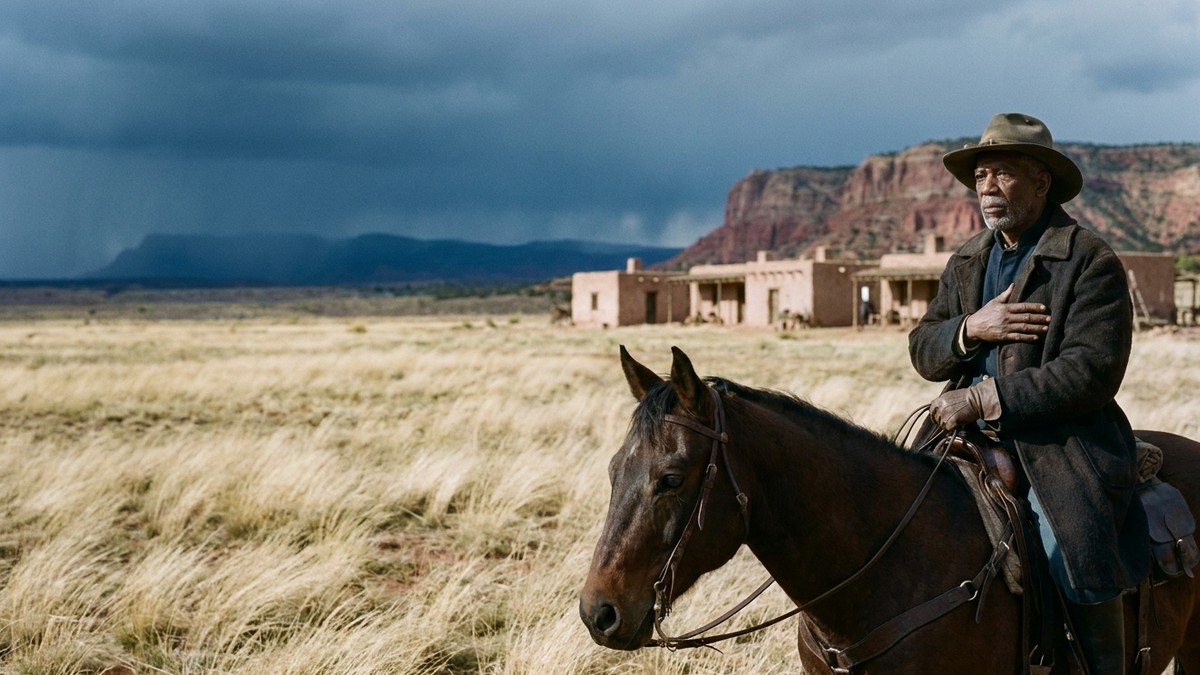
There was nothing else to do. He took the bay's reins over his shoulder and turned his face into the sleet and walked, east, toward the mountains he could not see.
The horse limped behind him, blowing. The sleet hissed in the grass. Every few hundred yards Abram put his hand flat against his chest and felt the parcel there, square and dry, the doll's china head a small hard lump under his palm.
He talked to the bay to keep his mind off his feet.
"Seventy-two miles for a toy," he told it. "That's what the captain said. Sixteen years I've been in this army. I've ridden after horse thieves and stolen cattle and a paymaster's wagon and a lieutenant's runaway mule. Never once rode after something I wanted to bring home." The bay snorted. "No. You're right. Not for me, either. For a little girl who stopped wanting anything."
By three o'clock his boots were full of ice water and his feet had gone past hurting into a kind of wooden numbness that frightened him more than the pain.
He knew the country. That was the one thing he had. He knew that four miles on, under the shoulder of a low ridge, there was an old stone sheep pen some Mexican herder had built and left before the war, with one wall still standing high enough to break the wind.
He reached it at dusk.
The wall was there. Three feet of rough stone, crusted white on the north side.
Abram led the bay into its lee and stood him against it. He scraped a hollow in the sleet with his boot. He found dead greasewood in the corners of the pen, wet through, and he shaved the inside of the thickest sticks with his knife until he had a little pile of dry curls, and he struck matches out of the oilskin pouch he had carried on every scout since 1867.
The first three went out. The fourth caught.
He fed it stick by stick, hunched over it with his back to the storm, until he had a fire no bigger than a hat. Then he took off his boots and held his white feet to it, and swore steadily and quietly at the pain as it came back into them, which he took to be a good sign.
He did not open his coat. The doll stayed where it was.
Sometime after dark, the sleet stopped.
Abram did not notice at first. He noticed only that the wind had dropped, and the hiss in the grass had gone, and there was a strange enormous stillness over everything.
He looked up. The clouds had torn open. Behind them the sky was black and full of stars, more stars than he had ever seen, so bright and close they seemed to crackle, and the whole white country lay under them shining.
It was bitter cold. But it was clear.
He put his boots back on. He banked the fire with sleet and stood up, stiff as an old gate, and took the bay's reins.
"Fourteen miles," he said. "We'll go slow."
He came down into the canyon mouth below the red cliffs at four o'clock on Christmas morning.
The sentry at the edge of the post was a young trooper from his own troop, so bundled in his coat that only his eyes showed. He brought up his carbine and then lowered it.
"Pop?" he said. "Sergeant Coles? Lord, Sergeant, we thought you'd frozen."
"Not yet," said Abram. "Take my horse to the farrier. He's lame in the near fore."
He walked across the dark parade ground to the laundress quarters. There was a light in Celia Banks's window. He knocked once.
Celia opened the door. Her face went very still when she saw him, ice in his beard and his buffalo coat white to the shoulders.
"She's awake," Celia said. "She's been awake since midnight. She said you promised."
Rosie was sitting up in the narrow bed with a blanket around her shoulders. Her face was thin. Her eyes were enormous.
Abram knelt down beside the bed, which took him a while, and unbuttoned his buffalo coat, and took out the parcel. The brown paper was warm from his chest and a little damp at the corners. Otherwise it was as dry as the day it was wrapped.
He put it in her lap.
Rosie opened it very slowly, the way a child opens something she is afraid will not be real. The paper fell away. The china-headed doll looked up at her with painted blue eyes, in a blue dress, with painted black hair.
Rosie did not say anything. She held the doll against her chest with both arms, as Abram had held it for thirty-six miles, and put her chin down on its china head, and closed her eyes.
Then she began, very quietly, to cry. And then she laughed. And then she asked her mother if there was anything to eat.
Celia Banks put her hand over her mouth and went to the stove.
Abram got up off his knees. He stood in the doorway a moment in the lamplight, with his hat in his hand.
"What will you name her, Miss Rosie?" he said.
Rosie opened her eyes and considered the doll.
"Sergeant," she said.
Outside, across the parade ground, the bugler stepped out of the guardhouse into the starlight and lifted his horn. Reveille. Christmas morning, on time, to the minute.
Abram Coles put his hat on, and went out to answer it.