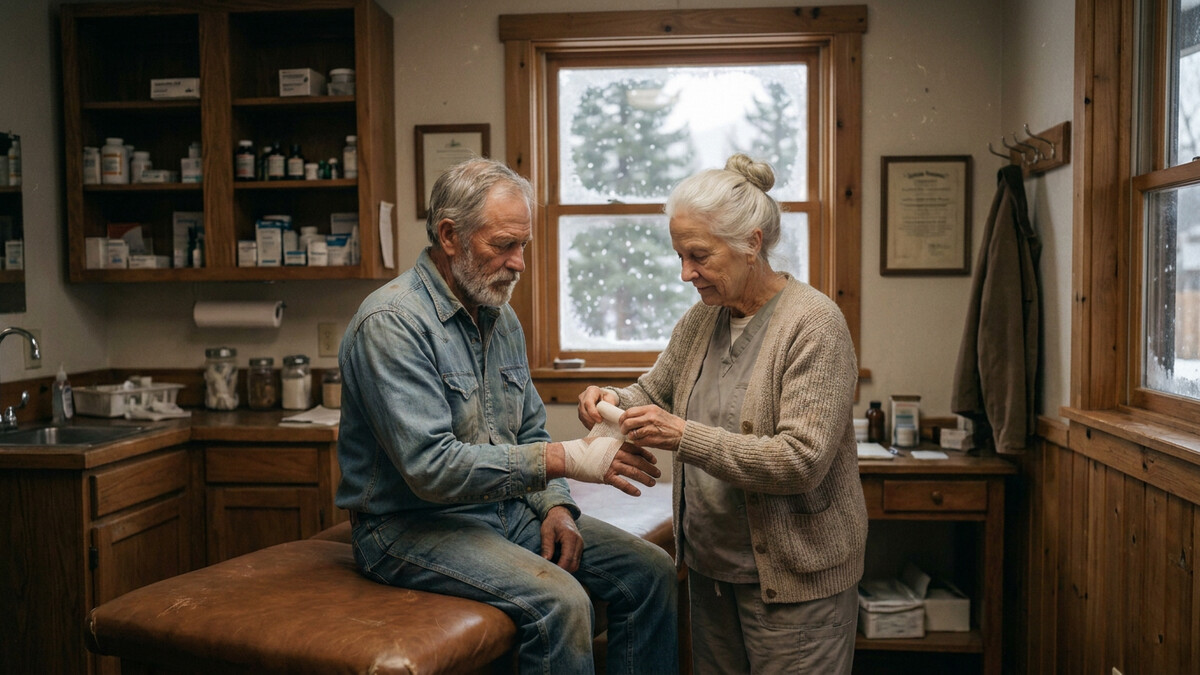
For a long moment, the man on the exam table did not breathe.
Then something in his face gave way, all at once, the way a bank gives way in a spring flood. He put his good hand over his eyes. His shoulders shook.
Agnes did not say anything. She pulled her rolling stool up close and sat beside him and waited, the way she had waited beside a great many people in fifty-two years.
"Not a soul's called me that," he said finally, behind his hand, "since I was eighteen."
He told her in the empty clinic, with the snow coming down outside and the old radiator ticking.
The week after Tommy drowned, his father had come home drunk from the mill and beaten him so badly he could not stand. That was nothing new. What was new was the thing his father said, standing over him in the kitchen. That Danny should have been the one in the boat. That it would have been a mercy for the whole family.
Danny had walked out that night with a bloody nose and eleven dollars. He walked six miles up the valley in the dark to the only house he could think of. Ellen Rourke's.
"She opened the door in her nightgown," Danny said. "She'd buried her son two weeks before. She looked at me and she didn't say a word. She just brought me in and cleaned me up."
He stopped.
"The next morning, she gave me Tommy's birth certificate. And his Social Security card. And a hundred dollars from the coffee can." His voice cracked. "She said, Tommy doesn't need these anymore, and you do. Go somewhere your daddy will never find you. Be a good man. That's all I'll ever ask."
He had gone to Oregon. He had worked on ranches in the Wallowa country as Tom Rourke, eighteen years old, until he was old enough that people quit looking twice. He had married a schoolteacher named Joan in 1986. They had raised two daughters and run three hundred cows on a lease outside Enterprise. Joan had died last year of cancer.
"I never told her," he said. "I never told my girls. I was Tom Rourke for forty-six years. I paid taxes as Tom Rourke. I voted. I built a whole life on that boy's name." He looked down at his hands. "And every Christmas, I mailed a card to Ellen with no return address. Just a card. So she'd know I was being a good man."
"Did she know it was you?"
"I don't know." He shook his head. "I never signed them. I was too afraid."
"Why did you come back?"
He looked out the window, toward the head of the valley.
"Joan's gone. My girls are grown. My daddy's been dead since 1994. I read it in the Fairplay paper." He swallowed. "And I heard Ellen was in the care home. Ninety-five. I thought, I can buy her place, keep her cattle, and maybe go and see her before she dies. Sit in a chair by her bed. Just once. Tell her thank you."
"Without telling her who you are?"
"I don't know who I am," Danny said. "That's the trouble."
Agnes was quiet for a long time.
She thought about the law. She knew some of it. A man could not live under a dead boy's name for forty-six years without consequences, no matter how good his reasons were. Brian would be at the ranch on Monday morning.
She thought about Ellen Rourke, sitting in the chair by the clinic window in 1980, holding her hand.
And she thought about a boy on her exam table at midnight in 1979, with a broken arm, telling her he had fallen off a hay wagon, while she let the county send one man out once.
"Danny," she said. "I failed you once. When you were seventeen. I knew what your father was, and I let it go when the county didn't do anything. I've thought about that for forty-seven years."
He looked at her.
"I'm not going to fail you twice," Agnes said. "Get your coat. We're going to Fairplay."
Ellen Rourke's room at the care home looked out on the mountains. She was ninety-five, very small in the bed, with white hair spread on the pillow and her eyes closed.
Agnes went in first.
"Ellen," she said softly, taking her hand. "It's Agnes. I brought somebody to see you."
Ellen's eyes opened. They were still blue. She looked past Agnes at the tall, gray-bearded man standing in the doorway with his hat in his hands.
She looked at him for a long time.
Then she said, in a thin, clear voice, "Danny Kehoe. You're late."
He made a sound Agnes would remember for the rest of her life. Then he crossed the room and knelt down by the bed, and Ellen put her small hand on his gray head, the way she must have on the night he came to her door.
"I got your cards," she whispered. "Every Christmas. Forty-five of them. I kept them in the coffee can."
"How did you know they were from me?"
"Because Tommy never could have mailed one on time in his life," Ellen said. "And you always did."
Danny Kehoe walked into the county sheriff's office on Monday morning at eight o'clock, on his own, with Agnes Halloran beside him and a folder of her old records under her arm.
It took most of a year to sort out. There were lawyers and letters and a hearing in Denver. Ellen Rourke gave a sworn statement from her bed at the care home, in a clear voice, that she had given the papers freely in 1980 to save a boy's life. Agnes gave hers about the broken arm and the burns. The county attorney read both statements twice and declined to file charges against a man who had never harmed a soul and paid every tax he owed.
A judge in Denver restored his name in October.
Ellen Rourke died that December, at ninety-six, with Danny in the chair by her bed. She left her ranch, in her will, to the man who had already bought it, along with the coffee can.
The next spring, the county recorder in Fairplay sent the corrected ranch deed up the valley to the old Rourke place for a signature.
Agnes was there when it came. She had driven up with a pie, because Danny's two daughters were visiting from Oregon for the first time, and she wanted to meet them.
Danny sat at Ellen's old kitchen table with the deed in front of him and a pen in his hand for a long time.
Then he signed it. Slowly. Carefully. As if he were learning to write.
Daniel James Kehoe.
He looked at it for a while. Then he turned to his daughters, who were watching him from the doorway, and smiled.
"Girls," he said. "Sit down. I want to tell you about two boys and a rowboat."