Part 2
"Amos," Abigail said. "Go to the far end of the table. All the way, past the pie. Turn your back to me, and say something to Martha. Anything at all. Then turn around and say it again, to her face, where I can see you. Not to me. To her."
Amos Reed stopped with his hand still out.
"Abby, this isn't..."
"Please, Amos." She heard nothing of her own voice, but she could feel it in her chest, and she knew it had gone thin. "Josiah would have done it for me."
Amos's face worked. Then he walked down the long plank table, past the pies and the chicken bones, to where his wife Martha sat with the minister's wife. He turned his back to Abigail. He said something.
Then he turned around and faced his wife, and said it again.
He was forty feet away, in lantern light. Abigail watched his mouth.
"You said," she called down the table, "Martha, I believe I have made the worst mistake of my life, and I believe Abby Thorne is about to show me."
Martha Reed put both hands over her mouth. Around the tables, people began to look at one another.
Amos stood still at the end of the table. He did not look at the reverend. He looked at Abigail, and slowly he nodded.
The yard had gone so still that Abigail could feel nothing at all through the bench.
"Last Sunday," Abigail said, "after the last hymn, the reverend stood in the church door with Mr. Dade. He thought the church was empty except for me. He said, Saturday night. After the supper. The eleven-ten east. Have the trunk at the depot by dark, and don't let the fools see you carry it."
Every face in the yard turned toward the reverend.
He was still smiling. But the smile had gone stiff at the edges, like a plaster face, and Abigail watched him start to say something and stop.
At the end of the table, Mr. Dade stood up. He tucked the gray satchel under his arm and began to walk, not fast, toward the dark road.
"Hold on there, Mr. Dade," said Oscar Lund from the store, getting up, and two farmers got up with him.
Dade stopped. He looked at the three big men between him and the road. For a moment he looked as if he might run anyway. Then he set the satchel down on the end of the table very carefully, the way a man sets down something hot.
Amos Reed opened it, with half the town crowding around him.
Inside, under a folded newspaper, were bundles of greenbacks tied with string and a heavy cloth bag of silver. There was the Sunday school's penny jar, with the lid wired shut. And on top of everything, in a little envelope, two railroad tickets east to Kansas City, for the eleven-ten that night.
There had never been a church account in Topeka. The handsome receipts were printed on paper Dade bought by the ream.
The sheriff was at the supper. He had eaten three pieces of pie. He wiped his mouth and came forward with a look of great sorrow.
"Reverend," he said. "You'd best come along."
Silas Marlowe climbed down from the bench. He walked over to where Abigail stood, and stopped in front of her, close, so she could see his face in the lantern light.
"Every one of you wanted a stone church," he said, "so that Jericho Springs would see your steeple from the county road and be jealous. I sold this town a feeling, Mrs. Thorne. It was worth the price." His mouth twisted. "And you were the one person in Kansas I never bothered to lower my voice for."
"I know," Abigail said. "Nobody ever does."
Somebody wanted to put him on a rail. A few men wanted worse. Abigail looked at Amos Reed, and Amos stood up on the same bench the reverend had preached from and said that this was a church yard and they would not shame it. The sheriff took Marlowe and Dade to the county seat in his own buggy that night. They did not catch the eleven-ten.
Every dollar was counted out on the plank table before midnight. Eleven hundred and eighty dollars and forty-one cents. Not a penny was missing. The Sunday school children counted their own jar themselves, three hundred and twelve pennies, and two of the littlest fell asleep under the table before they were done.
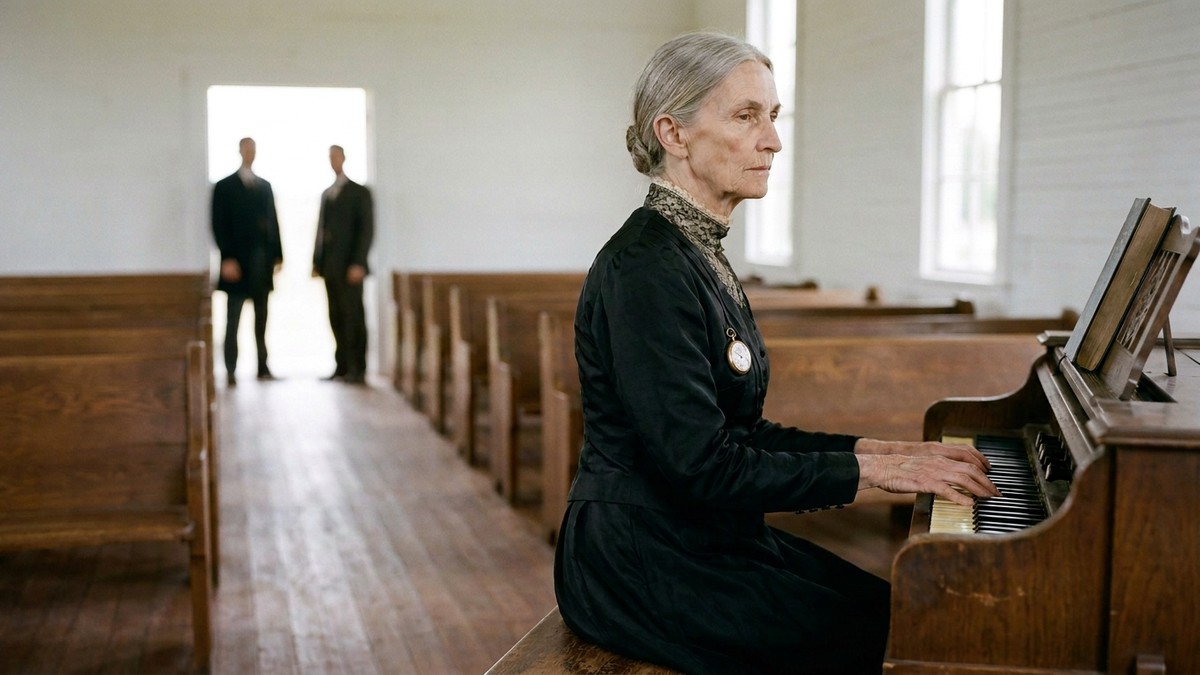
On Sunday morning, in the old white frame church with the cracked bell, Abigail Thorne sat down at the pump organ and set her feet on the pedals.
Amos Reed came up the aisle before the first hymn and sat down on the end of the organ bench beside her. He had never done that in thirty-one years. He opened the hymnal on the music rack for her, and held it there with one hand, and did not say a word.
She began to play.
The hymn itself was lost to her, and always would be. But the bellows breathed under her feet, and she could feel the music through the keys and up through the pedals, and she could see their faces down the long aisle, every one of them turned toward her, every mouth open and singing.
She had never seen Willow Ford sing so loud.