Part 1
People in Willow Ford said anything at all in front of Abigail Thorne, because Abigail Thorne had not heard a sound in eighteen years.
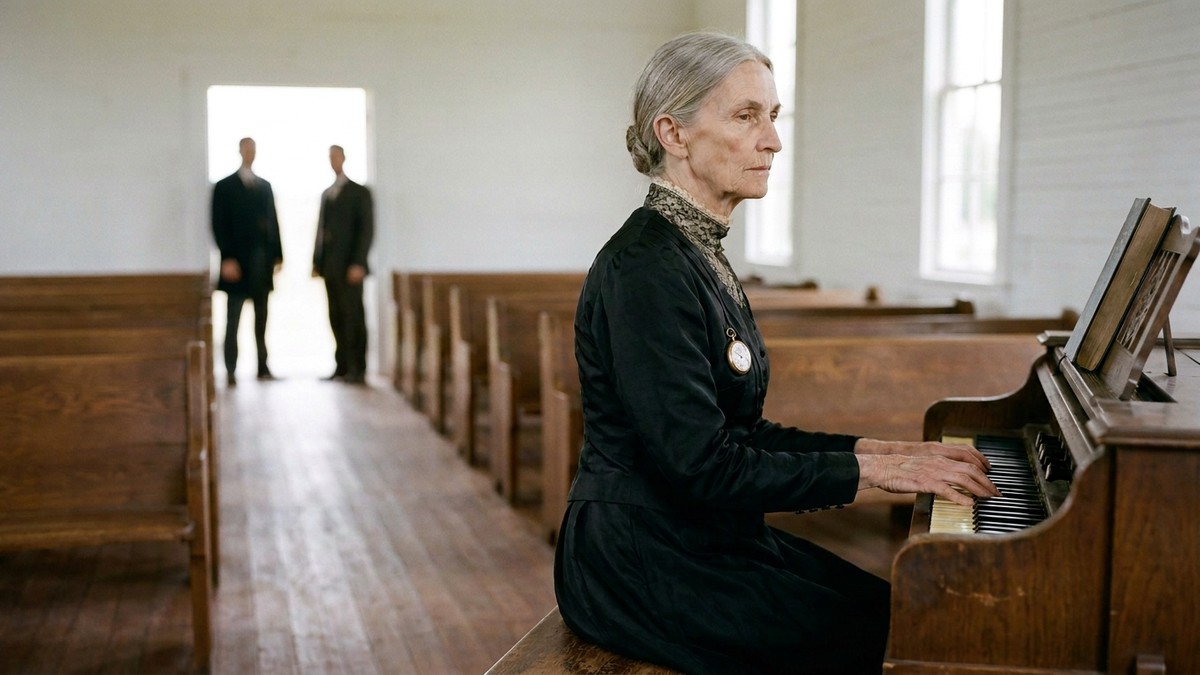
It was June 1881, in Willow Ford, Kansas, a farm town of white frame houses and one white frame church with a bell that had cracked in the winter of '76. Abigail was seventy. She had played the pump organ in that church for thirty-one years, the last eighteen of them deaf.
Scarlet fever had taken her hearing when she was fifty-two. She had learned to play again by the feel of the keys and the tremble of the bellows through the pedals under her feet. And she had learned to read faces. Her late husband, Josiah, had sat across the supper table from her every night for nine years after the fever, talking slowly, until she could read him like print.
Nobody else in Willow Ford had ever quite believed it.
At Lund's store on Tuesday, she bought a spool of thread. Mr. Lund, behind the counter, turned to his clerk and said something with his hand half over his mouth.
"Yes, I know it's the old price," Abigail said to him. "I don't mind paying the new one. You needn't whisper about it."
Mr. Lund went pink to his collar. The clerk dropped a scoop of nails.
Abigail paid and went home. She did not think much of it. It happened once a week.
The Reverend Silas Marlowe had come to Willow Ford in May.
He was handsome, with a voice that made the women sit up straighter, and Abigail could tell from the way the congregation's faces lifted when he preached that it must be a beautiful voice. He wanted a stone church. A real one, he said, with a steeple you could see from the county road and a bell that rang true.
By the third week of June, Willow Ford had pledged eleven hundred and eighty dollars. Farmers who had not had a new coat in five years pledged ten. Widows pledged their butter money. The Sunday school children brought pennies in a jar.
The money was kept by Mr. Dade, the reverend's brother-in-law, a quiet man with a gray satchel, who took it to the bank in Topeka every two weeks and brought back very handsome receipts.
The last pledges would come in on Saturday evening, at the subscription supper in the church yard. Fourteen hundred dollars, the reverend said. Then they would break ground.
On Sunday, after the last hymn, Abigail sat at the organ and let the bellows sigh out under her feet.
From the organ bench she could see straight down the aisle and through the open doors to the church steps. The reverend stood in the doorway in the sunlight, shaking hands. When the last family had gone down the steps, Mr. Dade came up beside him with the gray satchel.
The reverend turned to him and spoke. He spoke low, with his hand on Dade's shoulder and his back to the street. But he did not turn his face from the church, because there was no one left in the church but deaf old Mrs. Thorne at the organ.
Abigail read every word.
"Saturday night. After the supper. The eleven-ten east. Have the trunk at the depot by dark, and don't let the fools see you carry it."
Dade nodded. They went down the steps together into the sunshine.
Abigail sat at the organ until her hands stopped shaking.
She told Deacon Amos Reed on Monday morning, in his own parlor, slowly and carefully, exactly as she had read it.
Amos had been her husband's best friend. He listened, and nodded, and took her hand in both of his.
"Abby," he said, very slowly, so she could follow his lips. "My dear. You were at the far end of the church."
"I could see his face as plain as I see yours."
"You can't hear a church bell, Abby." He patted her hand. "I'd not say this to anyone else. People might think you'd gotten confused. Let's just keep it between us."
She went home. She did not know who else to tell.
On Wednesday evening, at prayer meeting, the reverend preached on the third chapter of James. The tongue is a fire, he read. Abigail watched his mouth form the words, and she watched him look down the aisle, once, at the organ.
Someone had told him. She did not have to wonder who.
The subscription supper was held on Saturday under the cottonwoods in the church yard, on long tables made of planks and sawhorses. There was fried chicken and pie. There were paper lanterns in the trees.
At the end of it, the reverend stood up on a bench and held up the jar of Sunday school pennies, and the whole yard cheered. Abigail could not hear it. She could feel it through the bench, a long rolling tremble, like a train going by.
Mr. Dade sat at the end of the table with the gray satchel on his knees.
Abigail looked at the watch pinned to her dress. It was half past eight.
She stood up.
She had never in her life spoken in front of the whole town. Her knees were shaking. Faces turned toward her one by one, and she watched the cheering stop on them.
"The Reverend Marlowe," Abigail said, "is going to leave on the eleven-ten train tonight with our money."
Nobody moved. Then, up on his bench, the reverend smiled at her. A sad, gentle, pitying smile.
"Sister Thorne," he said, and she read every word of it, "cannot hear a church bell."
Somebody laughed. Then a few more, embarrassed. Amos Reed was on his feet, coming down the table toward her with his hand out, his mouth forming the words sit down, Abby.
Abigail did not sit down.