Part 2
"Wait," said Martha Keel.
It came out louder than she meant. The conductor turned. The agent turned. Half the people still on the depot platform turned. Agnes Moran stopped with one foot on the iron step of the car and looked back over her shoulder.
Martha walked down the platform toward her. Her knees were shaking under the black dress. She did not let them show.
"That girl," she said to the agent. "Agnes. We'll take her."
Henry caught up with her at the car step. He took her elbow, not roughly.
"Martha," he said, low. "Martha, listen to me. I'm sixty-eight. My back is gone. There's forty acres of corn in the field and I can't husk it alone. I need a boy's back. Not a girl to feed and clothe and marry off." He looked at Agnes and away again, ashamed, but he said it anyway, because it was true. "We can't afford to be kind."
"I know it," said Martha.
"Then why?"
Martha looked up at him. Forty-five years married. He had never once seen her cry, and she did not cry now.
"Because nobody picked me either, Henry," she said.
The agent wrote it in his book.
The committee had to approve. That was the rule. But the committee was Mr. Lyle the banker, who had known the Keels for thirty years, and he only looked at Martha's face and nodded and signed his name.
Agnes stood on the platform with her flour sack while the train pulled out for Macon without her. She did not say thank you. She did not say anything. Martha did not expect her to.
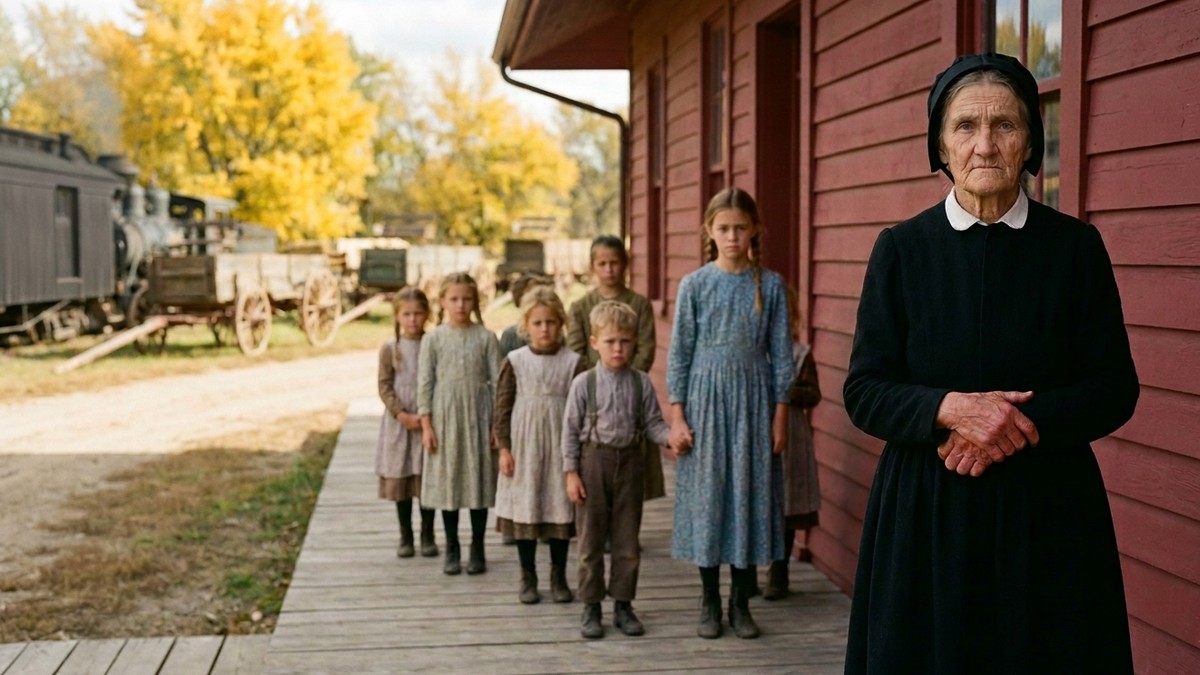
They drove home in the wagon in the long gold October light, Henry on the seat with the reins, silent and stiff, Martha beside him, and Agnes in the back on a pile of feed sacks with her bundle in her lap, looking at the corn going by.
That night, after supper, after Henry had gone out to the barn, Martha took a little tin box down off the high shelf in the kitchen.
She had not opened it in years. Inside, wrapped in a handkerchief, was a single folded paper, brown at the edges and soft as cloth.
"Can you read, Agnes?"
"Yes, ma'am."
"Read that."
Agnes unfolded it under the lamp. It was an old printed form with the blanks filled in by hand, in brown ink.
"This Indenture," Agnes read slowly, "made the third day of April, in the year eighteen hundred and forty-one, witnesseth that Martha Ann Ruddle, a poor child of the county of Fairfield, Ohio, aged eleven years, is bound out to serve Josiah Peck, farmer, until she reaches the age of eighteen years, for her keep and two suits of clothes."
She looked up.
"My mother died in the winter of '40," Martha said. "The county put the children up at the courthouse. My brother went the first day. I stood there three days before Mr. Peck took me, and he took me because I was cheaper than a hired girl." She held out her hands on the table, red-knuckled, old. "I scrubbed his floors seven years. I never saw my brother again."
Agnes looked at the hands. Then at her own.
"I watched you darn that stocking on the platform," Martha said. "I knew."
For the first time since New York, Agnes Moran put her head down on a kitchen table and cried. Martha did not tell her to stop. She only sat beside her and held her hand.
The next morning, Henry went out to the field at dawn to start husking, alone, as he had said he would.
When he got to the end of the first row, Agnes was there.
She had on an old pair of his overalls, rolled at the ankles, and one of Martha's sunbonnets, and a husking peg strapped to her right hand with a leather thong. Martha had shown her how at breakfast. Hook the peg under the husk, rip it down, snap the ear off, throw it in the wagon. Agnes had practiced on the kitchen table until her palm was sore.
Henry looked at her. He looked at Martha, standing behind her at the edge of the field with a second peg on her own hand.
"Well," he said. "Don't stand there. The wagon's moving."
They husked forty acres in five weeks. The three of them.
Agnes was slow the first week and fast the second. By the third week she could husk a row as quick as Henry, and she threw the ears against the bang-board of the wagon so hard that he started calling her the Bang-Board Kid. By the fifth week he had stopped calling her anything but Agnes.
On the last day of the husking, Henry stopped the team at the end of the field and sat a while with the reins in his hands.
"Get your good dress on Sunday," he said to Agnes, not looking at her. "Both of you."
"Where are we going?" Martha asked.
"Wheeler place. Over in Randolph County. Twenty-two miles." He cleared his throat. "I asked at the depot. That's where the boy went. Tommy." He flicked the reins. "Man ought to see his sister, I'd think. They've got horses."
They drove over that Sunday, and every fourth Sunday after that, for six years.
The first time, Tommy saw the wagon coming from the barn and came down the lane at a dead run, shouting her name, and Agnes jumped off the wagon before it stopped and caught him in the road.
Martha watched them from the wagon seat. The two brown heads together. The two hands, holding on.
Beside her, Henry Keel took out his handkerchief, and blew his nose very loudly, and said it was the dust.