Part 1
Martha Keel had come to town to help her husband pick out a boy, and she was watching a girl.
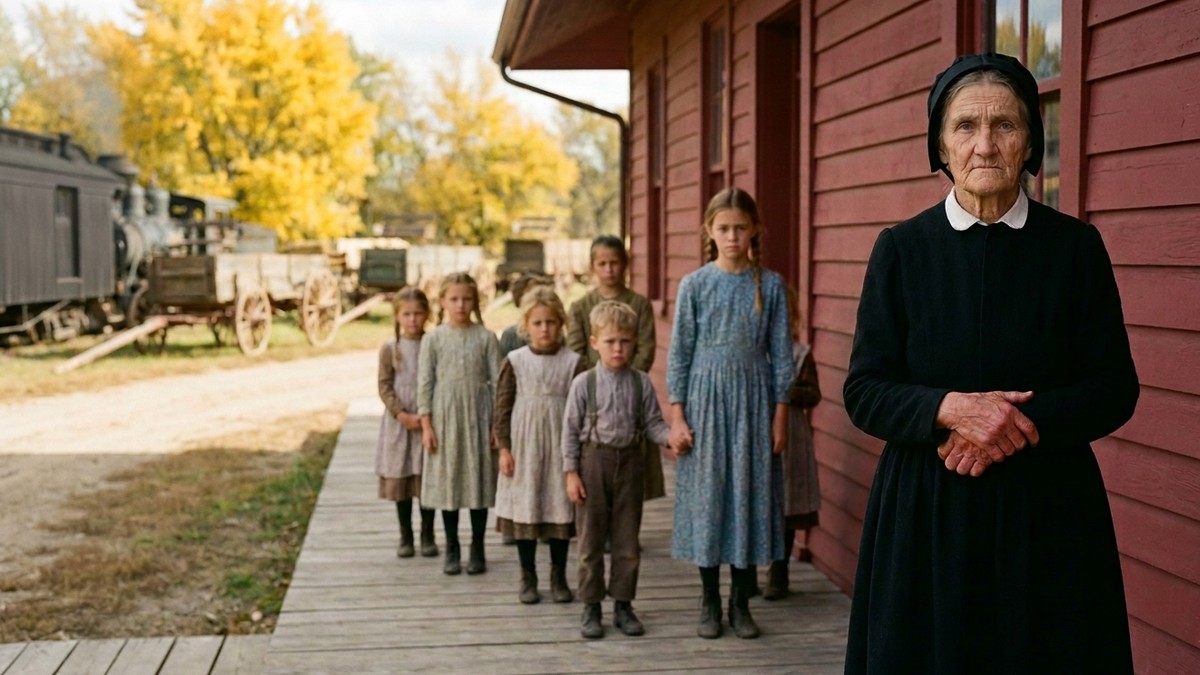
It was October 1893, in Linden Grove, Missouri, a little depot town in the northern part of the state, and the orphan train had come in that morning from New York. Twenty-two children. The notice had been up in the post office for a month: Homes Wanted for Children. Farmers and their wives had come from all over the county, in wagons and buggies, to look them over.
They were lined up now on the depot platform, scrubbed and brushed, in their best clothes, while the agent from the Children's Aid Society read out their names.
Martha was sixty-four. Henry was sixty-eight. They had come because Henry's back had given out at last, and their own boys were grown and gone, one to Kansas City and one to the churchyard, and there were forty acres of corn standing in the field waiting to be husked.
"A boy," Henry had said at breakfast. "Twelve or thirteen. Big for his age. Somebody to work."
Martha had not argued. She had put on her good black dress and her bonnet and come along.
The girl stood at the far end of the platform.
She was older than most. Eleven or twelve, thin, with straight brown hair pulled back hard and a face too pale to be pretty. Her dress was faded blue calico, let out at the hem as far as it would go. She held a small boy by the hand, seven or so, with the same brown hair.
While the agent talked, the girl did a strange thing. She knelt down on the platform, took a needle out of her own collar, where it had been pinned, and a bit of thread, and darned a hole in the little boy's stocking, right there in front of everybody, in about a minute. Then she pinned the needle back into her collar and stood up.
Martha watched her hands do it. Quick, neat, red at the knuckles from lye soap.
She knew those hands.
Agnes Moran had stopped hoping somewhere around the second town.
She was twelve. She knew how it went. The little ones went first, the pretty ones, the babies with curls. Then the big boys, for farms. Girls of twelve went last, if they went at all. At the last stop the agent took whoever was left back to New York.
She did not mind so much for herself. She minded for Tommy.
Tommy was seven, and he was all the family she had left. Their mother had died in the spring, in the tenement on Mulberry Street, and their father long before that. Agnes had promised her mother, at the end, that she would look after Tommy. She had darned his stockings and washed his face and held his hand on the train for nine hundred miles.
"Thomas Moran," the agent read out. "Age seven."
A man and his wife came forward. They had a good wagon and a kind face between them. They looked at Tommy and talked to the agent in low voices, and the wife bent down and asked Tommy if he liked horses.
He said yes. He did. He liked horses more than anything.
"Agnes," he said, turning around, "they have horses."
The agent wrote in his book. The woman took Tommy's hand. Agnes let go of the other one. She had not known, until that moment, that letting go of a hand could hurt so much.
"Be good," she told him. "Mind them. I'll write."
Then Tommy was gone, up into the wagon, looking back at her over the tailboard, until the wagon turned the corner by the feed store.
Martha saw her face when the wagon turned the corner.
The girl did not cry. She stood perfectly straight on the platform with her empty hand at her side, and her face did not move at all. Only her throat moved, once, as if she had swallowed something sharp.
Martha Keel had seen that face before. A long time ago. In a looking glass.
"That one," Henry said, low, at her elbow. "The big fellow at the end. Sam something. He'd do."
Sam was thirteen, broad and freckled, with hands like shovels. But a farmer from over by the creek had already stepped up and taken him by the shoulder, and was talking to the agent, and nodding.
Henry swore under his breath. "Well, that's that."
One by one, the children went. A girl of five with yellow curls, before the agent had finished her name. Twin boys of nine. A baby nobody had known was on the train. By three o'clock there were four children left on the platform, and three of them were small boys with spectacles or a limp or a cough.
The fourth was Agnes Moran.
Nobody had looked at her twice. One woman had asked to see her teeth.
At ten minutes to four, the engine whistled.
The agent closed his book with a sigh. "Remaining children back aboard, please," he called. "We go on to Macon."
Henry Keel turned his hat in his hands and looked at the empty road.
"No boy," he said. "Well. They'll send another train in the spring. We'll make out. I can hire the Dawson boys for the husking, if I have to."
Martha did not answer.
She was watching Agnes Moran pick up her bundle. A little flour sack, tied at the neck with string. Everything the girl owned in the world. Agnes did not look at anybody. She walked to the step of the passenger car with her back very straight, and put her hand on the iron rail, and lifted her foot to the step.
"Martha," said Henry. "Come along. It's a long drive home."
The conductor raised his hand to signal the engineer.
And Martha Keel, who had not raised her voice in public in sixty-four years, opened her mouth.