Loretta laid the pen down on the deed, crossways, so it covered her typed name.
"Darlene, hon," she said. "Could you give us the room for a few minutes?"
Darlene looked at Shelby, then at Loretta, and picked up her coffee mug. The door clicked shut behind her. The air conditioner hummed on.
"Mama, it's two o'clock in eight minutes."
"I know what time it is." Loretta opened her purse and took out the long white envelope. She set it on top of the deed. "This is for you."
Shelby's knee stopped bouncing.
"What is it?"
"Open it and see."
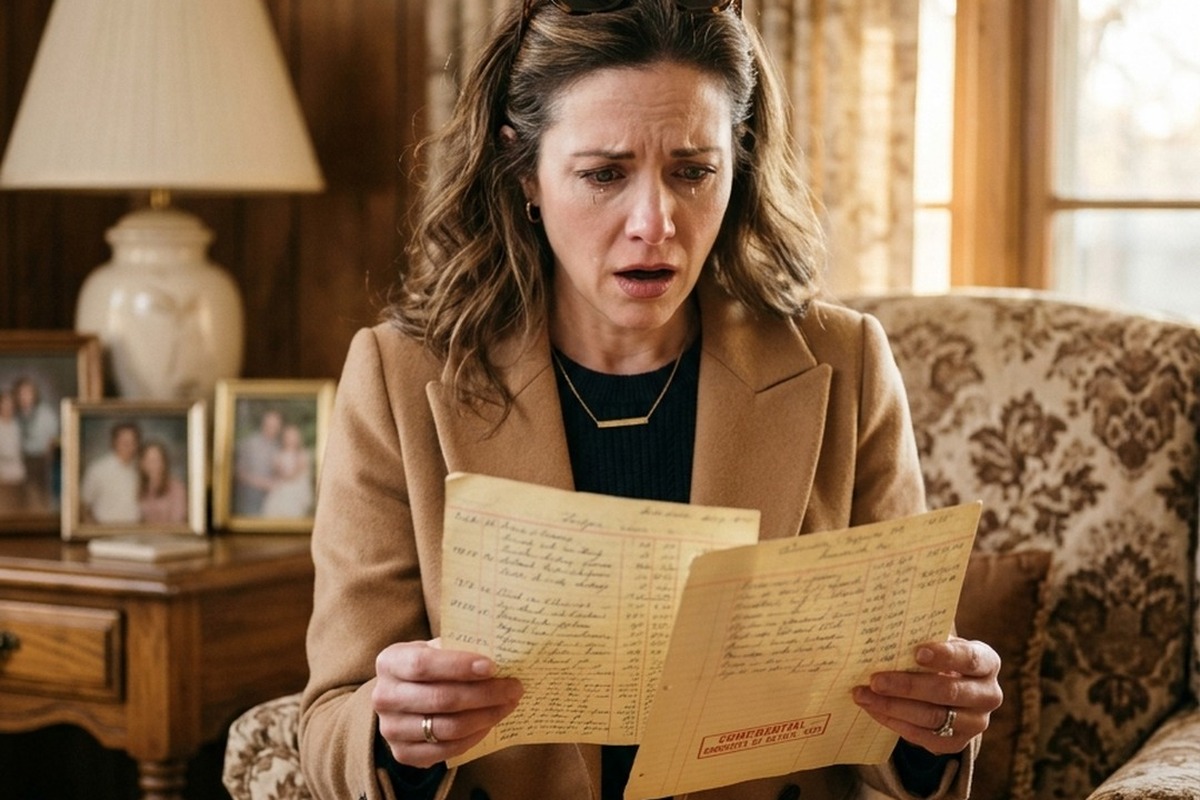
Shelby slid a nail under the flap. Inside were six sheets of green ledger paper, copied out in Loretta's cafeteria hand over four evenings at the kitchen table. Every line had a date, an amount, and a word.
March 3, 2010. $250. Transmission.
Nov. 19, 2011. $600. Electric and gas.
Dec. 22, 2014. $1,200. Christmas for Kaylee.
Aug. 5, 2017. $3,000. Lawyer, divorce.
The lines went on. A deposit on an apartment. A dentist. A car note, then the same car note, then the same car note again. Every single line was stamped in square red letters at the right margin.
PAID.
Shelby turned the pages slowly. On the last sheet, under the last line, a total was written and circled.
$71,840.
Under that, in the same green ink, Loretta had written one more sentence and stamped it.
Paid in full. That was your inheritance.
Shelby read it twice. Her lips moved the second time.
"You kept a list." Her voice came out small. "Fifteen years, and you kept a list on me."
"I kept books," Loretta said. "It's what I did for thirty-one years. I never once sent you a bill."
"So what is this, then?"
"It's a receipt."
Shelby pushed the papers back an inch. Her eyes had gone bright and hard.
"I called Mr. Ortiz," she said. "I guess you know that."
"He told me."
"I wasn't trying to take anything. I was scared, Mama. You're seventy-six, you live by yourself, you don't lock the back door." Shelby pressed her palms flat on the table. "And I'm forty-eight years old and I rent a room from a man who texts in capital letters. You've got a paid-off house with nobody in it but you and a television."
She looked up.
"And you never once said no. Not one time in fifteen years. How was I supposed to learn the word if you never used it?"
The air conditioner cycled off. In the quiet, Loretta could hear the clock over the door.
She had no answer that was better than the truth.
"You're right," she said. "That part's on my page. Not yours."
Loretta reached into her purse again and took out the stamp and the ink pad. She set them side by side on the table.
She turned the ledger copy to the last sheet. Above the total, the final line from Tuesday night had no stamp beside it yet.
Oct. 14, 2025. $400. Rent.
She opened the pad. The ink was still wet from Thursday.
She pressed the stamp down into it once. Lifted it. Set it beside the line.
Brought it down.
The table jumped a little under her hand. The sound was the same one the lunch line had heard ten thousand times, a flat, solid knock.
Loretta lifted the stamp away. PAID sat square and red next to the four hundred dollars, the ink just beginning to shine.
She capped the pad and put both things back in her purse.
"Here is what I did yesterday," Loretta said. "So you hear it from me and not from Abel."
Shelby didn't move.
"The house stays mine as long as I'm in it. After that it goes to Kaylee, held in trust until she's twenty-five, so nobody can borrow against it in a hurry. A little goes to the lunch account at the elementary school. For kids who come up short."
"Kaylee," Shelby said. "Kaylee knew about this?"
"Kaylee showed me where the red button was. That's all Kaylee knows."
Shelby laughed, once, without any fun in it. She picked up the blue pen and turned it over in her fingers.
"So I get a receipt."
"You got seventy-one thousand eight hundred and forty dollars, sugar. You got it while I was alive to watch you spend it." Loretta kept her voice low. "I'm not signing anything today. I'm not sending money anymore. That's the new rule, and it starts now."
"And if I don't call?"
Loretta folded her hands on her purse.
"The phone works both ways. Sunday dinner's at noon. It always has been."
Shelby sat a long time. Then she gathered the six green sheets, squared their edges against the table the way Loretta had taught her at nine years old, and slid them back into the envelope.
She took it with her. She did not take the deed.
When Darlene came back in, Loretta asked her to shred it. The machine in the hall made a high, grinding whine, and then it was done.
Shelby did not call that Sunday, or the one after.
Loretta made pot roast both times anyway. She ate a plate, wrapped the rest in foil, and took it next door to the Delgado boys, who were seventeen and fourteen and could eat a roast like it owed them money.
On the third Sunday it turned cold. The front came through Junction and on into Verbena, and the pecan trees let go of almost everything at once.
The phone rang during the ten o'clock weather.
Loretta looked at the name on the screen and let it ring twice. Then she muted the weatherman and picked up.
"Mama, I'm." Shelby stopped. Loretta heard her breathe in. "I'm calling to see how you are."
"I'm fine, sugar. How are you?"
"I sold the SUV. I got a little Corolla with a hundred and forty thousand miles on it. It smells like somebody's dog." A small, rough laugh. "I'm still renting the chair. I'm picking up Saturdays."
"That's good."
"Is it still noon? Sunday?"
"Bring a dish," Loretta said. "Something you made."
After they hung up, she sat at the kitchen table a while with the weatherman pointing silently at the cold.
Then she opened the second drawer, took out the green ledger, and turned to the last page. She wrote the date in her cafeteria hand, and beside it, two words.
Shelby called.
She left the amount column empty and closed the drawer on the stamp.