The lawyer's envelope sat unopened on Dale Kessler's kitchen counter for eight days, and his father was buried without him.
Linda finally set it on his dinner plate, right on top of the pork chop. "Open it or throw it out," she said. "I'm tired of dusting around it."
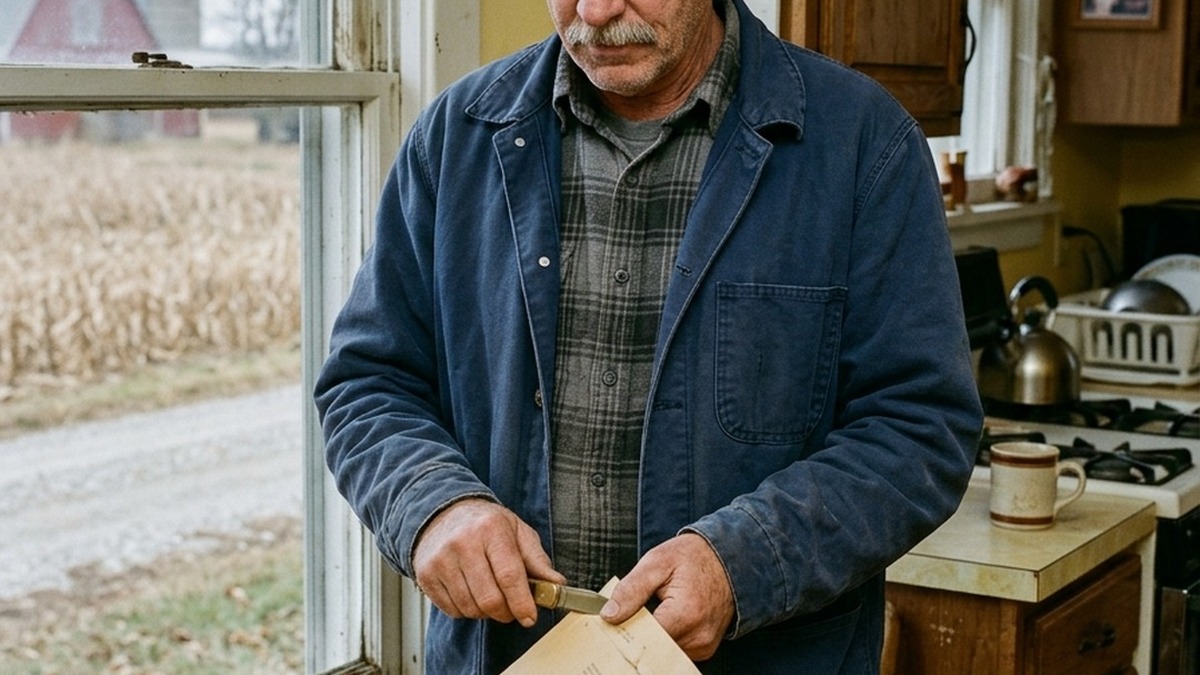
Dale took out his pocketknife and slit the envelope along the short end, so the address stayed whole. His father had opened every feed bill and seed invoice that way at the kitchen table, then saved them in an old seed-corn box on the shelf above the cellar door. Dale had been gone forty years and still could not open mail any other way.
The letter was one page. Walter Kessler, 86, of Alder Springs, Iowa, had passed on October 28. The will would be read Thursday, November 13, at 10 a.m., in the office of Martin Albrecht, Attorney at Law.
The last line had been underlined in ink. Your presence is specifically requested.
"That's two days," Linda said.
"I know what day it is." Dale folded the letter on its old creases. "He didn't want me there in 1985. I don't see why he'd want me there now."
"Dale."
"I wrote that man every month for twenty years. Every month, Linda. Not one line back." He pushed the plate away. "I'd bet my pension he burned every one of them in the barrel behind the machine shed."
Linda picked up his plate and carried it to the sink. The water ran hot for a long time before she spoke.
"Then go find out," she said.
The drive from Chicago took five hours, and the last forty minutes were gravel. Harvest was done. The fields on both sides of the road were cut to stubble, and the wind coming across them smelled of corn dust and cold dirt.
The farmhouse looked smaller. The grain bins looked bigger. A new machine shed stood where the hog barn used to be.
His brother Gary was in the yard, coiling an extension cord over his elbow. He was fifty-four now, heavy through the shoulders, with their father's way of standing with his weight on his heels. He did not stop coiling.
"Funeral was Tuesday," Gary said.
"I got the letter late."
"You got it on time. Albrecht told me when he sent it."
The screen door banged, and Ruth came down the steps in a barn coat over her church sweater. She was sixty-one and had gone gray all at once, like their mother had. She hugged him with one arm, quick and stiff, and she smelled of coffee and dish soap.
"You look like him," she said. "Around the eyes. Come in before you freeze."
The kitchen was the same yellow, with a newer refrigerator. Dale stood by the table where he had eaten every meal until he was eighteen, and he did not sit down.
Ruth poured him coffee. "He got the mail himself every day, right up until August," she said. "Walked out to the box at the road with his cane. Wouldn't let either of us get it."
"Why?"
Ruth shrugged and looked at Gary, and Gary looked at the floor.
Above the cellar door, the shelf where the seed-corn boxes had always sat was bare. There was only a clean rectangle in the dust where they had been. Dale figured Gary had already started clearing the house out.
After supper, Gary laid a folder on the table and opened it with two fingers.
"Prairie Ridge Land Partners, out of Des Moines," he said. "Eleven thousand four hundred an acre for all two hundred forty. Ruth and I sign Friday at noon, or the offer's off the table."
Dale read the first page. His own name was not on it anywhere.
"You're not on the paperwork," Gary said, "because you're not on anything. You haven't been since you drove off."
"It's Dad's land. Nobody knows what's in the will yet."
"I know." Gary sat back. "I got up at five every morning of my life for that man. I was here when the bank came out in '86. I was here when the hogs went bad. I was the one who sat with him in August when he couldn't get his breath." He tapped the folder. "You want to tell me where you were, Dale? Because all you ever sent was paper."
"I sent a letter every month for twenty years."
Gary looked at him a long time.
"I never saw one," he said.
Dale went out the back door without his coat. The burn barrel still stood behind the machine shed, rusted through at the bottom. He tipped it with his boot and the ashes slid out gray and fine in the yard light, nothing left in them to read.
His old room was cold. The storm window had a crack in one corner, and all night the wind came through it with a thin, steady whistle.
Martin Albrecht's office was over the hardware store on Main Street. The radiator under the window knocked and hissed, and the room smelled of hot dust and old paper.
Albrecht was close to eighty, in a brown cardigan, and he read the will out loud the old way, with his glasses down his nose.
The machinery and the pickup went to Gary. The savings account went to Ruth. Albrecht turned the page and cleared his throat.
"The farm and all the ground, two hundred forty acres in Clay Township, I leave to my son Dale Kessler."
Nobody moved. Ruth's hand went flat on the table.
"That's not right," Gary said quietly. "Read it again."
Albrecht read it again, word for word.
Then he stood, bent down behind his desk, and lifted a seed-corn box onto the table, the green and yellow cardboard gone soft at the corners. Two more sat on the floor behind him.
"Your father asked me to give you these," Albrecht said to Dale, "with your brother and sister in the room."
The lid was held down with old masking tape. Across the top, in his father's square, heavy pencil, was one word.
Dale.
Behind him, Gary's chair scraped back hard against the floor.