The barnyard went quiet. Two hundred people stood in the cold, looking up at the auctioneer who had just put down his gavel in the middle of a bid.
Ray climbed down off the wagon. His knees told him about it.
He walked through the crowd, slowly, the way he walked through a sale barn on a busy day. People stepped out of his way. He went to the back of the crowd, where the first dealer stood with his bidder card still half raised.
"Morning," Ray said.
The man was about sixty, with a red face and a good insulated jacket. "Problem?"
"Maybe," Ray said. "What's your name, sir?"
"Ron Kessinger."
"And those two fellows over there, by the corn crib and by the church table. Friends of yours?"
Kessinger's face didn't change. "Never met them."
Ray nodded slowly. Then he turned around and raised his voice so it carried across the barnyard without a microphone, the way he'd learned to do before there were microphones at farm sales.
"Bev," he called. "Would you bring me the bidder sheets?"
Bev Truitt had kept the books for the Calder County sale barn for thirty-one years. She ran the clerk's table at every farm sale Ray called, and she never missed a name, a number, or a dollar.
She came across the barnyard with her clipboard.
"Bidders 47, 48, and 51," Ray said. "Where are they from?"
Bev didn't even have to look. She'd noticed when they signed in.
"All three gave the same business address," she said. "Kessinger Equipment, Route 3, Seymour, Indiana. Same phone number too."
The crowd murmured. Kessinger's red face got redder.
Ray turned back to the crowd. He didn't shout. He didn't have to.
"I've called sales for forty-six years," he said. "I've seen this before, not often, but enough. Three men from the same company standing in three different places, never bidding against each other. It's called pooling. It's against the law, and the reason it's against the law is that it steals from the man who's selling."
He looked at Emmett Sauer in his lawn chair by the barn door.
"It's been stealing from Emmett all morning," Ray said.
Kessinger opened his mouth. Then he looked around at two hundred farmers in coveralls, and he shut it.
"Here's what's going to happen," Ray said. "The terms of this sale say the auctioneer's decision is final in all disputes. It's printed on the bill on the side of that wagon. I'm reopening the last six lots. Every one of them goes back up, starting fresh. You fellows are welcome to stay and bid on them, separately, against each other and everybody else, the way the rest of these people have been bidding all morning. Or you're welcome to go."
One of the younger dealers shook his head, walked to his truck, and drove off with an empty trailer.
Kessinger stood there a long moment. Ray waited.
"It's a thin business," Kessinger said finally, low, so only Ray could hear. "Margins are nothing anymore. Fuel, trucks, insurance. Plenty of guys do it."
"I don't care what plenty of guys do," Ray said. "I care what happens in my sale."
Kessinger looked at him. Then he looked at his bidder card, and he put it back in his pocket, and he didn't take it out again for the rest of the day.
Ray climbed back up on the wagon and turned on the microphone and started over.
The hay rake that had gone for eleven hundred went for nineteen. The disk went for twice what it had. The baler sold to a young couple from Zanesville for a price that made Emmett sit up straight in his lawn chair.
Then they got back to the Farmall H.
It went up fast. Wyatt raised his card at three thousand, and at thirty-five hundred, and at four. Then a collector from Columbus raised his, a pleasant man in a good coat who restored old tractors and paid honest money for them.
Five thousand. Six. Seven.
Wyatt looked at the ground.
"Seventy-two hundred," Ray called. "I have seventy-two hundred. Going once."
Over by the barn door, Emmett Sauer stood up.
It took him a moment. He put one hand on the barn wall and pushed himself up out of the lawn chair and let the blanket fall, and he raised his other hand toward the wagon.
Ray stopped. He knew what that hand meant. He'd been calling farm sales long enough.
"Ray," Emmett said. His voice was thin in the cold, but it carried. "That tractor isn't sold yet. Is it?"
"Gavel hasn't fallen, Emmett."
"Then I'm taking it out of the sale," Emmett said. "It's mine till you say sold. And I'm not selling it."
He looked at the collector from Columbus. "I'm sorry, mister. You bid fair. It's just I've got a better use for it."
The collector took it well. He came over afterward and shook Emmett's hand and said if he had a grandson like that, he'd have done the same thing.
When Bev finished the books at four o'clock, the reopened lots had brought in eleven thousand, three hundred dollars more than they'd sold for the first time around.
"Ray got me more for the rest of it than I'd have got for the whole thing," Emmett told Wyatt, putting the Farmall's key in his grandson's hand. "Those Indiana fellows were going to walk off with it for half. I reckon I can afford to give away one tractor."
Wyatt couldn't say anything. He just stood there holding the key.
"My daddy was at that penny auction in '32," Emmett told Ray. "Did you know that? Down on Hollow Creek. He bid a nickel on a mule and gave it right back."
"I didn't know that," Ray said.
"Well, he did." Emmett looked at the tractor. "He'd have called today a penny auction."
"No," Ray said. "He'd have called it a fair one."
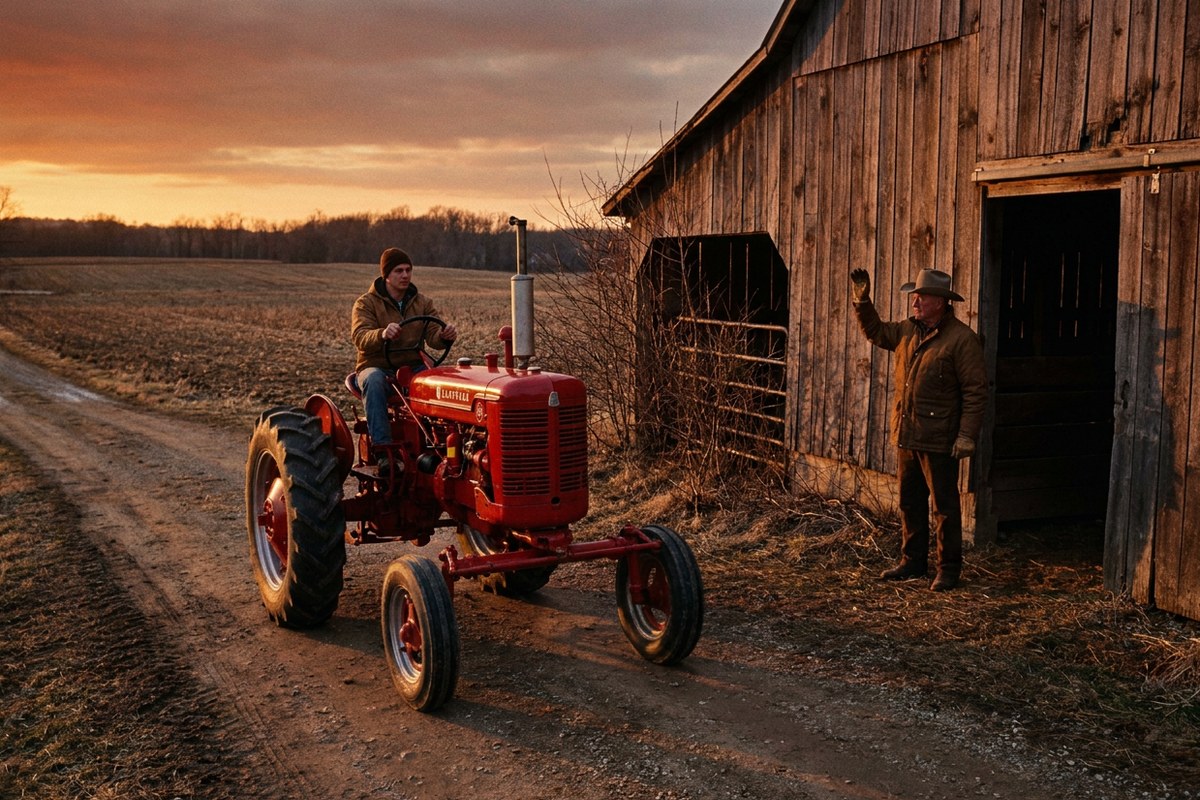
At a quarter to five, with the sun going down orange over the bare fields, Wyatt climbed up into the seat of the Farmall H and turned the key.
It started on the first try, the way it always had. He eased it out of the barnyard and onto Route 9, headed for his forty rented acres on the other side of the road, and the whole crowd that was left stood along the fence to watch him go.
Emmett stood at the barn door with his hand raised until the little red tractor went over the hill.