The voice on the phone said, "You probably don't remember me," and Clay Hollister sat down hard on the kitchen stool.
"Try me," Clay said.
"Lonnie Bascom. I worked pickup at Cheyenne in '83."
Clay didn't say anything for a long moment. Across the kitchen, Marlene looked up from the sink, saw his face, and turned off the water.
"Lonnie," Clay said. "Well, I'll be. Where are you?"
"Columbus," the voice said. "The bus station. I'm just passing through. Saw on a map I was close to Pine Hollow and remembered you'd settled out this way. Thought I'd say hello."
There was something in the voice Clay didn't like. Something careful.
"You stay right there," Clay said. "I'm coming to get you."
It was ninety minutes to Columbus. Clay drove it with the radio off.
He was seventy-three. He'd ridden saddle bronc from 1970 to 1988, from Pendleton to Calgary to Houston. He'd won some and lost more, and he'd been stomped, kicked, dragged, and thrown into the fence more times than he could remember.
But he remembered Cheyenne.
Frontier Days, July of 1983. Clay drew a big gray horse named Widowmaker, which was a fine name for a horse and a bad one for a rider. At the fourth jump, the gray went straight up and came down sideways, and Clay came off, and his left boot didn't.
His foot hung in the stirrup.
Being hung up is the thing every bronc rider fears most. A horse that's still bucking, a man upside down, his head and shoulders bouncing in the dirt under those hooves. A rider can die that way in a few seconds.
Clay remembered the dirt. He remembered the sky going around. He remembered the hooves.
And then he remembered a big bay horse coming in alongside at a dead run, close enough to touch. A man leaned down out of the saddle, caught the gray's rein, and hauled its head around hard against his own horse's shoulder.
The gray stumbled and quit bucking for one second. Clay's boot slipped free, and he hit the dirt and rolled.
The pickup man was Lonnie Bascom. He'd been twenty-nine.
Clay's hip was broken in three places. He'd ridden again, eventually, but never as well.
He still limped. Every morning of his life since, when he stood up out of bed, his left hip had reminded him that he was alive because Lonnie Bascom had ridden into a wreck that most men would have stayed out of.
He'd never properly thanked him. There'd been a hospital, and then a long winter, and then another season, and they'd lost track. That was how the rodeo was.
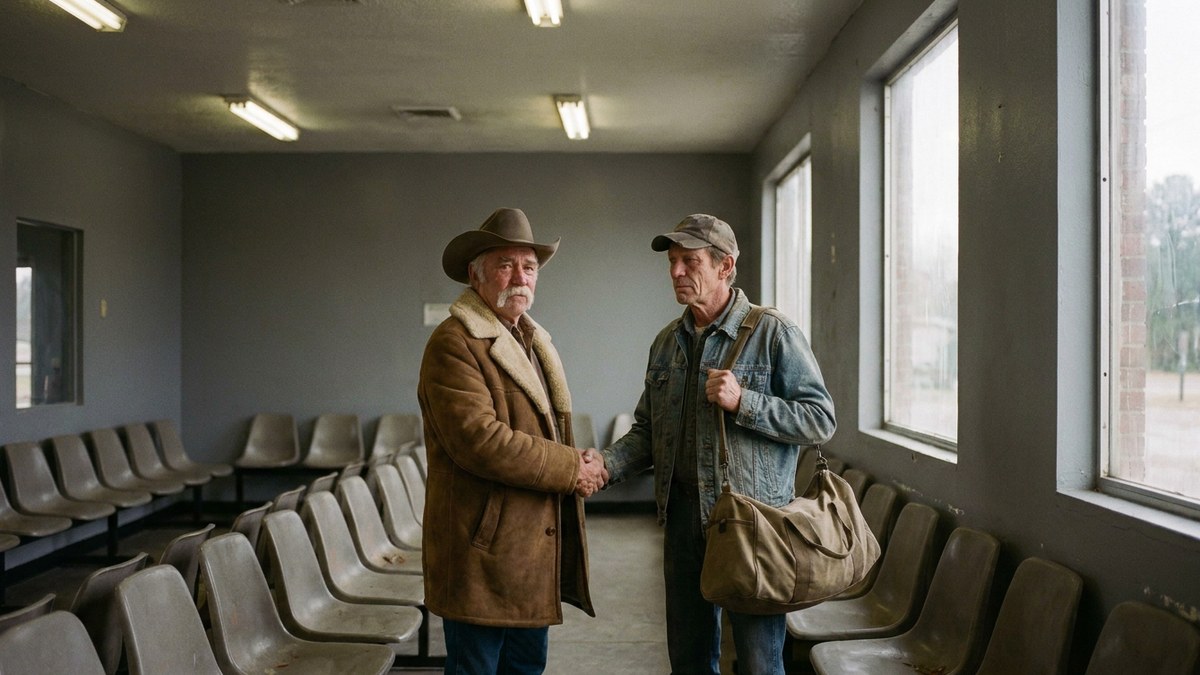
The Columbus bus station was gray and bright and smelled like floor cleaner and coffee. Clay limped in through the front doors and saw him right away.
Lonnie was sitting on a bench near the ticket counter with a canvas duffel bag between his boots. He was seventy-two, rawboned and weathered, in a sheepskin coat that had seen better decades, with his hat on his knee. When he saw Clay, he stood up straight, the way an old cowboy stands up, all at once.
They shook hands. It turned into something else, and they both let it, for about three seconds.
"You look like hell, Hollister," Lonnie said.
"You look worse."
"I've had a longer bus ride."
Clay looked at the duffel bag. It was stuffed so full the zipper wouldn't close. A pair of old leather chaps stuck out of one end, and a coffee can, and the corner of a framed picture.
A man doesn't carry a framed picture on a bus when he's just passing through.
"Where are you headed?" Clay asked.
"Pittsburgh. My daughter's there." Lonnie said it easily. "She's expecting me. Got a room all fixed up."
"That's good."
"Yeah. I just need to change buses. I'm a little short on the ticket. Forty dollars, if you've got it. I'll send it back to you when I get settled."
Clay reached for his wallet. Then he stopped.
He'd been reading horses and men for fifty years. He'd learned to watch how they held themselves, more than what they said.
A horse that's lying to you about being gentle holds its ears a certain way. A man does too.
Lonnie Bascom was holding his shoulders up around his ears. He was looking at the floor, not at Clay. And his hand, on the strap of the duffel, was holding on so tight the knuckles were white.
"What's your daughter's name?" Clay asked.
"Rae Ann."
"What's her number? I'll call her and tell her you're running late. So she won't worry."
Lonnie didn't answer for a moment.
"I've got it written down somewhere," he said.
He found it in his coat pocket, on a scrap of paper, and Clay dialed it on his phone while Lonnie watched. It rang once. Then a recorded voice came on and said the number was no longer in service.
Clay lowered the phone.
Lonnie didn't look at him. "She doesn't know I'm coming," he said quietly. "We haven't spoken in nine years. I lost the place in Wyoming in October. I thought maybe if I just showed up at her door."
He stopped.
Over the loudspeaker, a voice announced the eastbound to Wheeling and Pittsburgh, now boarding at gate six.
Lonnie picked up his duffel bag.
"Thanks for coming, Clay," he said. "It was real good to see you."
He walked to gate six without looking back. Clay watched him count out the last of his bills at the door and buy a ticket only as far as Wheeling, as far as the money would go.
Then he climbed on. The bus doors folded shut behind him.