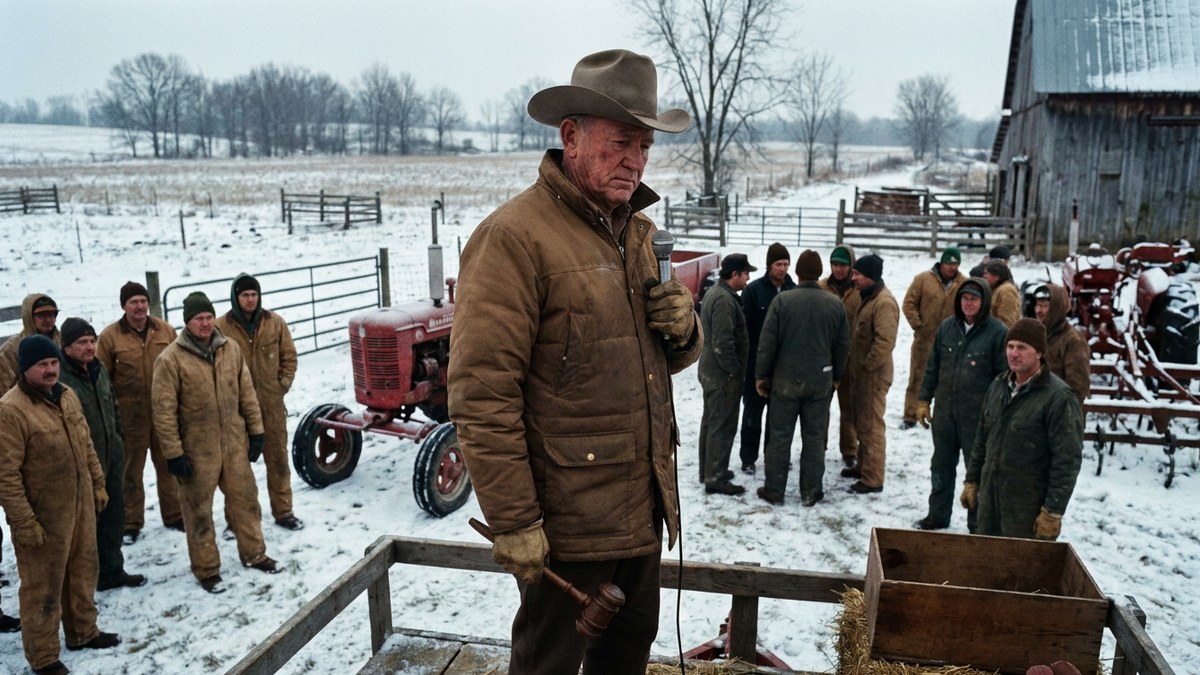
Ray Dunbar had called more than three thousand auctions in forty-six years, and he'd never once wanted to put the microphone down before the first lot.
He wanted to this morning.
The sale bill was taped to the side of the hay wagon. EMMETT SAUER FARM DISPERSAL. Saturday, January 23, 10 a.m. Tractors, machinery, hay, tools, household.
4 miles north of Pine Hollow on Route 9. Lunch by the Grace Methodist Women.
Terms: cash or good check. Auctioneer's decision final in all disputes.
Emmett was eighty-six. He'd farmed this ground since 1958. In the fall he'd had a heart attack in the barn, and his daughter in Cincinnati had found him a room at Maple Grove, and he'd agreed, finally, that it was time to sell.
Ray had known him for fifty years. He'd sold Emmett's first bull for him, in 1977.
It was nineteen degrees. The crowd stood in the barnyard in insulated coveralls and stocking caps, stamping their feet, holding foam cups of coffee from the church women's table.
There were maybe two hundred people. Most of them were neighbors.
Some of them weren't.
Ray had seen the trucks pull in at eight. Three big dually pickups with long flatbed trailers, Indiana plates, lettering on the doors. Equipment dealers.
They went to sales all over the Midwest, bought low, hauled it home, cleaned it up, and sold it high. That was their business. Ray had no quarrel with it.
He'd watched the three of them walk the line of machinery together at nine, though, talking low. And he'd watched them separate when the sale started, so they were standing in three different parts of the crowd.
That he had a quarrel with. He just didn't know it yet.
At the end of the machinery line, by itself, sat a red tractor.
It was a 1952 Farmall H. Emmett had bought it used in the spring of '58 from a dealer in Marietta, with money he'd saved working at the glass works.
It still ran. He'd restored it himself in 1990, every bolt, and he'd driven it in the Pine Hollow Fourth of July parade every year until his heart gave out.
Emmett's grandson was standing next to it with his hand on the rear tire.
Wyatt Sauer was twenty-four. He'd grown up on this farm. He worked at the feed mill now and rented forty acres on the other side of Route 9, and what he wanted more than anything was to farm, and what he had was four thousand dollars in the bank.
"That's for the H," Wyatt had told Ray at the coffee table, half embarrassed. "That's all of it. It's all I've got."
"Collectors go crazy for an H in that shape," Ray said carefully. "Might go higher than that, son."
"I know it." Wyatt looked over at his grandfather, who sat in a lawn chair by the barn door with a blanket over his knees. "But I've got to try."
Before the first lot, Ray climbed up on the wagon and keyed the microphone.
He always told a story first. It warmed people up. Today he told the one his grandfather used to tell.
"In the winter of 1932," Ray said, "the bank foreclosed on a farm down by Hollow Creek. My grandpa was there. Neighbors came from all over the county, and every time the auctioneer put up a plow or a cow, somebody bid a penny. Then they stood there and looked at anybody else who'd thought about bidding. Not one man there bid against them. When it was all over, they'd bought the whole farm for about four dollars and eighty cents, and they gave every bit of it back to the family."
The crowd laughed. A few of the old men nodded.
"That was a penny auction," Ray said. "Those were hard times, and it was a hard thing they did. But I'll tell you plain, that's not how I run a sale. Emmett Sauer worked sixty-eight years for what's sitting in this yard, and every item is going to sell for what it's worth to the folks bidding on it. Fair and open. That's my job. Let's go to work."
They started with small tools. Then the hay. Then the machinery.
By the fourth lot, Ray was sure.
The first dealer bid on a hay rake and got it for cheap. The second dealer bid on the disk and got it. The third bid on the baler.
They never once bid against each other. When one of them raised his card, the other two looked away, or checked their phones, or turned to talk to somebody.
Ray watched the neighbors bid up to what they could pay and stop. He watched the prices come in at sixty and seventy percent of what that equipment was worth, lot after lot. Emmett sat in his lawn chair by the barn door and watched too, and didn't say anything.
They were pooling. Ray was nearly sure of it.
Three men bidding as one, so there'd be no competition between them. When they got back to Indiana, they'd divide it up among themselves, and the money Emmett should have gotten would stay in their pockets.
But nearly sure wasn't sure. A man doesn't stop a farm sale and accuse three strangers in front of two hundred people on a hunch.
Then they rolled out the Farmall H.
Ray started it at two thousand. Wyatt raised his card. Twenty-five hundred.
A neighbor bid three. Wyatt bid thirty-five hundred. The neighbor shook his head and stepped back.
"Four thousand," Ray called. "I've got four thousand from the young man. Who'll give forty-five?"
In the back of the crowd, the first dealer raised his card.
Ray saw Wyatt's face go white. Then, out of the corner of his eye, he saw the second dealer, across the barnyard, give the first one a small, short nod.
Ray raised his gavel to call it.
Then he stopped. He lowered the gavel slowly, set it down on the hay wagon, and switched off his microphone.