Part 2
Honora Fahey took Mr. Brack by the front of his shirt.
She had never laid a hand on a boarder in her life. She did now. She pulled his big red face down close to hers in the hot red light of the hall.
"I was fourteen," she said, "at the Miramichi. In New Brunswick, in 1825. The fire came through the woods just like this one. My mother put us in the river. The neighbors went into their root cellars, because the cellars were stone." She held up her scarred left hand between them. "I went back for my friend Brigid. I got this. I never found her."
Mr. Brack stared at the scar.
"The cellar is an oven, Mr. Brack," said Honora. "The river is the only place in this town that won't burn. Two hundred and eighty steps. Every one of you has walked them. Now walk them again."
She let go of his shirt.
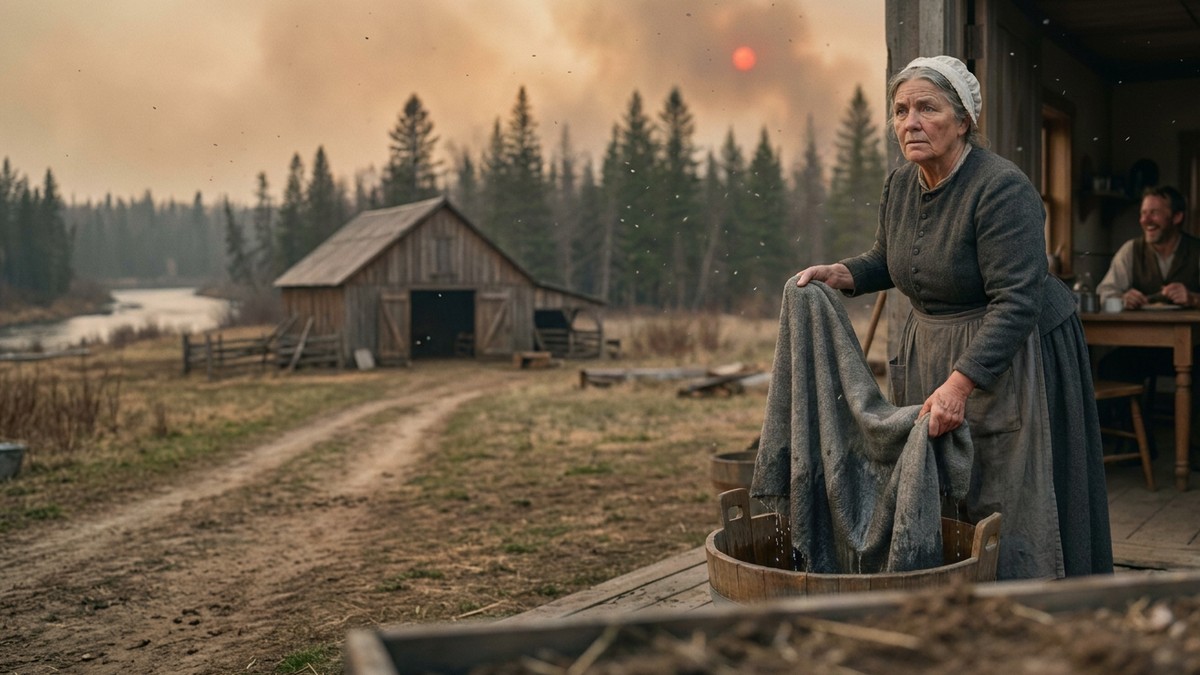
Then she picked up a dripping blanket in each hand and went out the back door into the fire.
They followed her.
Owen Kerrigan first, with the oldest Dunphy boy on his back. Then Mrs. Dunphy with the baby, under the wet blanket. Then the men from the mill, one after another, each with a blanket from the tubs over his head and shoulders, down the back lane into the howling, burning dark.
Mr. Brack came last. He stood in the doorway a moment, looking back at the cellar door. Then he grabbed the last blanket out of the last washtub, and the middle Dunphy child, a girl of four, who was standing frozen and screaming in the hall, and ran.
The lane was a tunnel of fire. Sparks blew past them sideways like hail. The air was so hot it hurt to breathe, and the wind screamed so loud that Honora could not hear her own voice counting. But she counted anyway. She had counted these steps every evening for a week, in the dusk, until her feet knew them.
Two hundred and seventy-eight. Two hundred and seventy-nine.
The bank went down under her feet, easy, into sand. And then she was in the river.
The water was cold. It was the most beautiful thing she had ever felt.
She waded out until it was at her waist, and turned, and shouted, and hauled them in after her one by one by the arms. Owen. Mrs. Dunphy. The mill men. Mr. Brack with the little girl. All of them. She counted heads in the red light. Thirteen. And herself. Fourteen.
All of them.
"Down," she shouted. "Down in the water to your necks. Keep the blankets wet. Keep the children's heads covered."
The whole river was full of people now. They had come pouring down from every street in Peshtigo, men and women and children, cows and horses swimming among them in terror. Behind them the town was burning. All of it. The church. The mill. The woodenware works, with its stacks of seasoned pails and tubs, went up in one great roar of flame that lit the sky like noon.
Honora stood in the river with the Dunphy baby against her chest under a dripping blanket, and dipped the blanket, and covered the baby's head, and dipped it again.
She did that for five hours.
Burning branches fell into the water around them. Sparks landed on the blankets and hissed out. Whenever a blanket began to steam, she pushed it under and raised it again. Her arms went numb. Her legs went numb. The cold water and the hot air fought over her body all night long.
Sometime after midnight, she looked across and saw Mr. Brack.
He was standing in the river to his chest, holding the four-year-old Dunphy girl up on his shoulders, out of the water, with his own wet blanket draped over both their heads. His face was black with soot. His shirtsleeves were scorched. He was dipping the corner of the blanket in the river with one hand and wiping the little girl's face with it, over and over, and singing to her. Some old hymn. Badly.
He saw Honora looking. He did not stop singing.
Dawn came up gray and terrible over Peshtigo.
The town was gone. Where the houses had been there were only chimneys, standing up out of the smoking ash like gravestones. The woodenware works was a heap of white embers. The boardinghouse on the east side, with its fourteen rooms and its six washtubs, was a black square in the ground.
They came up out of the river in the cold morning, shaking, coughing, holding each other up.
Honora counted them one more time on the bank. Thirteen, and herself. Mrs. Dunphy and her three children. Owen Kerrigan. Seven men from the mill. Mr. Brack.
Not one lost.
Many families in Peshtigo could not say that, that morning. Honora knew it. She knew it the way she had known it at fourteen, at the Miramichi, and she sat down in the wet sand and put her face in her scarred hand.
Mr. Brack came and sat beside her.
He still had the little Dunphy girl in his arms. She was asleep, worn out, with her head on his shoulder. He did not say anything for a while.
"I laughed at your washtubs," he said at last.
"You did."
"Every morning for a month." He looked down at the sleeping child. "Mrs. Fahey. When they rebuild the works, there'll be water barrels at every door. And wet blankets. I'll see to it myself. And every man on the payroll will walk to the river once a month and count his steps, whether he likes it or not."
Honora wiped her face.
"Two hundred and eighty," she said.
"Two hundred and eighty," said Mr. Brack.