Part 1
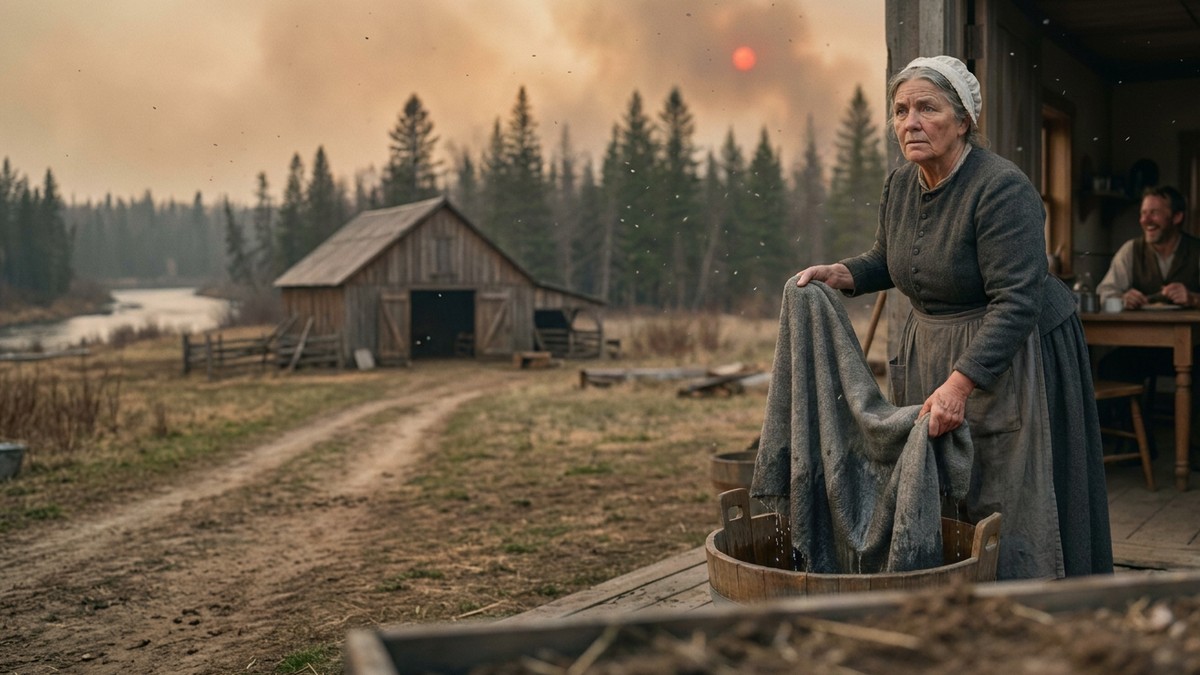
Mrs. Honora Fahey kept a washtub of wet blankets by every door of her boardinghouse, and the man who laughed loudest at them slept upstairs.
It was October 1871, in Peshtigo, Wisconsin, a sawmill town in the pine woods near the shore of Green Bay. It had not rained properly since July. All through August and September, small fires had smoldered in the woods and the slashings and the peat bogs, and the air in Peshtigo had smelled of smoke so long that nobody noticed it anymore.
Honora noticed.
She was sixty, a widow, a broad, slow, gray-haired Irishwoman with a burn scar across the back of her left hand, who kept a boardinghouse of fourteen rooms on the east side of the Peshtigo River, two streets back from the water. She had nine men boarding with her, most of them from the mill, and one widow, Mrs. Dunphy, with three small children.
And she had six washtubs, one by each door and two by the stairs, each with two wool blankets folded in it and covered with water.
She changed the water every morning.
"Mrs. Fahey," said Mr. Asa Brack at breakfast, "you'll have the floors rotted through."
Mr. Brack was the superintendent of the woodenware works, a big, red-faced, pleasant man of fifty who had boarded with her for three years. The woodenware works made pails and tubs and clothespins by the thousand, and he was proud of every one of them. He had a laugh you could hear across the street.
"There's water barrels on every corner of town, Mrs. Fahey," he said. "The company put them there. And there's smoke in this valley every fall. If I shut the works every time it smelled like fire, there'd be four hundred men out of a wage and nobody in Peshtigo would eat." He grinned and reached for the bread. "We're in no danger. Wet blankets. Lord."
The men laughed. Honora poured him more coffee.
"You'll know where they are, Mr. Brack," she said, "if you want one."
She did one other thing that the boarders thought was odd.
The first week of October, she walked every one of them down to the river. One at a time, after supper, in the dusk. Down the back lane, past the Henshaws' cow barn, across the marsh grass, to the place below the bridge where the bank went down easy into the water and the river ran wide and shallow, waist deep, over sand.
"There," she told each of them. "Look at it. Count your steps. Two hundred and eighty from my back door. You'll want to know the way in the dark."
"Why would I be going to the river in the dark, Mrs. Fahey?" asked young Owen Kerrigan, who was nineteen and worked the lathes.
"I hope you never will," said Honora.
She did not say anything else. She walked back up the lane with her scarred hand in her apron pocket.
Sunday the eighth of October dawned strange.
The sun came up red through the smoke and stayed red all morning. The air was hot and very still, hotter than it had any right to be in October. Ash drifted down out of the sky like gray snow. At church, the windows were shut against it, and still the smoke got in, and the little ones coughed through the sermon.
In the afternoon the birds stopped singing.
Honora noticed that too. She went out into the yard and stood with her head up, listening. Far off to the southwest, below the edge of hearing, there was a sound. Not thunder. Lower than thunder. A long, steady, growing roar, like the sea.
She went back into the house and changed the water in every washtub.
Then she went to Mrs. Dunphy's room.
"Dress the children," she said. "Shoes and coats. Don't put them to bed tonight."
"Mrs. Fahey, whatever for?"
"Do as I say, dear. Please."
At supper, Mr. Brack laughed at her again.
"I hear you've got the Dunphy children in their boots, Mrs. Fahey," he said. "Are we marching somewhere?"
"We might be," said Honora.
"You'll frighten them half to death."
"Better half," said Honora Fahey, "than all the way."
That shut him up. For a moment.
At nine o'clock the roar became a sound you could not talk over.
The sky to the southwest was no longer dark. It was red, and then orange, and then a terrible pulsing yellow, like the inside of a stove, and it was coming toward Peshtigo across the tops of the pines faster than a horse could run. The wind came first. It came out of nowhere, a hot screaming wind that tore the shingles off the roofs and filled the street with sparks.
Honora was at the back door before anyone else had moved. She hauled the first two blankets dripping out of the washtub and flung one over Mrs. Dunphy and the baby.
"The river," she said. "Everyone. Now. Two hundred and eighty steps."
Mr. Brack came thundering down the stairs in his shirtsleeves.
"Not the river," he shouted. "The cellar. Everybody into the cellar. It's stone. We'll be safe there till it passes."
The boarders stopped in the hall, in the red light, looking from one to the other.
Outside the window, the Henshaws' barn burst into flame all at once, from the ground to the ridgepole, like a match.