Mrs. C. L.
H. Fed the night shift.
Dolores sat on an overturned box in the basement and read it about twenty times. Then she went upstairs and started with the H.
That was a mistake, and it cost her a day. When she searched the Herald's index for the name Hammond, she got eleven thousand results.
Hammond, Indiana, was twelve miles up the road. Every fire, every ballgame, and every city council fight in Hammond for seventy years came pouring out.
So she quit searching for a name and searched for a meal.
The Herald had run small display ads on its back pages for decades, the kind a diner or a shoe repair shop could afford by the week. Dolores went through the microfilm for 1952 a page at a time with a magnifier.
In the third week of March, she found it. A box two inches square, at the bottom of page fourteen.
CORA'S KITCHEN. Open All Night. Plate Supper 65¢.
Biscuits & Gravy. 1418 Gate Street, Across from Gate 3.
Dolores sat back in her chair. Gate 3 was the night shift entrance. Men coming off at seven in the morning and men going on at eleven at night would have walked right past that door.
The Polk city directory for 1952 was on the shelf behind her. She ran her finger down the Gate Street listings until she got to 1418.
Hammond, Cora L. (wid Lucius) restr 1418 Gate St, h same.
Cora L. Hammond.
Widow of Lucius. Restaurant at 1418 Gate Street, and she lived there too.
Dolores said the name out loud in the empty reading room. It was the first time anybody had said it in that building.
After that, the paper trail came in pieces. Cora's Kitchen appeared in the directories every year from 1946 to 1967, then disappeared.
Lucius Hammond had worked at the coke plant and died there in 1945. The family had come up from Mississippi in 1943, like thousands of other families who rode the Illinois Central north during the war to work in the mills.
Cora had opened the kitchen a year after her husband died. For twenty-one years, she'd fed the men of the mill that killed him.
The obituary was in the Herald in February of 1979, four paragraphs long. Cora Lee Hammond, 82, a member of Greater Bethel A.M.E. Church.
Survived by a son, Lucius Jr., two grandchildren, and four great-grandchildren. It didn't mention the kitchen.
Dolores had a name now, and dates, and an ad. What she didn't have was a person.
Then one of the Tuesday regulars said, "You ought to ask Eddie Pawlak."
Ed Pawlak was ninety-four. He'd started at the Lakeshore mill in 1951, at eighteen, and retired in 1993, and he lived at the senior apartments on Chestnut Street with a parakeet named Truman. Dolores brought both prints and set the big one in his lap.
He studied it for a long time. Then he put his finger on the second row.
"That's me," he said. "Skinny kid with the big ears." Then his finger moved across the crowd, slowly, all the way to the far right edge. It stopped on the woman with the coffee pot.
"Well, I'll be," Ed said softly. "That's Cora."
Dolores's throat went tight. "You knew her."
"Honey, I ate at her counter four nights a week for fifteen years." Ed's eyes were wet, and he didn't seem to mind. "I came here from a farm in Wisconsin. Eighteen years old, homesick as a dog, didn't know a soul. First night on the job, I went into Cora's at six in the morning because it was the only light on. She looked at me and said, 'Baby, you look like you need a biscuit.' And I said I didn't have money till payday."
"What did she say?"
"She said, 'Then you'll pay me on payday.' And I did. Every payday, for fifteen years." He smiled. "Biscuits as big as your fist. Sausage gravy. She knew every man's order and every man's name, and she'd ask about your mother."
He told Dolores about the 1959 strike, a hundred and sixteen days with no paychecks, when Cora kept the kitchen open and wrote the men's suppers on slips of paper in a cigar box behind the register.
"After the strike, a lot of fellas paid her back," Ed said. "Some couldn't. She never asked them. Not once." He tapped the print. "And I'll tell you something else. That counter was the first place in this town I ever saw a white man and a Black man off the same crew sit down on two stools next to each other and eat. Cora didn't make a speech about it. That's just how she ran her place."
Dolores wrote it all down. Her hand was shaking.
Finding the family took four more days. Lucius Hammond Jr.'s obituary, from 2004, listed his grandchildren. One of them, Marcus Hammond, was thirty-one now and taught chemistry at a high school in Merrillville, twenty minutes away.
Dolores called the school and left a message. He called back that same evening.
"Cora Lee Hammond," he said slowly. "That was Big Mama Cora. My granddad's mother." There was a pause on the line. "I've got her biscuit recipe on a card in my kitchen. That's about all I've got. We never had a single picture of her."
He drove to the society on Saturday. Dolores laid out the big print, and the small one, and the ad, and the directory page, and Ed Pawlak's words typed up on two sheets of paper. Marcus read every bit of it standing up.
Gerald Fisk came in while he was reading. He stood in the doorway and looked at the young man and the photograph for a long time.
On Monday, Gerald called the printer himself.
Lake Ridge at 150 came out in May with a new cover. It was Stan Wozniak's close shot from the right side of the crowd: a woman in a white apron pouring coffee for two young men in hard hats, smiling at one of them like she knew his mother.
The caption underneath said Cora Lee Hammond, Cora's Kitchen, 1418 Gate Street. She fed the night shift.
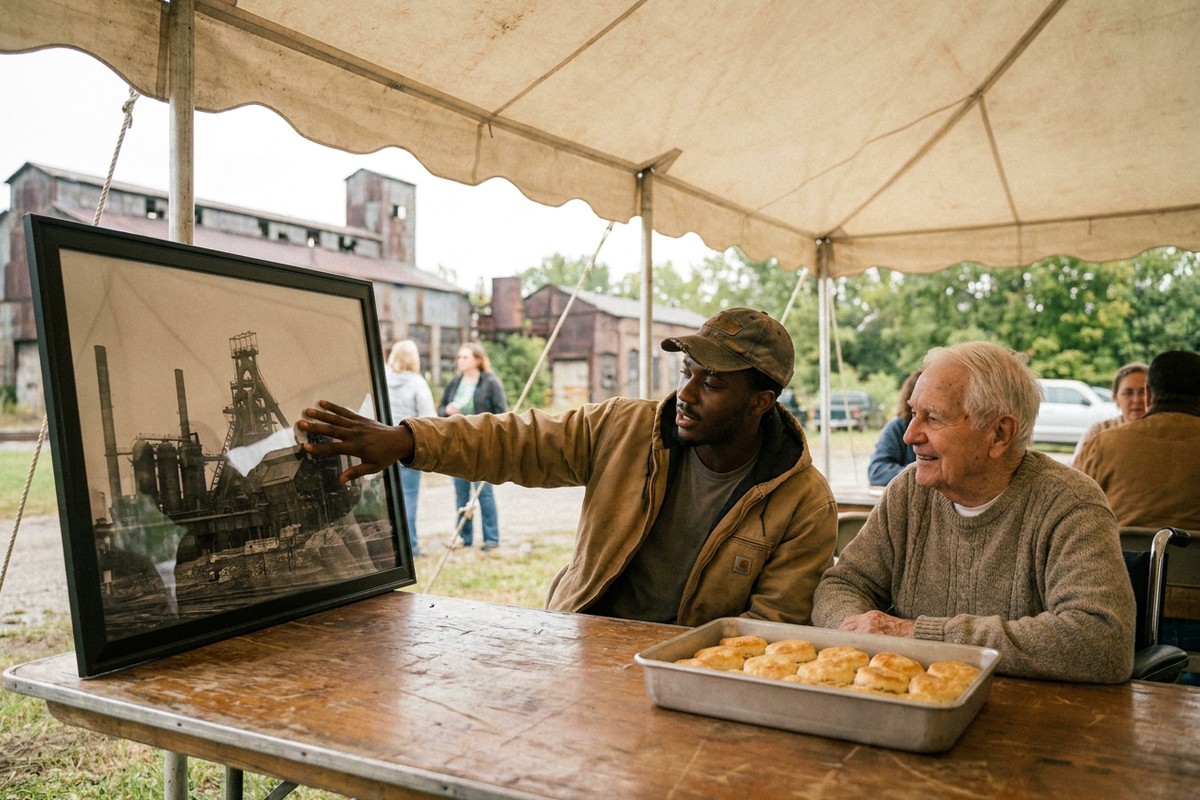
The town held its 150th celebration in the park by the old mill gate on the third Saturday in May. The society set up a long table under a tent with the big 1952 print in a frame at the end of it.
Ed Pawlak came in his wheelchair, wearing his Lakeshore Steel retirement jacket. Marcus came with his wife and two little girls and a pan of biscuits made from a recipe card, enough for the whole tent.
Dolores watched him stand in front of the framed photograph. He didn't say anything for a while. Then he reached out and touched the glass, very gently, and ran his finger over the face of a woman at the edge of the crowd.
She was looking straight back at him.