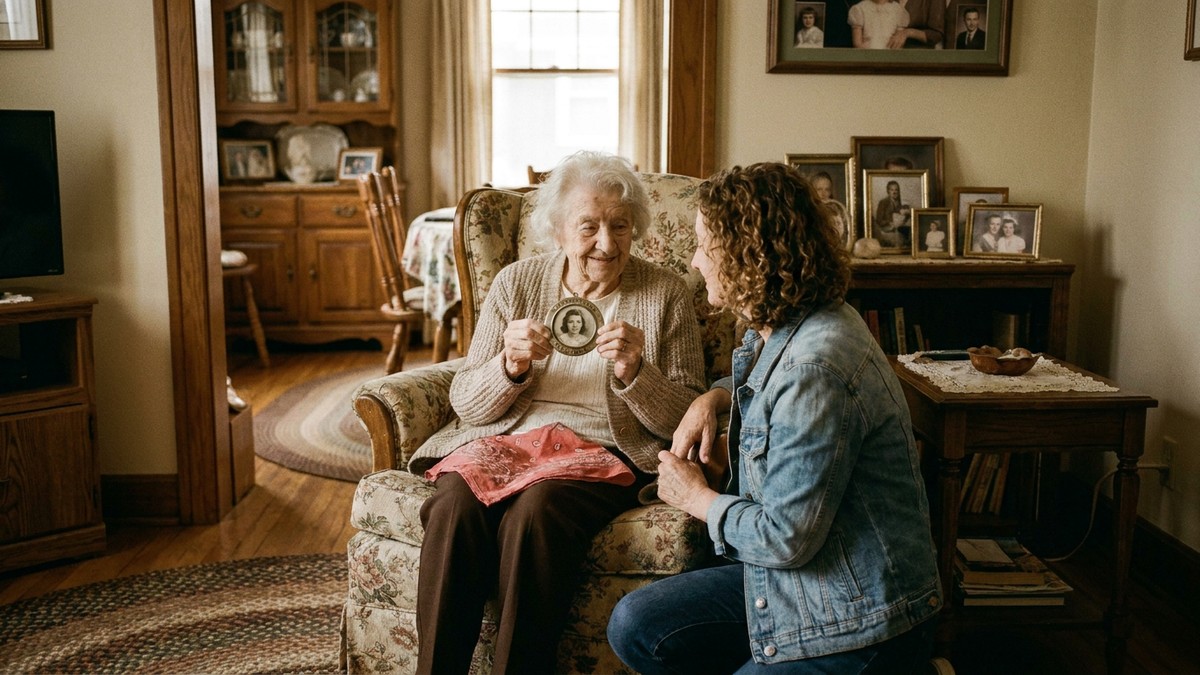
The badge said Frances Kowalczyk, Department 7, and Grandma had always said she typed letters during the war.
Megan Mazur found it at the bottom of a cedar chest in her grandmother's spare room, wrapped in a faded red bandanna. A round metal pin with a photograph on it, a girl of about seventeen with dark curls tied up and a stubborn chin, looking straight at the camera.
Underneath the photo, stamped in the metal: Willow Run. Ford Motor Company. 1943.
Megan sat back on her heels on the carpet. Then she picked up the badge and went to find her grandmother.
Frances Mazur was a hundred and one years old. The family called her Frankie, and so did the mailman, the pastor, and the girl at the bank drive-through who saved her the good lollipops.
She lived alone in the same brick house in Ypsilanti, Michigan, where she'd raised four children. She still did her own crossword in ink. She still made pierogi every Christmas Eve, a hundred and twenty of them, and she still told her great-grandchildren they were doing it wrong.
Megan was thirty-four, a high school history teacher, and Frankie's favorite, though Frankie would never say so out loud. She'd come over that Saturday to help clean out the spare room. Frankie had finally agreed to move the cedar chest to the basement.
"Grandma," Megan said, standing in the kitchen doorway. "What's this?"
Frankie looked up from her crossword. She saw the badge in Megan's hand, and the red bandanna, and her face did something Megan had never seen it do before.
It closed. Like a door.
Frankie had always said she worked in an office during the war.
She'd told the story a hundred times. How she'd been a typist for a Ford manager, a nice man who smoked a pipe.
How she'd met Grandpa Eddie Mazur at a USO dance in 1945, when he came home from the Navy, and married him six months later. How she'd typed letters about bomber parts and never once seen a bomber.
That was the story. It was a nice, tidy story. Megan had even used it in her classroom, when she taught the home front unit.
"Grandma," Megan said gently. She sat down across the kitchen table. "This is a factory badge. Department 7 was the wing line. I've seen the old photos at the museum. You weren't a typist, were you."
Frankie set down her pen.
"Put that back where you found it," she said.
"Grandma, this is amazing. Do you know how many women from Willow Run are still alive? You're a Rosie the Riveter. You could talk to my students. The Yankee Air Museum is right there at the old airport."
"No."
It came out sharp and hard, the way Frankie used to say no to the grandchildren when they reached for the stove. Megan stopped.
Megan didn't put the badge back.
She went home that night and looked up everything she could find. She knew some of it already. Willow Run was the giant bomber plant Henry Ford built outside Ypsilanti in 1941.
At its peak, it turned out a B-24 Liberator bomber every hour. Tens of thousands of people worked there, and a huge share of them were women.
Teenage girls, farm girls, mothers, grandmothers. Many of them had never held a tool before.
They riveted wings and fuselages. They drilled and bucked and wired. They worked ten-hour shifts on concrete floors under lights so bright you couldn't tell night from day.
Frankie had been born in March of 1926. In 1943, she'd have been seventeen. The plant hired women at eighteen.
She'd lied about her age to get the job.
Megan laughed out loud at that, alone at her kitchen table. It was the most Grandma thing she'd ever heard.
Megan sat at her laptop and stared at the photograph on the badge for a long time. That stubborn chin. That look straight into the camera.
Why would a girl that proud of herself spend eighty years pretending she'd never been there?
She went back the next Saturday with a coffee cake and didn't mention it. They did the crossword together. They watched a Tigers game on the radio, the way Frankie liked it.
Frankie fell asleep in her chair in the fifth inning. Megan noticed, for the first time, a thin white scar across the back of her grandmother's right hand, the kind of scar a rivet gun might leave.
When she woke up, Megan was sitting across from her, holding the red bandanna in her lap.
Frankie looked at it for a long time.
"You're not going to let this go," she said. It wasn't a question.
"I'm a history teacher, Grandma. You raised me to ask questions."
Frankie almost smiled. Then she didn't.
She reached out one thin, spotted hand, and Megan gave her the bandanna. Frankie held it up to the window light, turning it, and Megan saw for the first time that one corner of it was stained a dark, old brown.
"I wore this on the line every day," Frankie said quietly. "It kept the hair out of the machines. On the last day I worked there, I tied it around another girl's arm."
She folded the bandanna slowly into a small square in her lap.
"Her name was Lucille Hendricks. She was sixteen," Frankie said. "She lost two fingers on the wing line in October of 1944. And it was my fault."