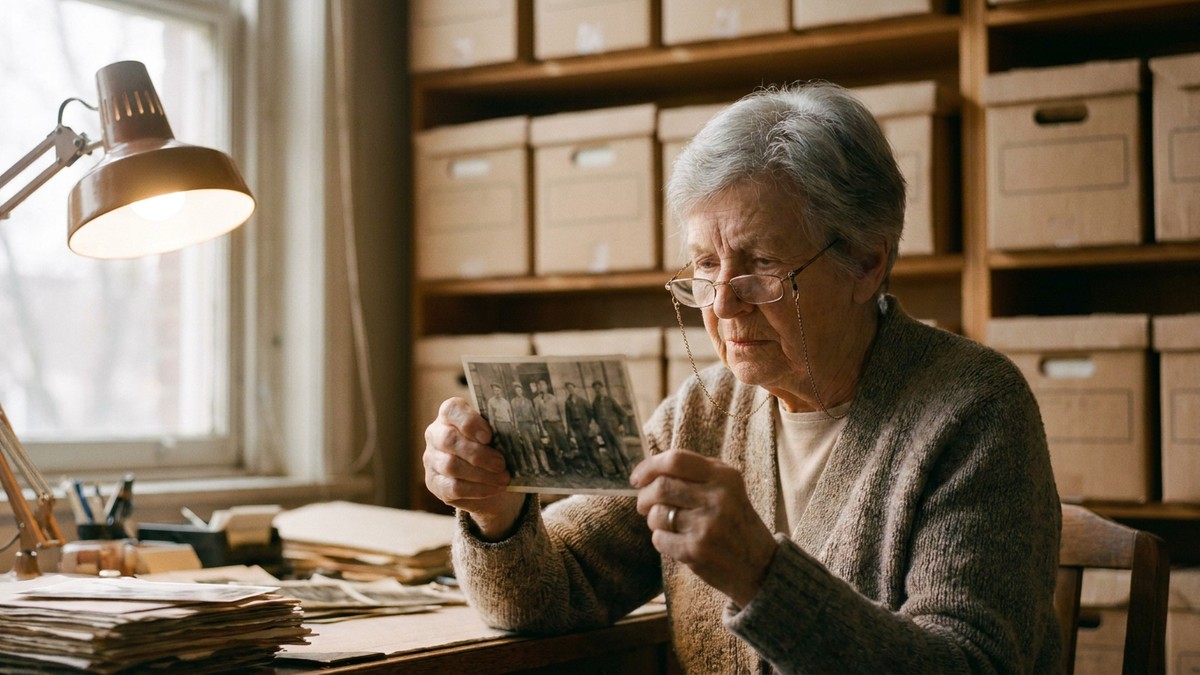
Dolores Kemp knew every face in the photograph except one, and that one was looking straight at the camera.
It was a big print, eleven by fourteen, a little curled at the corners. The Lake Ridge Herald had taken it on a gray morning in October of 1952, the day the Lakeshore Steel Company dedicated its new open hearth shop. Four hundred men in work clothes and hard hats stood packed in front of the building, with the mayor and the plant superintendent on a wooden platform and a brass band off to the left.
Dolores had spent three weeks with that crowd. She'd matched faces against the company newsletter, the bowling league photos, the parish picture directories. She'd put names on a hundred and sixty-one men, and she'd written each one on an index card.
The woman stood at the far right edge of the picture, half out of the frame.
She was Black, somewhere past fifty, in a dark coat with a white apron showing at the hem. She held a big enamel coffee pot in one hand and a stack of tin cups against her chest with the other.
Every man in the photograph was looking up at the platform. She was the only one looking at the camera.
Dolores was seventy-one, a retired school librarian, and a volunteer at the Lake Ridge Historical Society two days a week. That spring, the society was putting together a book for the town's 150th anniversary. Lake Ridge, Indiana, had been a railroad stop in 1877, then a steel town, then a town that had lost half its mill and most of its downtown and was still, somehow, hanging on.
The book was called Lake Ridge at 150. It was going to the printer in three weeks.
"That's the cover," Gerald Fisk said on Tuesday morning, tapping the 1952 print with one finger. Gerald was the society's president, eighty years old and proud of it. His father was in the picture, second row from the front. "That's the whole town in one shot. The mill, the men, the band."
"I agree," Dolores said. "But I can't find out who she is."
Gerald leaned over the print. He squinted at the woman with the coffee pot for a while.
"We'll crop her," he said. "She's right where the title needs to go anyhow. Take an inch off the right side and you've got room for Lake Ridge at 150 in big gold letters."
Dolores looked at the woman's face. The woman looked back at her.
"She's the only woman in the picture, Gerald."
"She's the only person in it we can't name." Gerald straightened up. "I'm not saying she doesn't matter. I'm saying we don't know who she is, and the printer doesn't care. Three weeks, Dolores."
He went off to make coffee. Dolores sat there with the photograph.
She tried the Tuesday regulars first. Six retired men came to the society every Tuesday for coffee and an argument, and between them they'd worked a hundred and ninety years at the Lakeshore mill. Dolores laid the print on the long table and pointed to the edge.
"Who is she?"
They passed it around. They squinted. They argued, which they always did.
"Somebody's wife," one said. "Bringing coffee."
"Cleaning lady from the main office."
"Maybe she worked for the superintendent's family."
Dolores wrote it all down, and none of it felt right. A cleaning lady didn't carry a pot of coffee to a dedication in front of four hundred men.
A wife didn't wear an apron to watch her husband in a crowd. And none of those guesses explained the way she was looking at the camera, steady and a little amused, as if she knew perfectly well that the photographer had his lens pointed at the wrong thing.
Dolores went through the Herald's microfilm for the week of the dedication. The story ran on the front page.
It named the mayor, the superintendent, the company president, the bandleader, and the minister who said the blessing. It didn't say anything about coffee.
She tried the company newsletter. She tried the Lake Ridge Women's Club minutes, and the photographs from the Chamber of Commerce, and a box of funeral programs from the 1950s. She found a lot of men named Stan.
By the end of the first week, she'd found nothing about the woman at the edge.
On Saturday she called her sister in Valparaiso and told her about it.
"Dolores," her sister said, "you've got a hundred and sixty-one names. Let the one go."
"Would you let it go," Dolores asked, "if it was Mother at the edge of that picture?"
Her sister didn't answer that.
On Monday, Dolores went down into the basement of the historical society, where the boxes that hadn't been cataloged yet lived on steel shelves under a humming fluorescent light. The Herald's longtime photographer, a man named Stan Wozniak, had died in 1991.
His daughter had donated twenty-two boxes of his negatives and prints to the society in 1996. The volunteers had never gotten past box nine.
Dolores started with box ten.
It took her two days. Stan Wozniak had kept everything in brown paper envelopes, each one with a date written on it in grease pencil, and he'd filed them in no order that a librarian would recognize.
She found weddings and car wrecks and high school football. She found a parade from 1949 and a fire from 1957.
On Wednesday afternoon, in box fourteen, she found an envelope marked 10-52 OPEN HEARTH.
Inside were six negatives, curled with age, and two prints. The first was the same photograph she'd been staring at for a month.
The second was a smaller print, five by seven, cropped close on the right side of the crowd. Stan Wozniak had liked that corner too.
The woman with the coffee pot was in the middle of it now, sharp and clear. Two young men in hard hats were holding out tin cups to her, and she was pouring, and she was smiling at one of them like she knew his mother.
Dolores turned the print over.
Someone had written on the back in soft pencil, in small, neat letters. It was the only clue in twenty-two boxes, and it was barely a clue at all.
Mrs. C. L. H.
And under that, three words: Fed the night shift.