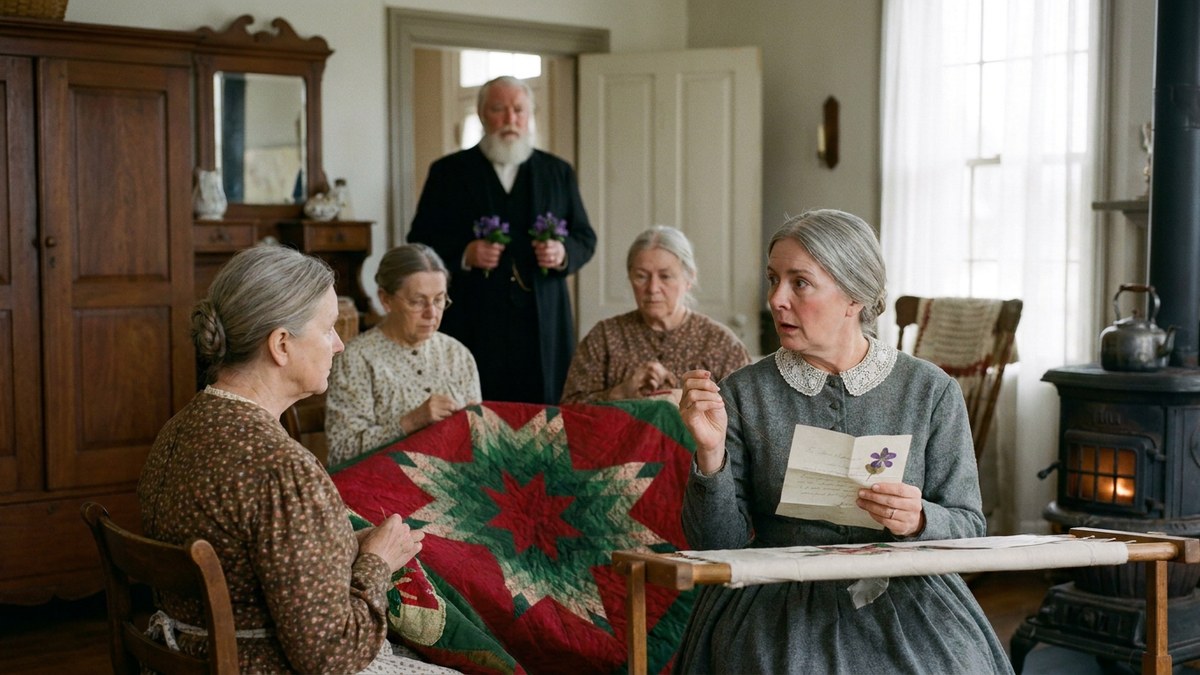
Nobody said anything at all.
Ezekiel Stout stood on the step with the three bunches of violets. He looked at the quilt frame. He looked at the letter lying on the Star of Bethlehem. He looked at Ada, and at Prudence, and at Hannah, one after another, and his face went slowly the color of the red calico.
"Well, Deacon," said Ada Fenn, in a voice that could have frozen the Cedar River. "Which of us is the morning rose?"
Ezekiel opened his mouth. Nothing came out.
He put the three bunches of violets down very carefully on the step, side by side. Then he turned around and walked back to his wagon and drove away.
That was when the bee became a council of war.
Prudence had her letters in her reticule, all four of them. Ada fetched the other four of hers from her bureau drawer. Hannah had three. They laid them out across the quilt, all twelve, side by side, while nine women leaned over the frame.
They were the same letters. Word for word. Thy cheek is like the morning rose. Thou art the lily of the valley. I find I cannot pass a day. Each woman had been sent them in the same order, one a week, with a violet.
"He copied them," said Prudence, trembling with rage. "Out of some book. Three of us at once. Like ordering seed."
"I say we sew every one of those letters into a quilt," said Ada, "and give it to him at the spring fair, in front of the whole church."
There was a murmur of approval around the frame.
Hannah was not listening. She was looking at the handwriting.
She had taught school eleven years. She knew handwriting the way a farmer knows weather.
This was not a man's hand. It was round and careful and too large, every letter made separately, the way a child makes them when she is still thinking about each one. The capital B in Birch was made backward at the top, the way children made it when they had learned from a slate instead of a copybook. The same round, labored hand was on Prudence's letters. And on Ada's, in Fenn, the F had the same little curl at the bottom that Hannah had spent a whole winter trying to break one particular child of.
She knew that curl.
She had seen it on a slate in the township school in 1873. On the slate of a little girl named Effie Stout, Ezekiel's granddaughter, who lived with him on the farm on the Cedar River and was now ten years old.
Then Hannah remembered the church paper, and his eyes being tired.
She put her own letters back in her pocket and stood up.
"Ada," she said. "Don't sew anything yet."
She drove to the Stout farm herself that evening, alone, in the buggy.
Ezekiel was in the barn, milking, in the lantern light. He did not get up when he saw her. He sat on the stool with his forehead against the cow's flank and his big hands still.
"You can't read," said Hannah. "Can you, Ezekiel."
It was a long time before he answered.
"No," he said. "Nor write. My pa needed me in the field. I was nine. I never went back."
"Effie wrote the letters."
"She copied them. From a book I bought in Cedar Rapids. A letter-writer, they call it, for every occasion. The man at the store read me which one was for courting." He did not lift his head. "I told her what names to put. She thought it was a game."
"Why three?" said Hannah. "Why on earth three of us?"
He was quiet so long she thought he would not answer.
"Because I'm sixty-two and can't read my own Bible," Ezekiel Stout said at last, into the cow's side. "I couldn't see any good woman taking me, once she knew. I thought if I asked three, maybe one wouldn't find out until it was too late to say no." He let out a breath. "It was a wicked thing. I knew it was. I've been sick over it since February."
Hannah stood in the barn door in the lantern light and looked at him.
She thought about the violet in her Bible. She thought about the way he had held her hand. She thought about Ada's idea of the quilt, and the spring fair, and the whole church laughing, and what that would do to a big, slow, kindly man who had been ashamed of the same thing for fifty-three years.
"Ezekiel," she said. "I taught school for eleven years. I have taught grown men to read before. It takes a winter, if they work at it."
He lifted his head.
"I won't marry a man who courts three women out of a book," said Hannah. "But I might consider a man who wrote me one letter himself. One. In his own hand. With his own spelling. However bad."
She went back out to the buggy.
"Monday evenings," she called back from the seat. "At my house. Bring a slate."
Ada Fenn did not sew the letters into a quilt. Hannah asked her not to, and told her why, privately, in Ada's kitchen. Ada cried a little, and said she would rather have the blacksmith anyway.
Prudence Gale took a good deal longer to come around. But she came to the wedding.
Because in October 1876, Hannah Birch received a letter. It came in the mail, in an envelope addressed in a large, slow, uneven hand, with no violet in it.
It said: Deer Hannah. I can rite now. I love you. Will you mary me. Ezekiel.
She kept it in her Bible, at the Song of Solomon, for the rest of her life.
> What really happened: On the Iowa frontier and across rural America, quilting bees were among the most important social gatherings for women, where neighbors worked together on a quilt for a family, a bride or a church cause and traded news, recipes and opinions over the frame. In the nineteenth century, many farm children left school early for fieldwork, and a good number of adults could not read or write. Popular "letter-writer" books offered model letters for every occasion, including courtship. Sources: Iowa PBS; Fremont County (Iowa) Historical Society.