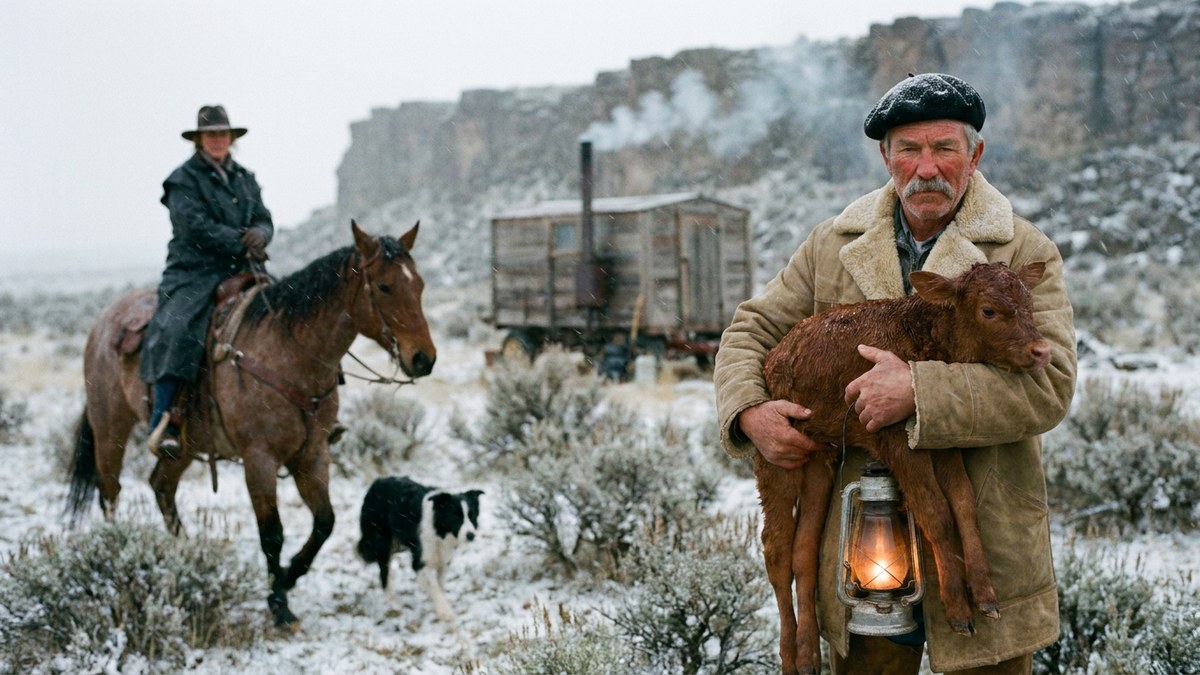
Silas Gentry rode down to Goose Creek on the first of April, 1897, and told the Basque sheepherder he had until Sunday to get his sheep off it.
"This is cattle range," Silas said. "Has been for twenty years. There's a law in this state says no sheep within two miles of a man's house, and my house is a mile and a half up that draw. You know it and I know it."
The herder stood by his sheep wagon with his hat in his hand. He was about fifty, short and broad, with a gray mustache and a face burned dark by twenty summers in the desert. Two black-and-white dogs lay at his feet, watching Silas's horse.
"The creek is the only open water for nine miles, señor," he said. "The ewes are lambing. One week more, and I move them to the high range."
"Sunday," said Silas, and turned his horse.
His daughter Kate was riding beside him, and she did not say anything until they were halfway home.
"He set a lamb's leg while we were talking," she said. "Did you see? Splinted it with two sticks and a strip of his own shirt, with the ewe standing right there. Never took his eyes off you."
"I saw."
"He's not doing any harm, Pa. It's one week."
"It's always one week," said Silas Gentry. "Then it's a season. Then there's ten thousand sheep on the range and not a blade of grass left for a cow. I've seen it happen up the Raft River. I'll not see it here."
Kate rode beside him and said nothing more. She was thirty-four, a widow, and had come home to her father's ranch from Boise the autumn before, after her husband died. She had learned long ago when there was no use arguing with Silas Gentry.
Silas was sixty-three. He had come into Cassia County, Idaho, in 1877, with forty head of cattle and a wife and a girl of fourteen. Now he ran eleven hundred head on the Goose Creek range, and his wife was buried behind the house, and the girl was riding beside him with gray already coming in at her temples.
He was a hard man. He was not a cruel one.
The year before, two sheepherders had been shot dead in their camp at Deep Creek, not forty miles away. The big cattle outfits had hired a gunman they called Diamondfield Jack to keep sheep off their ranges, and everybody in Cassia County believed Jack had done it. The trial was set for that spring, in Albion. The whole county talked of nothing else.
Some of the cattlemen had asked Silas to put money into keeping a man like that on the Goose Creek range.
He had thrown them out of his house.
"I'll run sheep off my range with the law," he had told them. "Not with a rifle. I won't have blood on my grass."
But he would run them off. Kate had never doubted that.
The storm came on Saturday.
It came out of the northwest at noon, without warning, the way spring storms did in that country. One hour it was April, with the meadowlarks singing on the fence posts. The next it was January again, the snow driving sideways across the sagebrush so thick a rider could not see his horse's ears.
And it was calving season. The cows were out on the north flat with their new calves, a hundred and forty of them, some no more than a day old.
A calf born that week would not last a night in that storm without shelter.
Silas and Kate and the two hired men rode out at one o'clock to bring them in.
It was hopeless from the first hour. The cows had drifted with the wind, the way cattle always did, and scattered across the north flat, and the snow filled their tracks as fast as they made them.
The hired men found thirty head along the fence and pushed them home.
Silas and Kate went on, north, after the rest.
At four o'clock, in a coulee Silas had ridden a thousand times, his horse went down.
It went into a drift to its shoulders and threw itself sideways, scrambling, and Silas went off and under it. Kate heard him cry out. When she got to him, the horse was up again and standing, shaking. Silas was lying in the snow with his face gray and his right leg bent under him in a way that made her stomach turn.
"Broke," he said through his teeth. "Below the knee. Kate, you'll have to go for the men."
"I'm not leaving you here."
"You'll leave me, or we'll both freeze. Go."
She got him into the lee of the coulee bank, under her own slicker and his saddle blanket, with his back to the wind. She tied his horse beside him for the warmth. Then she climbed onto her own horse and turned its head south, toward home.
Within ten minutes she was lost.
There was no north, no south, no anything. Only white, and roaring wind, and the snow in her eyes and her mouth. Her horse stopped and would not go on. She sat on it in the storm and knew, very clearly, that her father was going to die in that coulee, and so was she.
Then, through the snow, off to her left, she saw a light.
It was low and yellow and swinging, like a lantern carried by someone walking. She turned her horse toward it. It came and went in the gusts. Then a dog barked, close, and a shape came out of the white in front of her.
It was a man on foot, bent into the wind, with a lantern hung from his belt. In his arms, wrapped in his own coat, he was carrying a newborn calf.
Behind him, bawling and plunging through the drift after her calf, came a brindle cow with one horn. Kate knew that cow. It was her father's.
And the man carrying the calf was the Basque sheepherder from Goose Creek.