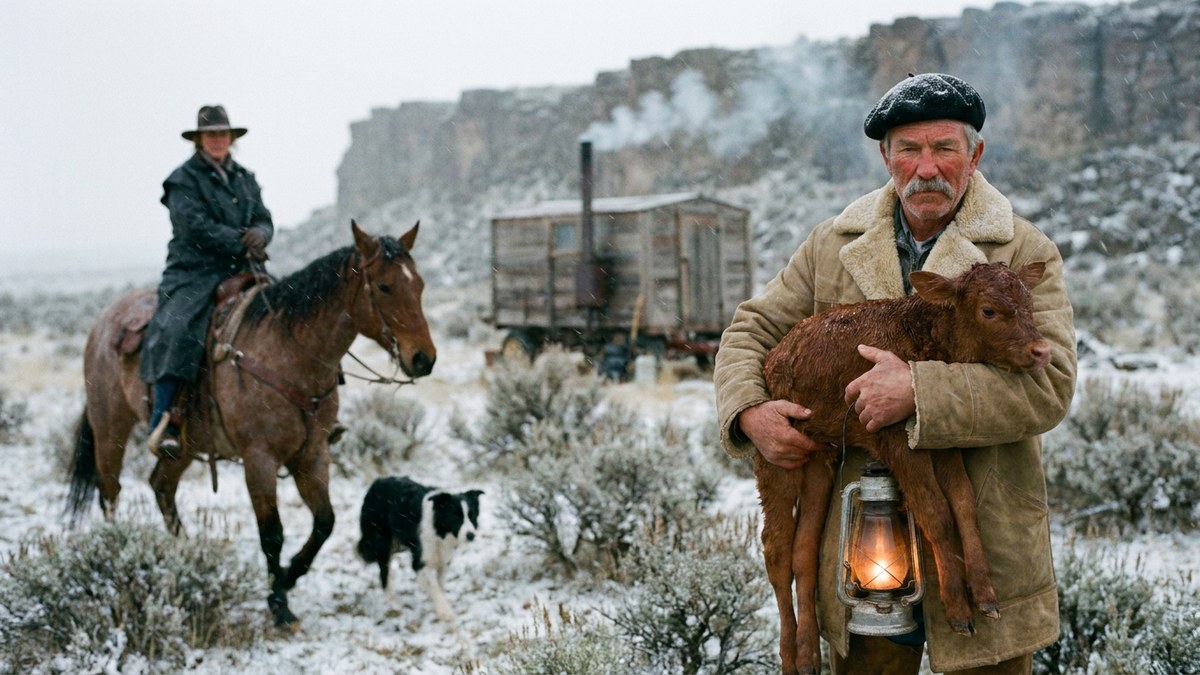
The herder looked up at her on her horse, with the snow driving between them, and did not seem surprised at all.
"Señora," he said. "Come. The camp is close."
"My father," Kate said. Her lips were so cold she could hardly make the words. "He's hurt. In the coulee. His leg is broken."
The herder's face changed.
"Where?"
"I don't know. North. I don't know where I am."
He looked at her a moment. Then he turned and whistled, two notes, high and sharp, and one of the black-and-white dogs came bounding out of the snow and sat at his feet.
"Your horse knows where it has been," he said. "The dog will know where your horse has been. First the calf. Then we go."
His camp was a quarter mile away, in the lee of a long rimrock wall, and Kate would never have found it.
The sheep wagon stood against the rock with smoke coming out of its stovepipe. Beside it, the herder had built a brush corral out of sagebrush and juniper, piled head high in a half circle against the cliff. Inside it were his ewes, eight hundred of them, packed together in a great gray steaming mass, with their lambs underneath them.
And among the sheep, in the middle of them, where the warmth was, stood her father's cattle.
Kate counted without meaning to. Thirty cows. Forty. More. With their calves pressed in against their sides and against the sheep, out of the wind, alive.
"They came with the storm," the herder said. He laid the calf he was carrying down among the ewes, and its mother pushed in after it. "Down the draw, with the wind. They would have gone over the rim in the dark. The dogs and I turned them in here." He shrugged. "Sheep are warm. In the snow, a calf is a calf, señora. It does not know it is a cow."
They found Silas Gentry at seven o'clock, by the dog.
It went out ahead of them into the dark on the herder's whistle, nose down, following the track of Kate's horse back through the snow, and stopped and barked on the lip of the coulee. The herder went down into it on a rope with the lantern. Kate held the rope.
Silas was alive. He was very cold and very quiet, and when the herder bent over him with the lantern, he looked up at the face and said nothing at all.
The herder made a splint for the broken leg with the staves of his own walking stick, cut in two with his knife, and strips of the saddle blanket. He did it fast and neatly, the way Kate had seen him splint the lamb. Then he got his shoulder under Silas Gentry's arm, and the two of them, the herder and the daughter, got him up the coulee bank and onto his own horse, and led it back to the camp through the storm.
They spent the night in the sheep wagon.
It was eight feet long, with a bunk across the back, a little iron stove, a table that folded down, and a shelf of tins. Silas lay in the bunk under every blanket the herder owned. Kate sat on the floor by the stove. The herder made coffee, and a stew of mutton and beans and red peppers in an iron pot, and gave them both bowls, and ate his own standing at the door.
His name, it turned out, was Inazio Zubiri. He was from a village in the mountains of Bizkaia. He had come to Idaho in 1880. He had herded other men's sheep for twelve years and his own for five.
"In my village," he said, "my father kept cows. Six. A great many, there. When I was a boy, I slept in the barn with them in the winter." He smiled under the mustache. "I like cows, señor. I never wished one harm."
Silas Gentry had not said a word all night. He lay in the bunk and looked at the ceiling of the wagon.
Outside, the wind roared and the sheep shifted and the cattle lowed, all together, in the brush corral against the rock.
At dawn, the storm blew out.
The herder dug the wagon door clear, and Kate went out into a world gone silent and white and blinding, under a clean blue sky. The brush corral was buried to the top. Inside it, sheep and cows stood shoulder to shoulder, breathing steam.
She counted the Gentry cattle while the herder fed the dogs. Ninety-one cows. Eighty-seven calves. Every one alive.
When she came back to the wagon, her father had raised himself on one elbow in the bunk and was looking out the open door at the corral.
"How many?" Silas said.
She told him.
He lay back down. For a while he did not say anything.
"Mr. Zubiri," he said finally.
"Jauna."
"How long do you need on Goose Creek?"
The herder looked at him, careful.
"Until the lambing is done," he said. "Ten days. Then I go up to the high range for the summer. In the fall, I go back to the desert."
"Take as long as you like," said Silas Gentry. "This year. And next year. You water at the creek, spring and fall, going up and coming down. Nobody will trouble you about it." He shut his eyes. "Not the law. Not me. I'll put it in writing."
He put it in writing. The Goose Creek water agreement between Silas Gentry and Inazio Zubiri was signed in the parlor of the Gentry ranch house on the twentieth of April, 1897, with Silas in a chair with his leg propped on a stool, and Kate as witness.
It was renewed every spring for twenty-two years.
At the county stockmen's meeting that summer, when the big outfits stood up to talk about deadlines and running the sheepmen out, Silas Gentry stood up on his crutches at the back of the room. He told them about a brush corral against a rimrock wall in a spring storm, and ninety-one cows and eighty-seven calves standing alive in the middle of eight hundred sheep.
It did not end the range wars. Nothing he said could have done that.
But there was never a deadline on Goose Creek again.
> What really happened: From the 1870s into the 1910s, cattlemen and sheepmen fought bitterly over Idaho's open range, and Basque herders were among those harassed and attacked. Idaho's "Two Mile Limit" law, first passed in 1875 and extended statewide in 1887, barred sheep from grazing within two miles of a settler's dwelling. In 1896, two sheepherders were shot to death at Deep Creek in Cassia County, and a hired range gunman known as Diamondfield Jack Davis was convicted in a sensational trial, though his death sentence was later commuted. Sources: Idaho State Bar; Idaho Legal History Society; Cornell Legal Information Institute.